The Affiliated Hospital of Nanjing University of Chinese Medicine, Department of Orthopedics, Nanjing 210029, China.
Key Laboratory for Metabolic Diseases in Chinese Medicine, First College of Clinical Medicine, Nanjing University of Chinese Medicine, Nanjing 210023, China.
Mediators Inflamm. 2021 Mar 16;2021:5534614. doi: 10.1155/2021/5534614. eCollection 2021.
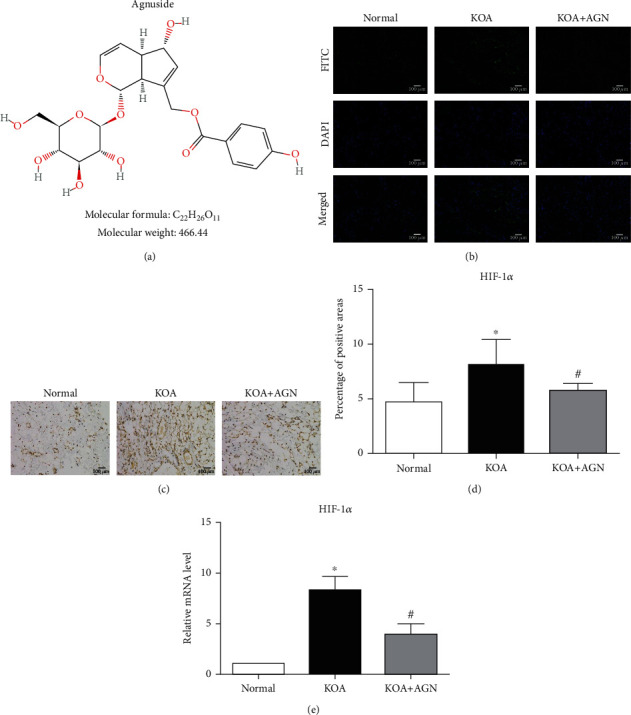
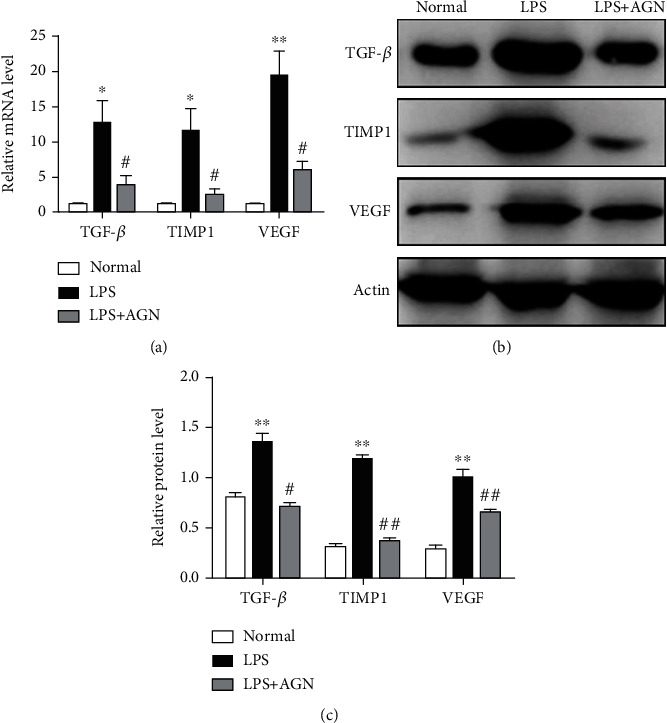
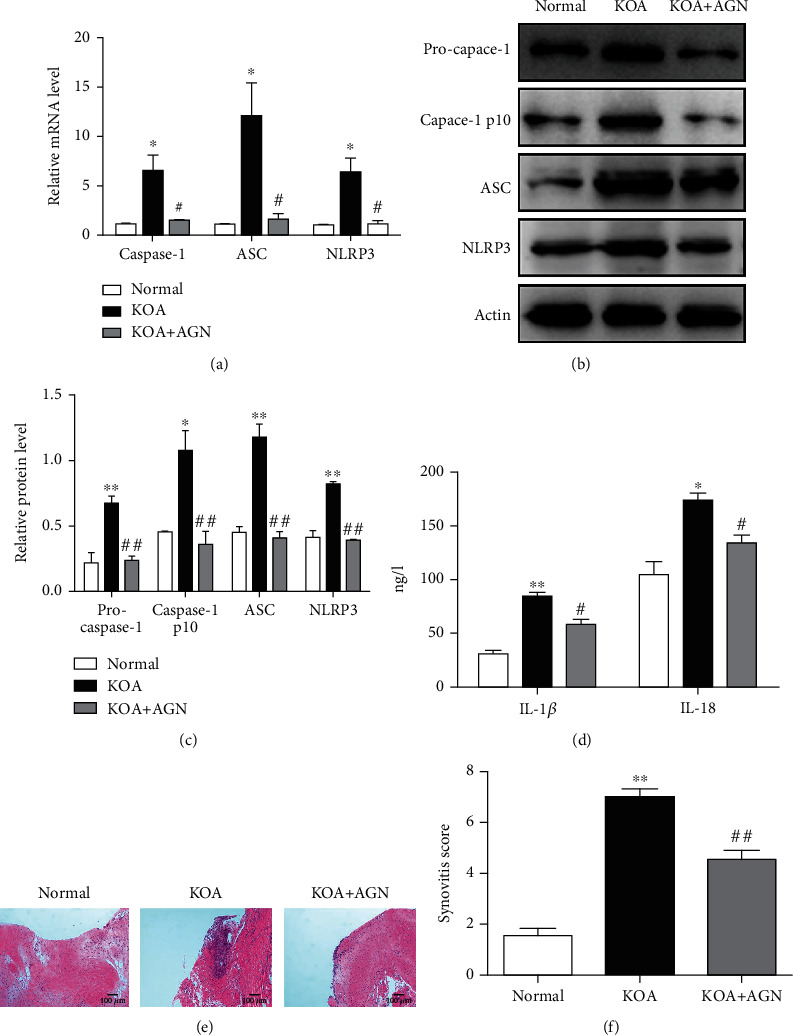
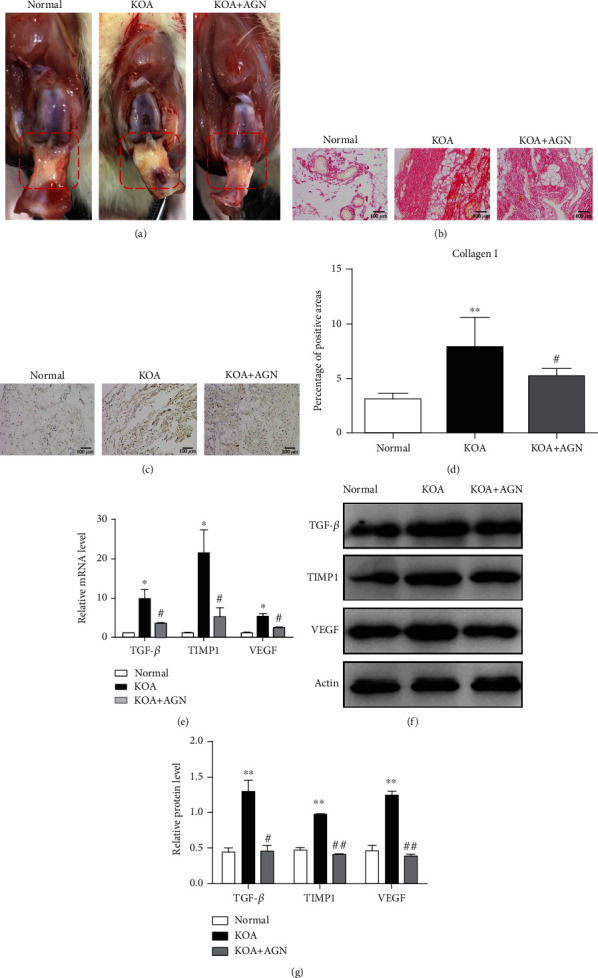
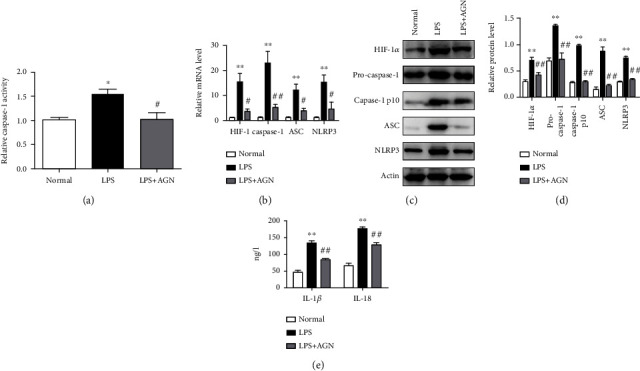
Increasing evidence has shown that NLRP3 inflammasome activation participates in chronic aseptic inflammation and is related to tissue fibrosis. Our last study also revealed the vital role of NLRP3 inflammasome, highly associated with tissue hypoxia, in the onset and development of knee osteoarthritis (KOA). In this study, we tried to find a possible benign intervention for that pathological process. Agnuside (AGN), a nontoxic, natural small molecule isolated from the extract of (Verbenaceae), has been demonstrated to have antioxidation, anti-inflammatory, analgesia, and many other properties as an iridoid glycoside, although its specific target is still unclear. Therefore, we established MIA-induced KOA model rats and investigated the effects of AGN oral gavage on oxygen-containing state, NLRP3 inflammasome, synovitis, and fibrosis in KOA. Pimonidazole staining and HIF-1 immunohistochemical assay both showed that AGN at the oral dose of 6.25 mg/kg can effectively relieve local hypoxia in synovial tissue. Besides, we observed a decrease of HIF-1, caspase-1, ASC, and NLRP3 after AGN intervention, both in the mRNA and protein levels. In addition, rats treated with the AGN showed less inflammatory reaction and fibrosis, not only in the expression of NLRP3, inflammasome downstream factors IL-1 and IL-18, and fibrosis markers TGF-, TIMP1, and VEGF but also in the observation of HE staining, anatomical characteristics, Sirius Red staining, and type I collagen immunohistochemistry. Subsequently, we established LPS-induced models of fibroblast-like synoviocytes (FLSs) mimicking the inflammatory environment of KOA and activating NLRP3 inflammasome. FLSs treated with AGN (3 M) resulted in a downregulation of HIF-1 and the components required for NLRP3 inflammasome activation. Meanwhile, the content of proinflammatory factors IL-1 and IL-18 in FLS supernatant was also reduced by AGN. In addition, both mRNA and protein levels of the fibrotic markers were significantly decreased after AGN management. To conclude, this study demonstrates that AGN alleviates synovitis and fibrosis in experimental KOA through the inhibition of HIF-1 accumulation and NLRP3 inflammasome activation. Additionally, not only does it reveal some novel targets for anti-inflammatory and antioxidant effects of AGN but also announces its potential value in treating KOA in humans.
越来越多的证据表明,NLRP3 炎性小体的激活参与了慢性无菌性炎症,并与组织纤维化有关。我们的最新研究还揭示了 NLRP3 炎性小体在膝骨关节炎 (KOA) 的发生和发展中的重要作用,该小体与组织缺氧高度相关。在这项研究中,我们试图为这一病理过程找到一种可能的良性干预措施。从马鞭草科植物(Verbenaceae)提取物中分离出的无毒天然小分子安格洛苷(AGN)作为环烯醚萜苷,已被证明具有抗氧化、抗炎、镇痛等多种特性,但其具体靶点尚不清楚。因此,我们建立了 MIA 诱导的 KOA 大鼠模型,并研究了 AGN 口服灌胃对 KOA 关节含氧状态、NLRP3 炎性小体、滑膜炎和纤维化的影响。吡莫硝唑染色和 HIF-1 免疫组化检测均表明,AGN 口服剂量为 6.25mg/kg 可有效缓解滑膜组织局部缺氧。此外,我们观察到,AGN 干预后,HIF-1、caspase-1、ASC 和 NLRP3 的 mRNA 和蛋白水平均降低。此外,AGN 治疗的大鼠表现出较少的炎症反应和纤维化,不仅表现在 NLRP3、炎性小体下游因子 IL-1 和 IL-18 以及纤维化标志物 TGF-β、TIMP1 和 VEGF 的表达上,而且在 HE 染色、解剖学特征、天狼星红染色和 I 型胶原免疫组化观察上也是如此。随后,我们建立了 LPS 诱导的类成纤维细胞滑膜细胞 (FLS) 模型,模拟 KOA 的炎症环境并激活 NLRP3 炎性小体。AGN(3μM)处理的 FLS 导致 HIF-1 和 NLRP3 炎性小体激活所需成分下调。同时,AGN 还降低了 FLS 上清液中促炎因子 IL-1 和 IL-18 的含量。此外,AGN 处理后,纤维化标志物的 mRNA 和蛋白水平均显著降低。综上所述,本研究表明,AGN 通过抑制 HIF-1 积累和 NLRP3 炎性小体激活,缓解实验性 KOA 中的滑膜炎和纤维化。此外,它不仅揭示了 AGN 抗炎和抗氧化作用的一些新靶点,还预示着其在治疗人类 KOA 方面的潜在价值。