Caba Mario, Lehman Michael N, Caba-Flores Mario Daniel
Centro de Investigaciones Biomédicas, Universidad Veracruzana, Xalapa, Mexico.
Brain Health Research Institute, Kent State University, Kent, OH, United States.
Front Neurosci. 2021 Mar 17;15:636764. doi: 10.3389/fnins.2021.636764. eCollection 2021.
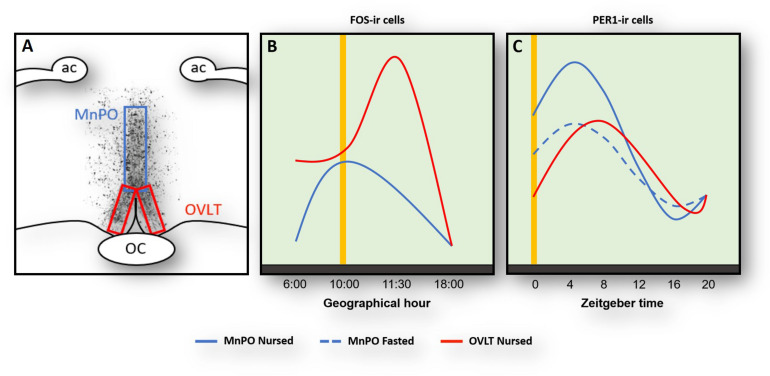
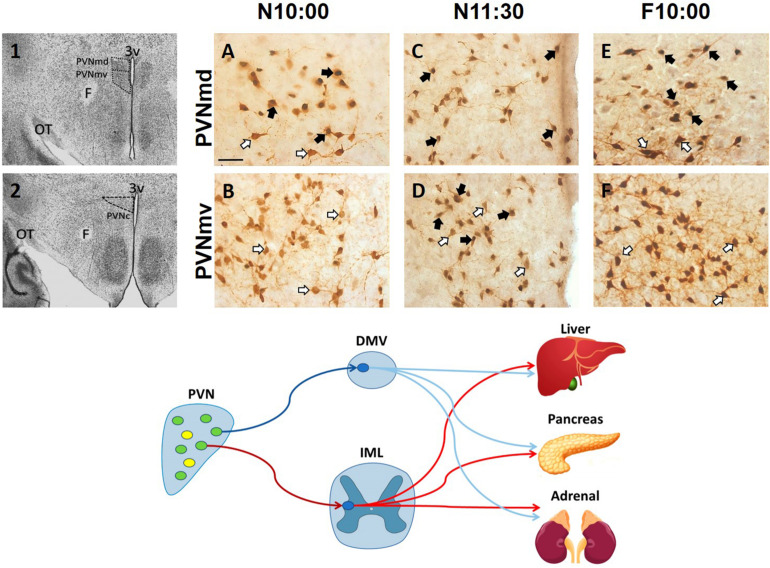
In the newborn rabbit, the light entrainable circadian system is immature and once a day nursing provides the primary timing cue for entrainment. In advance of the mother's arrival, pups display food anticipatory activity (FAA), and metabolic and physiological parameters are synchronized to this daily event. Central structures in the brain are also entrained as indicated by expression of Fos and Per1 proteins, GFAP, a glial marker, and cytochrome oxidase activity. Under fasting conditions, several of these rhythmic parameters persist in the periphery and brain, including rhythms in the olfactory bulb (OB). Here we provide an overview of these physiological and neurobiological changes and focus on three issues, just beginning to be examined in the rabbit. First, we review evidence supporting roles for the organum vasculosum of lamina terminalis (OVLT) and median preoptic nucleus (MnPO) in homeostasis of fluid ingestion and the neural basis of arousal, the latter which also includes the role of the orexigenic system. Second, since FAA in association with the daily visit of the mother is an example of conditioned learning, we review evidence for changes in the corticolimbic system and identified nuclei in the amygdala and extended amygdala as part of the neural substrate responsible for FAA. Third, we review recent evidence supporting the role of oxytocinergic cells of the paraventricular hypothalamic nucleus (PVN) as a link to the autonomic system that underlies physiological events, which occur in preparation for the upcoming next daily meal. We conclude that the rabbit model has contributed to an overall understanding of food entrainment.
在新生兔中,光可调节的昼夜节律系统尚未成熟,每天一次的哺乳为节律调节提供了主要的定时线索。在母兔到来之前,幼兔会表现出食物预期活动(FAA),代谢和生理参数会与这一日常事件同步。大脑中的中枢结构也会被调节,这可通过Fos和Per1蛋白的表达、胶质细胞标志物GFAP以及细胞色素氧化酶活性来表明。在禁食条件下,这些节律参数中的一些在外周和大脑中持续存在,包括嗅球(OB)中的节律。在此,我们概述这些生理和神经生物学变化,并聚焦于三个刚刚开始在兔中进行研究的问题。首先,我们回顾支持终板血管器(OVLT)和视前正中核(MnPO)在液体摄入稳态和觉醒神经基础中作用的证据,后者还包括食欲调节系统的作用。其次,由于与母兔每日来访相关的FAA是条件学习的一个例子,我们回顾关于皮质边缘系统变化的证据,并确定杏仁核和扩展杏仁核中的核团是负责FAA的神经基质的一部分。第三,我们回顾最近支持下丘脑室旁核(PVN)的催产素能细胞作为与自主神经系统联系的作用的证据,自主神经系统是为即将到来的下一顿日常餐食做准备时发生的生理事件的基础。我们得出结论,兔模型有助于对食物调节的全面理解。