Umejima Keita, Ibaraki Takuya, Yamazaki Takahiro, Sakai Kuniyoshi L
Department of Basic Science, Graduate School of Arts and Sciences, The University of Tokyo, Tokyo, Japan.
NTT Data Institute of Management Consulting, Inc., Tokyo, Japan.
Front Behav Neurosci. 2021 Mar 19;15:634158. doi: 10.3389/fnbeh.2021.634158. eCollection 2021.
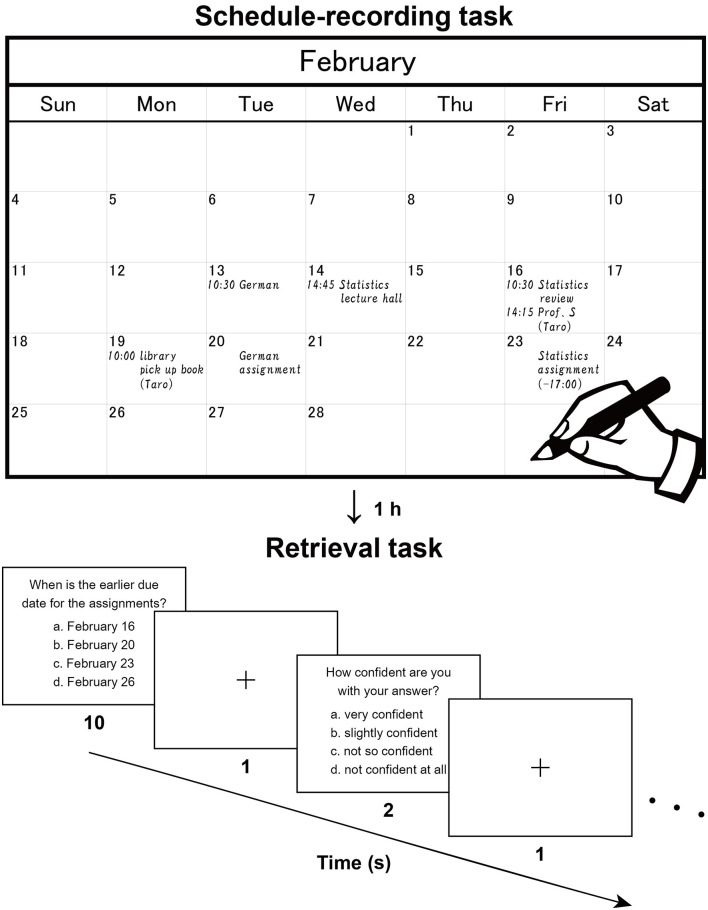
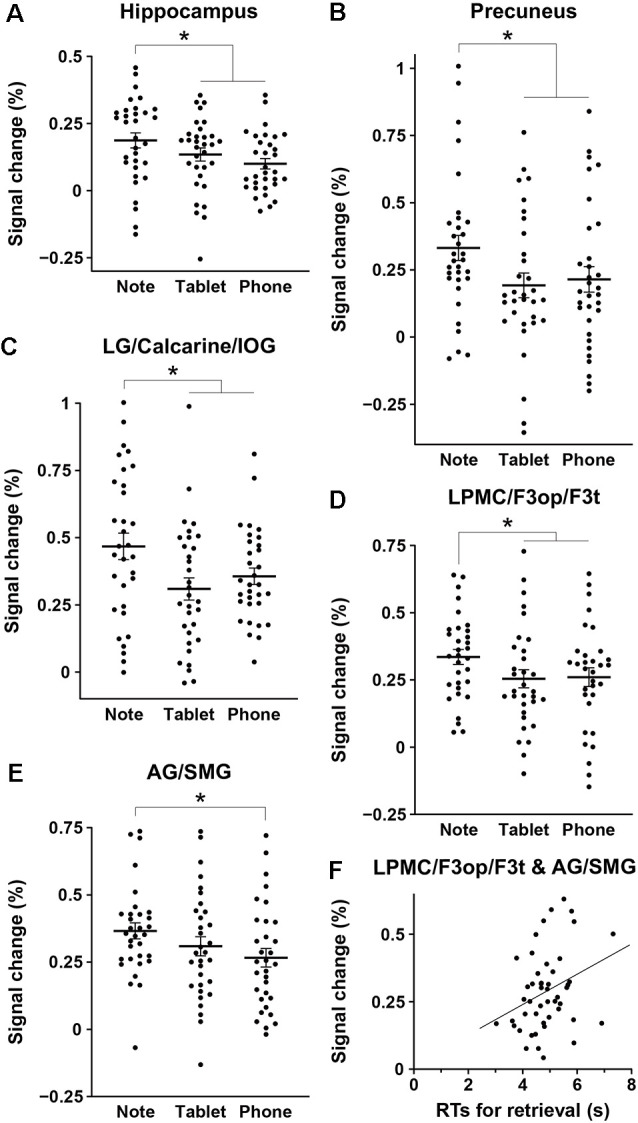
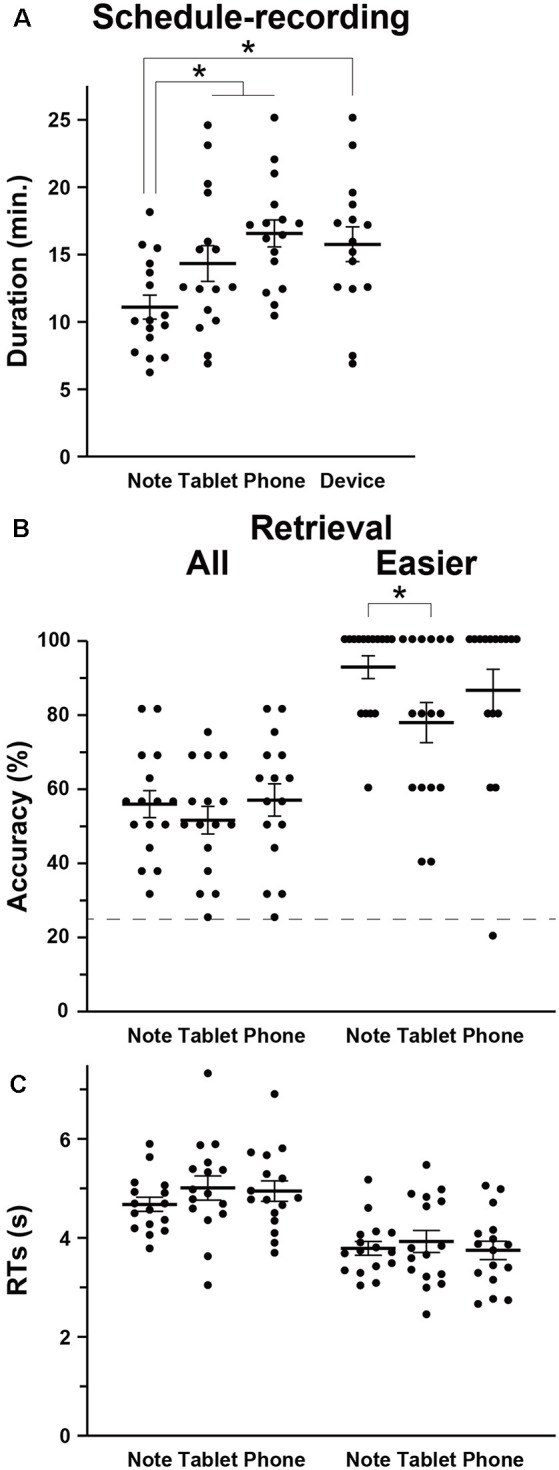
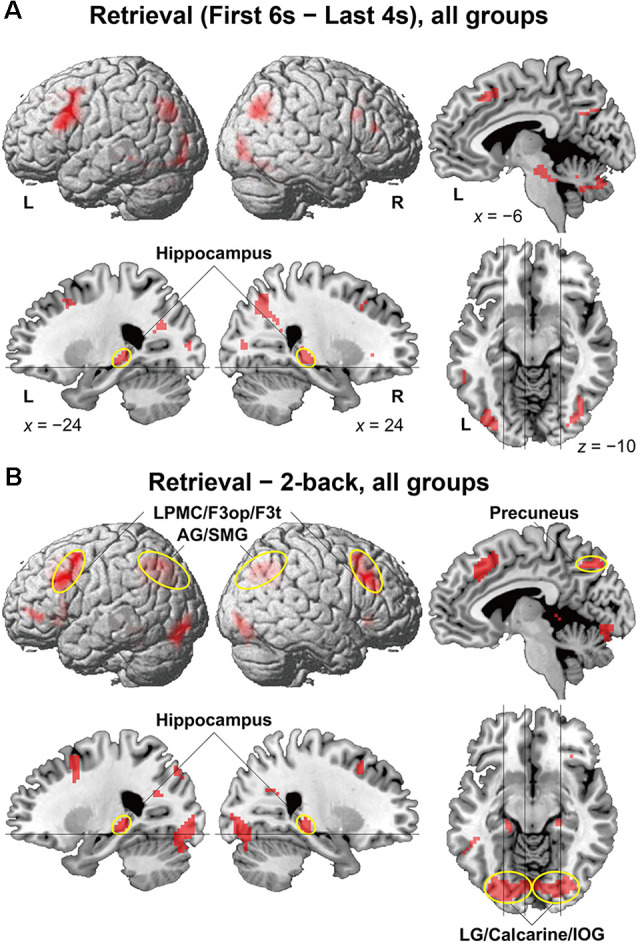
It remains to be determined how different inputs for memory-encoding, such as the use of paper notebooks or mobile devices, affect retrieval processes. We compared three groups of participants who read dialogues on personal schedules and wrote down the scheduled appointments on a calendar using a paper notebook (Note), an electronic tablet (Tablet), or a smartphone (Phone). After the retention period for an hour including an interference task, we tested recognition memory of those appointments with visually presented questions in a retrieval task, while scanned with functional magnetic resonance imaging. We obtained three major results. First, the duration of writing down schedules was significantly shorter for the Note group than the Tablet and Phone groups, and accuracy was much higher for the Note group in easier (i.e., more straightforward) questions. Because the input methods were equated as much as possible between the Note and Tablet groups, these results indicate that the cognitive processes for the Note group were deeper and more solid. Second, brain activations for all participants during the retrieval phase were localized in the bilateral hippocampus, precuneus, visual cortices, and language-related frontal regions, confirming the involvement of verbalized memory retrieval processes for appointments. Third, activations in these regions were significantly higher for the Note group than those for the Tablet and Phone groups. These enhanced activations for the Note group could not be explained by general cognitive loads or task difficulty, because overall task performances were similar among the groups. The significant superiority in both accuracy and activations for the Note group suggested that the use of a paper notebook promoted the acquisition of rich encoding information and/or spatial information of real papers and that this information could be utilized as effective retrieval clues, leading to higher activations in these specific regions.
记忆编码的不同输入方式,如使用纸质笔记本或移动设备,如何影响检索过程仍有待确定。我们比较了三组参与者,他们阅读个人日程安排中的对话,并使用纸质笔记本(笔记组)、电子平板电脑(平板电脑组)或智能手机(手机组)在日历上写下预定的约会。在包括干扰任务在内的一小时保留期后,我们在检索任务中用视觉呈现的问题测试了对这些约会的识别记忆,同时进行功能磁共振成像扫描。我们得到了三个主要结果。首先,笔记组写下日程的时间明显短于平板电脑组和手机组,并且在较简单(即更直接)的问题上,笔记组的准确率要高得多。由于笔记组和平板电脑组的输入方式尽可能保持一致,这些结果表明笔记组的认知过程更深入、更扎实。其次,所有参与者在检索阶段的大脑激活都集中在双侧海马体、楔前叶、视觉皮层和与语言相关的额叶区域,这证实了对约会的言语化记忆检索过程的参与。第三,笔记组在这些区域的激活明显高于平板电脑组和手机组。笔记组的这些增强激活不能用一般认知负荷或任务难度来解释,因为各组的总体任务表现相似。笔记组在准确率和激活方面的显著优势表明,使用纸质笔记本促进了对真实纸张丰富编码信息和/或空间信息的获取,并且这些信息可以用作有效的检索线索,从而导致这些特定区域的更高激活。