Oak Ridge National Laboratory, Center for Biomedical Informatics, Department of Pediatrics, College of Medicine, University of Tennessee Health Science Center, Memphis, TN, United States.
Hubert Department of Global Health, Rollins School of Public Health, Emory University, Atlanta, GA, United States.
Front Immunol. 2021 Mar 18;12:663074. doi: 10.3389/fimmu.2021.663074. eCollection 2021.
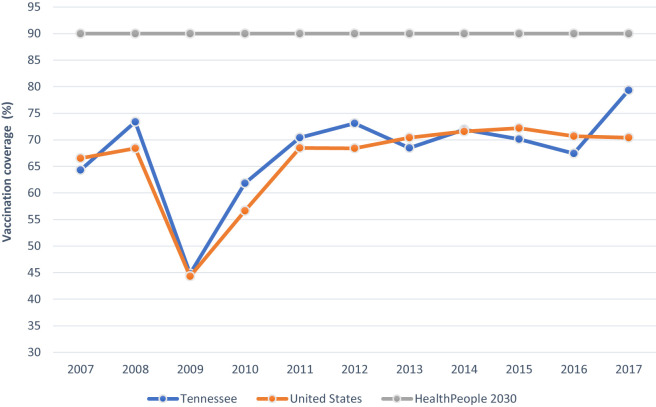
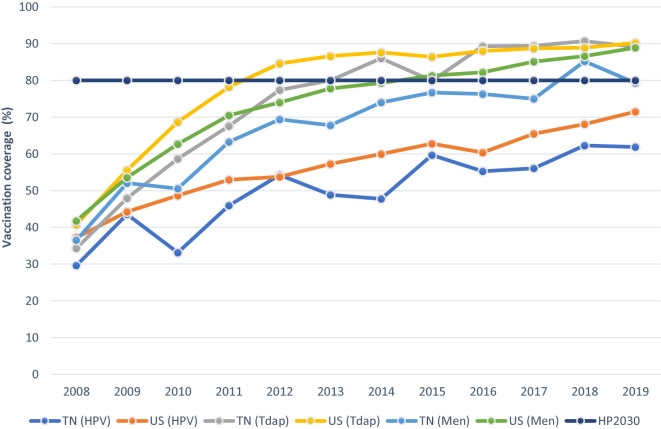
Routine childhood immunizations are proven to be one of the most effective public health interventions at controlling numerous deadly diseases. Therefore, the CDC recommends routine immunizations for children and adolescent populations against vaccine-preventable diseases e.g., tetanus, pertussis, diphtheria, etc. This current review sought to examine barriers to pediatric vaccine uptake behaviors during the COVID-19 pandemic. We also explored the implications for parental vaccine hesitancy/delay during an ongoing health crisis and proposed recommendations for increasing vaccine confidence and compliance. Our review determined that the receipt for vaccinations steadily improved in the last decade for both the United States and Tennessee. However, this incremental progress has been forestalled by the COVID-19 pandemic and other barriers i.e. parental vaccine hesitancy, social determinants of health (SDoH) inequalities, etc. which further exacerbate vaccination disparities. Moreover, non-compliance to routine vaccinations could cause an outbreak of diseases, thereby, worsening the ongoing health crisis and already strained health care system. Healthcare providers are uniquely positioned to offer effective recommendations with presumptive languaging to increase vaccination rates, as well as, address parental vaccine hesitancy. Best practices that incorporate healthcare providers' quality improvement coaching, vaccination reminder recall systems, adherence to standardized safety protocols (physical distancing, hand hygiene practices, etc.), as well as, offer telehealth and outdoor/drive-through/curbside vaccination services, etc. are warranted. Additionally, a concerted effort should be made to utilize public health surveillance systems to collect, analyze, and interpret data, thereby, ensuring the dissemination of timely, accurate health information for effective health policy decision-making e.g., vaccine distribution, etc.
常规儿童免疫接种被证明是控制多种致命疾病的最有效公共卫生干预措施之一。因此,疾病预防控制中心建议为儿童和青少年人群常规接种疫苗,以预防可通过疫苗预防的疾病,例如破伤风、百日咳、白喉等。本综述旨在探讨在 COVID-19 大流行期间儿童疫苗接种行为的障碍。我们还探讨了在持续的健康危机期间父母对疫苗犹豫不决/延迟的影响,并提出了增加疫苗信心和遵守率的建议。我们的综述确定,在过去十年中,美国和田纳西州的疫苗接种率都稳步提高。然而,这一渐进的进展因 COVID-19 大流行和其他障碍而受阻,例如父母对疫苗的犹豫不决、健康的社会决定因素(SDoH)不平等,这些障碍进一步加剧了疫苗接种的差异。此外,不遵守常规疫苗接种可能会导致疾病爆发,从而加剧正在发生的健康危机和已经紧张的医疗保健系统。医疗保健提供者处于独特的地位,可以提供有效的建议和推测性语言,以提高疫苗接种率,并解决父母对疫苗的犹豫不决。值得采用的最佳实践包括医疗保健提供者的质量改进辅导、疫苗接种提醒召回系统、遵守标准化安全协议(身体距离、手部卫生实践等),以及提供远程医疗和户外/驾车/路边疫苗接种服务等。此外,应共同努力利用公共卫生监测系统收集、分析和解释数据,从而确保及时、准确地传播健康信息,以进行有效的卫生政策决策,例如疫苗分配等。