Miricescu Daniela, Balan Daniela Gabriela, Tulin Adrian, Stiru Ovidiu, Vacaroiu Ileana Adela, Mihai Doina Andrada, Popa Cristian Constantin, Enyedi Mihaly, Nedelea Andrei Sorin, Nica Adriana Elena, Stefani Constantin
Department of Biochemistry, Faculty of Dental Medicine, 'Carol Davila' University of Medicine and Pharmacy, 020021 Bucharest, Romania.
Discipline of Physiology, Faculty of Dental Medicine, 'Carol Davila' University of Medicine and Pharmacy, 020021 Bucharest, Romania.
Exp Ther Med. 2021 May;21(5):539. doi: 10.3892/etm.2021.9969. Epub 2021 Mar 23.
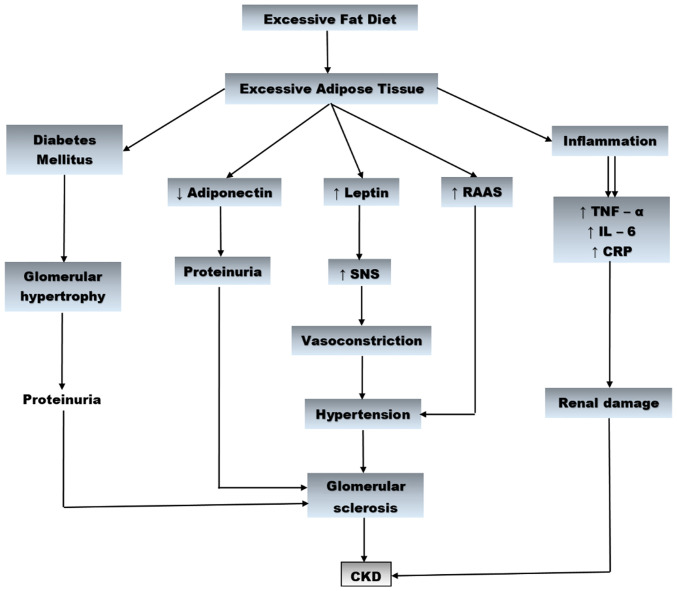
Obesity is a worldwide pandemic health issue. Obesity is associated with the pathogenesis of type 2 diabetes, hypertension, dyslipidemia, cardiovascular diseases, cancer, and kidney diseases. This systemic disease can affect the kidneys by two mechanisms: Indirectly through diabetes mellitus (DM) and hypertension and directly through adipokines secreted by adipose tissue. Obesity is a risk factor for chronic kidney disease (CKD), which is associated with an increased risk of morbidity and mortality among the adult population. Increased visceral adipose tissue leads to renal glomerular hyperfiltration and hyperperfusion, which may lead to glomerular hypertrophy, proteinuria, and CKD development. Adipokines are hormones produced by fat tissue. They are involved in energy homeostasis, sugar and fat metabolism, reproduction, immunity, and thermogenesis control. Hormones and cytokines secreted by adipose tissue contribute to the development and progression of CKD. Decreased serum or urinary adiponectin levels are specific in diabetic and non-diabetic CKD patients, while leptin presents increased levels, and both are associated with the development of glomerulopathy. Excessive adipose tissue is associated with inflammation, oxidative stress (OS), insulin resistance and activation of the renin angiotensin-aldosterone system (RAAS). Therefore, adipose tissue dysfunction plays an important role in the development of CKD.
肥胖是一个全球性的大流行健康问题。肥胖与2型糖尿病、高血压、血脂异常、心血管疾病、癌症和肾脏疾病的发病机制相关。这种全身性疾病可通过两种机制影响肾脏:间接通过糖尿病(DM)和高血压,以及直接通过脂肪组织分泌的脂肪因子。肥胖是慢性肾脏病(CKD)的一个危险因素,这与成年人群中发病率和死亡率增加的风险相关。内脏脂肪组织增加会导致肾小球高滤过和高灌注,这可能会导致肾小球肥大、蛋白尿和CKD的发展。脂肪因子是由脂肪组织产生的激素。它们参与能量稳态、糖和脂肪代谢、生殖、免疫以及产热控制。脂肪组织分泌的激素和细胞因子有助于CKD的发生和发展。糖尿病和非糖尿病CKD患者的血清或尿脂联素水平降低具有特异性,而瘦素水平升高,且两者都与肾小球病变的发展相关。过多的脂肪组织与炎症、氧化应激(OS)、胰岛素抵抗以及肾素血管紧张素 - 醛固酮系统(RAAS)的激活有关。因此,脂肪组织功能障碍在CKD的发展中起重要作用。