Alcaide Cristina, Sardanyés Josep, Elena Santiago F, Gómez Pedro
Departamento de Biología del Estrés y Patología Vegetal, Centro de Edafología y Biología Aplicada del Segura (CEBAS), CSIC, PO Box 164, 30100 Murcia, Spain.
Centre de Recerca Matemàtica (CRM), Edifici C, Campus de Bellaterra, Cerdanyola del Vallès, Barcelona 08193, Spain.
Virus Evol. 2021 Feb 23;7(1):veab017. doi: 10.1093/ve/veab017. eCollection 2021 Jan.
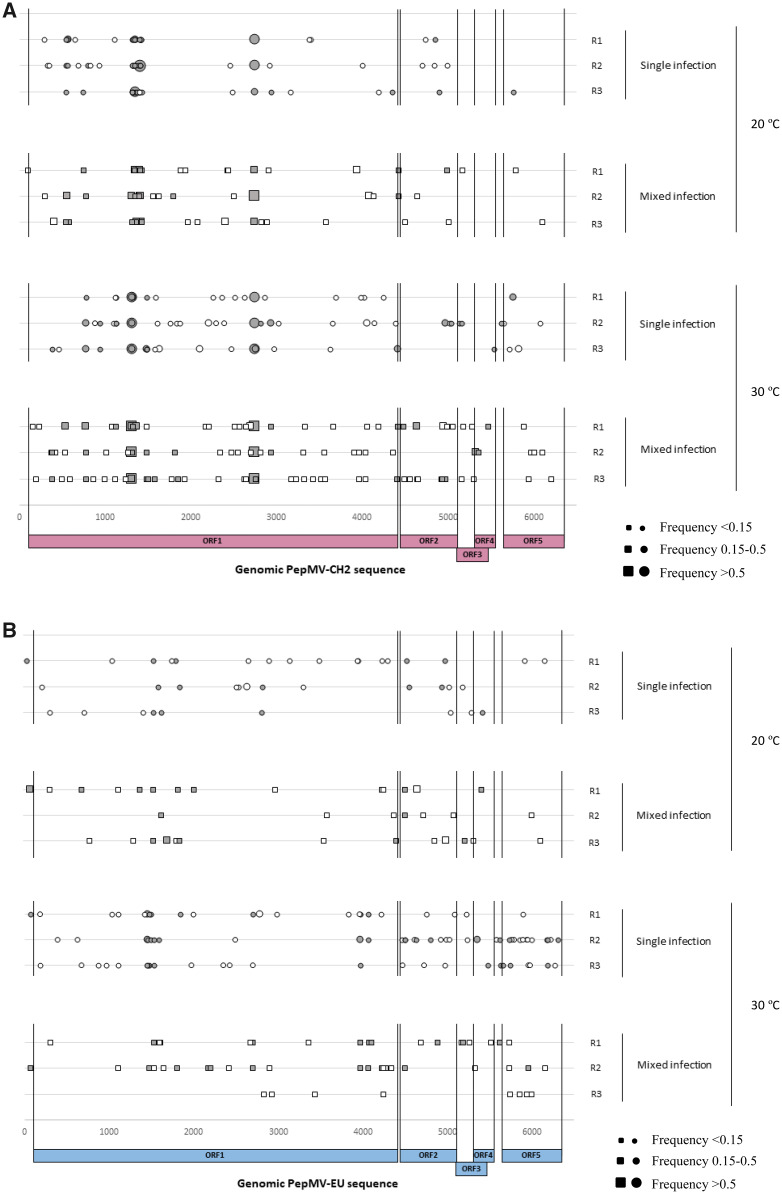
Environmental conditions can affect viral accumulation, virulence and adaptation, which have implications in the disease outcomes and efficiency of control measures. Concurrently, mixed viral infections are relevant in plants, being their epidemiology shaped by within-host virus-virus interactions. However, the extent in which the combined effect of variations in abiotic components of the plant ecological niche and the prevalence of mixed infections affect the evolutionary dynamics of viral populations is not well understood. Here, we explore the interplay between ecological and evolutionary factors during viral infections and show that isolates of two strains of coexisted in tomato plants in a temperature-dependent continuum between neutral and antagonistic interactions. After a long-term infection, the mutational analysis of the evolved viral genomes revealed strain-specific single-nucleotide polymorphisms that were modulated by the interaction between the type of infection and temperature. These results suggest that the temperature is an ecological driver of virus-virus interactions, with an effect on the genetic diversity of individual viruses that are co-infecting an individual host. This research provides insights into the effect that changes in host growth temperatures might have on the evolutionary dynamics of viral populations in mixed infections.
环境条件会影响病毒积累、毒力和适应性,这对疾病结果和控制措施的效率具有重要意义。同时,混合病毒感染在植物中也很常见,其流行病学受到宿主内病毒-病毒相互作用的影响。然而,植物生态位非生物成分的变化和混合感染的流行程度的综合影响在多大程度上影响病毒种群的进化动态,目前还不太清楚。在这里,我们探讨了病毒感染期间生态和进化因素之间的相互作用,并表明两种病毒株的分离物在番茄植株中共存,其相互作用在中性和拮抗之间呈温度依赖性连续变化。长期感染后,对进化后的病毒基因组进行突变分析,发现了特定毒株的单核苷酸多态性,这些多态性受到感染类型和温度之间相互作用的调节。这些结果表明,温度是病毒-病毒相互作用的生态驱动因素,对共同感染单个宿主的单个病毒的遗传多样性有影响。这项研究为宿主生长温度变化可能对混合感染中病毒种群的进化动态产生的影响提供了见解。