Organismal and Evolutionary Biology Research Programme, Viikinkaari 1 (PO box 65), FI-00014, University of Helsinki, Helsinki, Finland.
Department of Evolutionary Biology and Environmental Studies, University of Zürich, CH-8067, Zürich, Switzerland.
Nat Commun. 2020 Nov 5;11(1):5610. doi: 10.1038/s41467-020-19273-z.
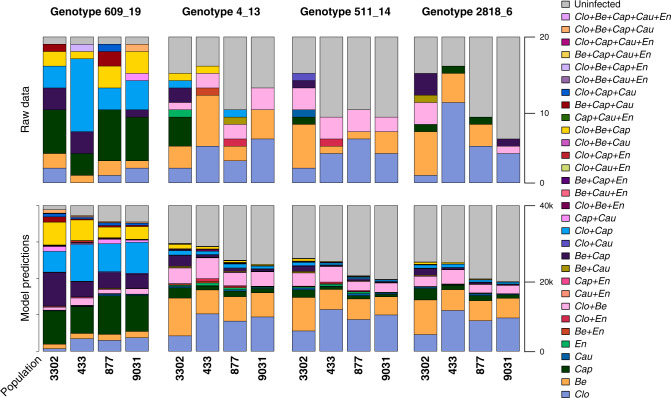
Infection by multiple pathogens of the same host is ubiquitous in both natural and managed habitats. While intraspecific variation in disease resistance is known to affect pathogen occurrence, how differences among host genotypes affect the assembly of pathogen communities remains untested. In our experiment using cloned replicates of naive Plantago lanceolata plants as sentinels during a seasonal virus epidemic, we find non-random co-occurrence patterns of five focal viruses. Using joint species distribution modelling, we attribute the non-random virus occurrence patterns primarily to differences among host genotypes and local population context. Our results show that intraspecific variation among host genotypes may play a large, previously unquantified role in pathogen community structure.
同一宿主被多种病原体感染在自然和人为环境中都很普遍。虽然同种内疾病抵抗力的变异被认为会影响病原体的发生,但宿主基因型之间的差异如何影响病原体群落的组装仍未得到检验。在我们的实验中,使用无性繁殖的 naive Plantago lanceolata 植物作为季节性病毒流行期间的哨兵植物,我们发现了五个焦点病毒的非随机共现模式。通过联合物种分布模型,我们将非随机病毒发生模式主要归因于宿主基因型和局部种群背景的差异。我们的研究结果表明,宿主基因型之间的种内变异可能在病原体群落结构中发挥了以前未量化的重要作用。