Guan Haonan, Dong Wei, Lu Yechen, Jiang Minfei, Zhang Di, Aobuliaximu Yakupu, Dong Jiaoyun, Niu Yiwen, Liu Yingkai, Guan Bingjie, Tang Jiajun, Lu Shuliang
Department of Burn, School of Medicine, Ruijin Hospital, Shanghai Jiaotong University, Shanghai, China.
Wound Healing Center, School of Medicine, Ruijin Hospital, Shanghai Jiaotong University, Shanghai, China.
Front Med (Lausanne). 2021 Mar 17;8:609584. doi: 10.3389/fmed.2021.609584. eCollection 2021.
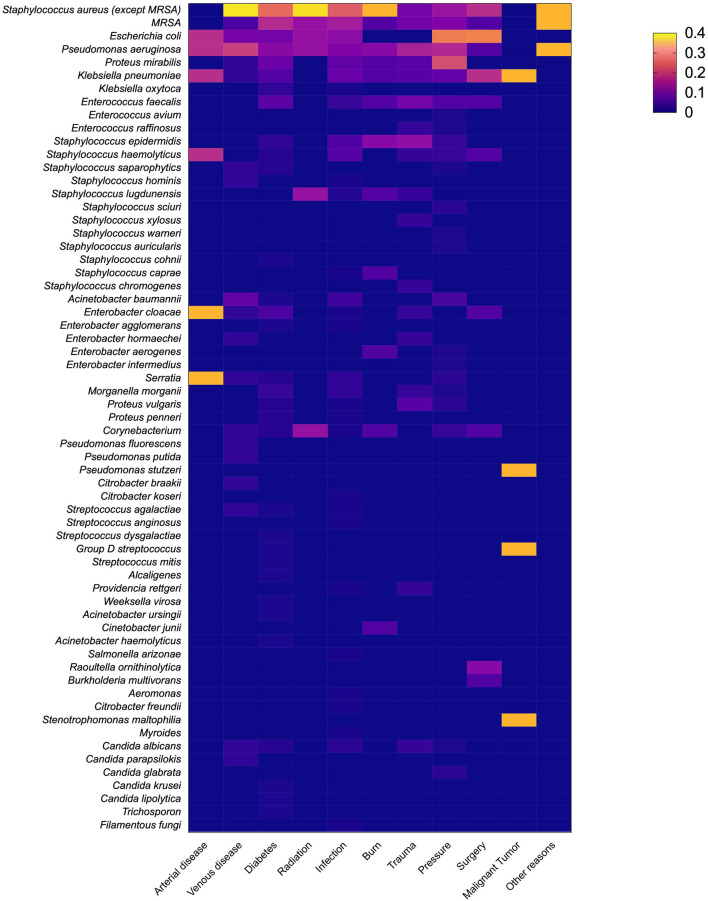
To determine the distribution and antimicrobial susceptibility pattern of pathogenic bacteria in patients with chronic cutaneous wounds on a national scale. A retrospective study was conducted using the data recorded between January 1, 2018 and January1, 2020 in 195 hospitals across China. After screening the data, 815 patients with chronic wounds were finally analyzed. The data collected included information about the patients' general condition and local cutaneous wound assessments, especially microbial culture and antibiotic susceptibility tests. The analyses were performed using SPSS Version 26. The study included 815 patients (290 [35.6%] females; 63 [50-74] years). The most common causes of chronic cutaneous wounds were diabetes (183, 22.5%), infection (178, 21.8%), and pressure (140, 17.2%). Among these, 521(63.9%) samples tested yielded microbial growth, including 70 (13.4%) polymicrobial infection and 451 (86.6%) monomicrobial infection. The positive rate of microbial culture was highest in wound tissue of ulcers caused by infection (87.6%), followed by pressure (77.1%), diabetes (68.3%), and venous diseases (67.7%). Bates-Jensen wound assessment tool (BWAT) scores >25 and wounds that lasted for more than 3 months had a higher positive rate of microbial culture. BWAT scores >25 and wounds in the rump, perineum, and feet were more likely to exhibit polymicrobial infection. A total of 600 strains were isolated, of which 46.2% (277 strains) were Gram-positive bacteria, 51.3% (308 strains) were Gram-negative bacteria, and 2.5% (15 strains) were fungi. The most common bacterial isolates were (29.2%), (11.5%), (11.0%), (8.0%), and (5.8%). The susceptibility tests showed that 116 cultured bacteria were Multidrug resistant (MDR) strains. The resistance rates of were 92.0% (161/175) to penicillin, 58.3% (102/175) to erythromycin, and 50.9% (89/175) to clindamycin. Vancomycin was the most effective antibiotic (0% resistance rate) against all Gram-positive bacteria. Besides, the resistance rates of were 68.1% (47/69) to ampicillin, 68.1% (47/69) to ciprofloxacin, 60.9% (42/69) to levofloxacin. However, all the isolated Gram-negative bacteria showed low resistance rates to tigecycline (3.9%) and amikacin (3.6%). The distribution of bacteria isolated from chronic cutaneous wounds varies with the BWAT scores, causes, duration, and the location of wounds. Multidrug resistance is a serious health issue, and therefore antibiotics used in chronic wounds must be under strict regulation. Our findings may help clinicians in making informed decisions regarding antibiotic therapy.
在全国范围内确定慢性皮肤伤口患者病原菌的分布及抗菌药物敏感性模式。采用回顾性研究方法,使用2018年1月1日至2020年1月1日期间中国195家医院记录的数据。经过数据筛选,最终分析了815例慢性伤口患者。收集的数据包括患者的一般情况和局部皮肤伤口评估信息,尤其是微生物培养和抗生素敏感性试验。使用SPSS 26版进行分析。该研究纳入了815例患者(女性290例[35.6%];年龄63[50 - 74]岁)。慢性皮肤伤口最常见的病因是糖尿病(183例,22.5%)、感染(178例,21.8%)和压力性损伤(140例,17.2%)。其中,521份(63.9%)检测样本有微生物生长,包括70份(13.4%)混合菌感染和451份(86.6%)单一菌感染。微生物培养阳性率在感染性溃疡伤口组织中最高(87.6%),其次是压力性损伤(77.1%)、糖尿病(68.3%)和静脉疾病(67.7%)。贝茨 - 詹森伤口评估工具(BWAT)评分>25分以及持续时间超过3个月的伤口微生物培养阳性率较高。BWAT评分>25分以及臀部、会阴和足部的伤口更易出现混合菌感染。共分离出600株菌株,其中46.2%(277株)为革兰氏阳性菌,51.3%(308株)为革兰氏阴性菌,2.5%(15株)为真菌。最常见的分离菌为……(此处原文未完整列出具体细菌名称)(29.2%)、……(11.5%)、……(11.0%)、……(8.0%)和……(5.8%)。药敏试验显示,116株培养菌为多重耐药(MDR)菌株。……对青霉素的耐药率为92.0%(161/175),对红霉素的耐药率为58.3%(102/175),对克林霉素的耐药率为50.9%(89/175)。万古霉素是对所有革兰氏阳性菌最有效的抗生素(耐药率为0%)。此外,……对氨苄西林的耐药率为68.1%(47/69),对环丙沙星的耐药率为68.1%(47/69),对左氧氟沙星的耐药率为60.9%(42/69)。然而,所有分离的革兰氏阴性菌对替加环素(3.9%)和阿米卡星(3.6%)的耐药率较低。从慢性皮肤伤口分离出的细菌分布因BWAT评分、病因、持续时间和伤口部位而异。多重耐药是一个严重的健康问题,因此慢性伤口使用的抗生素必须受到严格监管。我们的研究结果可能有助于临床医生在抗生素治疗方面做出明智的决策。