University of California San Francisco (UCSF) School of Medicine, San Francisco, CA, USA.
Medical Readiness Systems Biology, Center for Military Psychiatry and Neuroscience, Walter Reed Army Institute of Research, Silver Spring, MD, USA.
Transl Psychiatry. 2021 Apr 6;11(1):193. doi: 10.1038/s41398-021-01302-0.
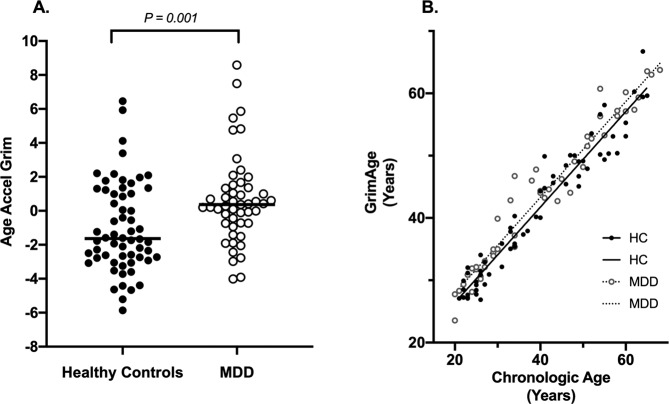
Major depressive disorder (MDD) is associated with premature mortality and is an independent risk factor for a broad range of diseases, especially those associated with aging, such as cardiovascular disease, diabetes, and Alzheimer's disease. However, the pathophysiology underlying increased rates of somatic disease in MDD remains unknown. It has been proposed that MDD represents a state of accelerated cellular aging, and several measures of cellular aging have been developed in recent years. Among such metrics, estimators of biological age based on predictable age-related patterns of DNA methylation (DNAm), so-called 'epigenetic clocks', have shown particular promise for their ability to capture accelerated aging in psychiatric disease. The recently developed DNAm metric known as 'GrimAge' is unique in that it was trained on time-to-death data and has outperformed its predecessors in predicting both morbidity and mortality. Yet, GrimAge has not been investigated in MDD. Here we measured GrimAge in 49 somatically healthy unmedicated individuals with MDD and 60 age-matched healthy controls. We found that individuals with MDD exhibited significantly greater GrimAge relative to their chronological age ('AgeAccelGrim') compared to healthy controls (p = 0.001), with a median of 2 years of excess cellular aging. This difference remained significant after controlling for sex, current smoking status, and body-mass index (p = 0.015). These findings are consistent with prior suggestions of accelerated cellular aging in MDD, but are the first to demonstrate this with an epigenetic metric predictive of premature mortality.
重度抑郁症(MDD)与过早死亡有关,是多种疾病的独立危险因素,特别是与衰老相关的疾病,如心血管疾病、糖尿病和阿尔茨海默病。然而,MDD 导致躯体疾病发生率增加的病理生理学机制尚不清楚。有人提出 MDD 代表了一种细胞加速衰老的状态,近年来已经开发出几种细胞衰老的衡量标准。在这些指标中,基于可预测的与年龄相关的 DNA 甲基化(DNAm)模式的生物年龄估计值,即所谓的“表观遗传时钟”,由于其能够捕捉精神疾病中的加速衰老,因此具有特别的应用前景。最近开发的 DNAm 衡量标准称为“GrimAge”,其独特之处在于它是基于死亡时间数据进行训练的,并且在预测发病率和死亡率方面优于其前身。然而,GrimAge 在 MDD 中尚未得到研究。在这里,我们在 49 名躯体健康、未经药物治疗的 MDD 患者和 60 名年龄匹配的健康对照者中测量了 GrimAge。我们发现,与健康对照组相比,MDD 患者的 GrimAge 明显高于其实际年龄(“AgeAccelGrim”)(p=0.001),存在平均 2 年的细胞过度衰老。在控制了性别、当前吸烟状况和体重指数后,这种差异仍然显著(p=0.015)。这些发现与 MDD 中存在加速细胞衰老的先前观点一致,但这是首次使用可预测过早死亡的表观遗传指标来证明这一点。