Department of Molecular Biomedical Sciences North Carolina State University Raleigh NC.
Joint Department of Biomedical Engineering North Carolina State University and University of North Carolina at Chapel Hill Raleigh NC.
J Am Heart Assoc. 2021 Apr 20;10(8):e020402. doi: 10.1161/JAHA.120.020402. Epub 2021 Apr 6.
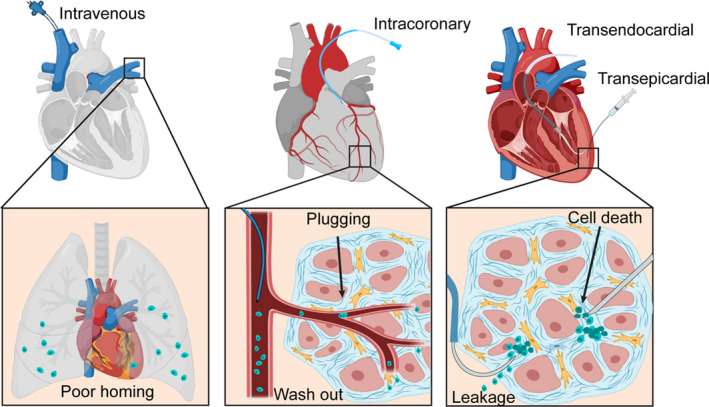
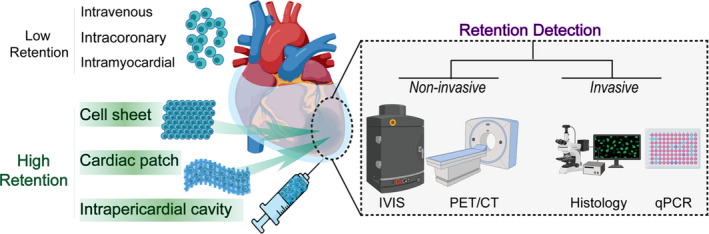
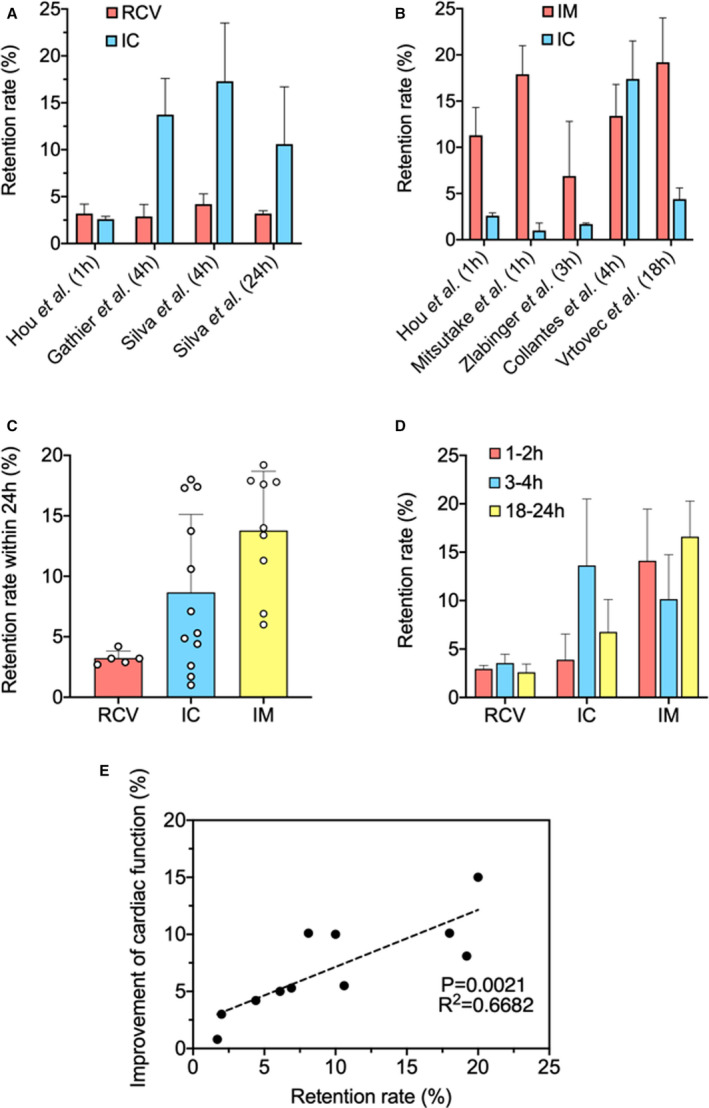
In the past decades, numerous preclinical studies and several clinical trials have evidenced the feasibility of cell transplantation in treating heart diseases. Over the years, different delivery routes of cell therapy have emerged and broadened the width of the field. However, a common hurdle is shared by all current delivery routes: low cell retention. A myriad of studies confirm that cell retention plays a crucial role in the success of cell-mediated cardiac repair. It is important for any delivery route to maintain donor cells in the recipient heart for enough time to not only proliferate by themselves, but also to send paracrine signals to surrounding damaged heart cells and repair them. In this review, we first undertake an in-depth study of primary theories of cell loss, including low efficiency in cell injection, "washout" effects, and cell death, and then organize the literature from the past decade that focuses on cell transplantation to the heart using various cell delivery routes, including intracoronary injection, systemic intravenous injection, retrograde coronary venous injection, and intramyocardial injection. In addition to a recapitulation of these approaches, we also clearly evaluate their strengths and weaknesses. Furthermore, we conduct comparative research on the cell retention rate and functional outcomes of these delivery routes. Finally, we extend our discussion to state-of-the-art bioengineering techniques that enhance cell retention, as well as alternative delivery routes, such as intrapericardial delivery. A combination of these novel strategies and more accurate assessment methods will help to address the hurdle of low cell retention and boost the efficacy of cell transplantation to the heart.
在过去的几十年里,大量的临床前研究和几项临床试验已经证明了细胞移植在治疗心脏病方面的可行性。多年来,细胞疗法的不同输送途径已经出现并拓宽了该领域的范围。然而,所有当前的输送途径都面临着一个共同的障碍:细胞保留率低。大量研究证实,细胞保留在细胞介导的心脏修复的成功中起着至关重要的作用。对于任何输送途径来说,将供体细胞保留在受体心脏中足够长的时间,以使其不仅能够自行增殖,而且能够向周围受损的心脏细胞发送旁分泌信号并修复它们,这一点非常重要。在这篇综述中,我们首先深入研究了细胞丢失的主要理论,包括细胞注射效率低、“冲洗”效应和细胞死亡,然后组织了过去十年中使用各种细胞输送途径(包括冠状动脉内注射、全身静脉内注射、逆行冠状动脉静脉内注射和心肌内注射)将细胞移植到心脏的文献。除了对这些方法进行总结外,我们还明确评估了它们的优缺点。此外,我们还对这些输送途径的细胞保留率和功能结果进行了比较研究。最后,我们将讨论扩展到增强细胞保留的最新生物工程技术以及替代输送途径,如心包内输送。这些新策略和更准确的评估方法的结合将有助于解决细胞保留率低的障碍,并提高细胞移植到心脏的疗效。