Jin Ye, Zhou Wangxiao, Yin Zhidong, Zhang Shuntian, Chen Yunbo, Shen Ping, Ji Jinru, Chen Weiwei, Zheng Beiwen, Xiao Yonghong
State Key Laboratory for Diagnosis and Treatment of Infectious Diseases, National Clinical Research Center for Infectious Diseases, Collaborative Innovation Center for Diagnosis and Treatment of Infectious Diseases, The First Affiliated Hospital, Zhejiang University School of Medicine, Hangzhou, People's Republic of China.
Department of Pathology, The Second Affiliated Hospital of Zhejiang University College of Medicine, Hangzhou, People's Republic of China.
Emerg Microbes Infect. 2021 Dec;10(1):1052-1064. doi: 10.1080/22221751.2021.1914516.
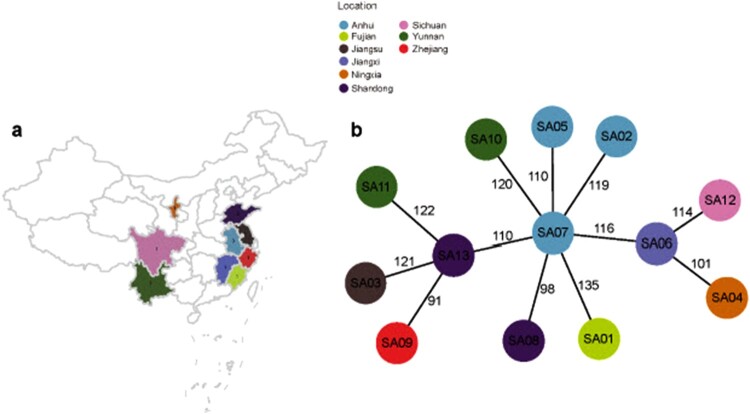
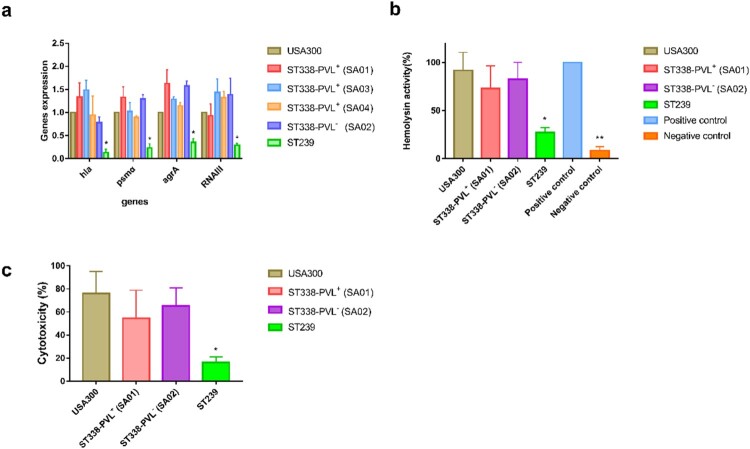
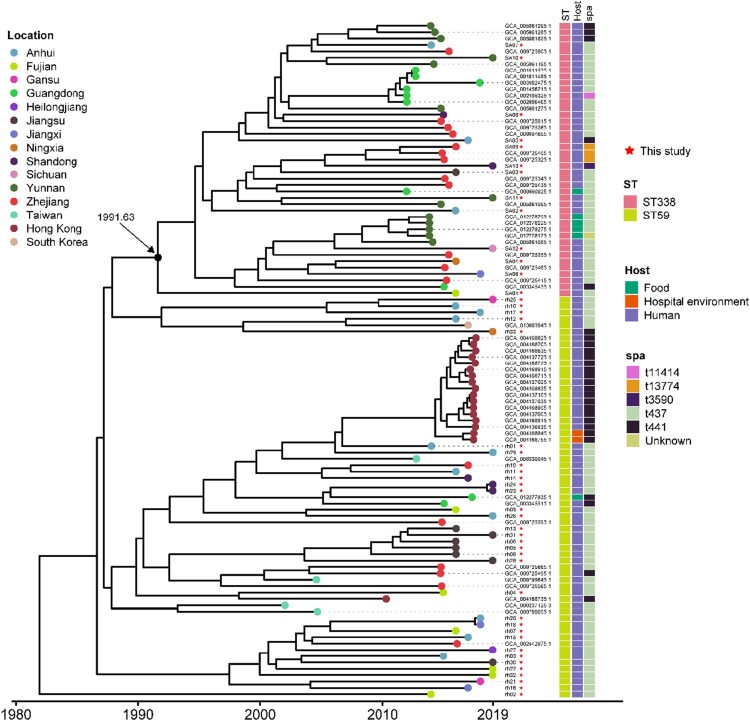
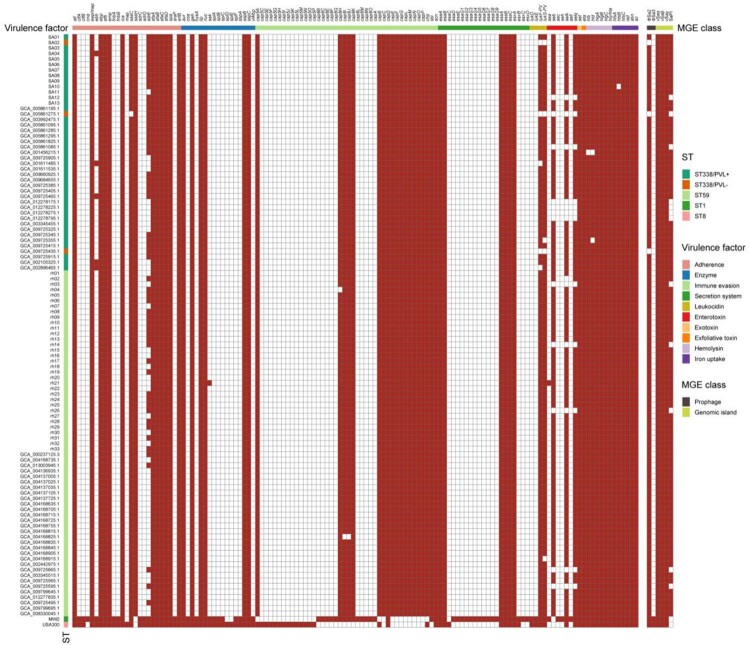
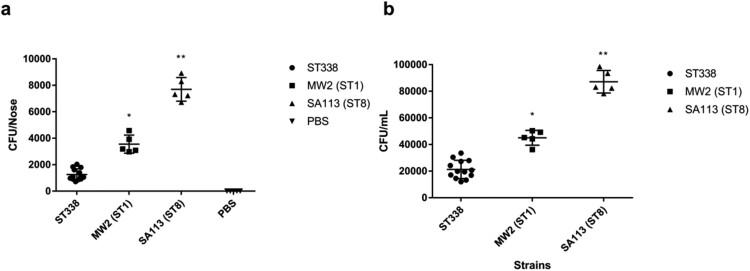
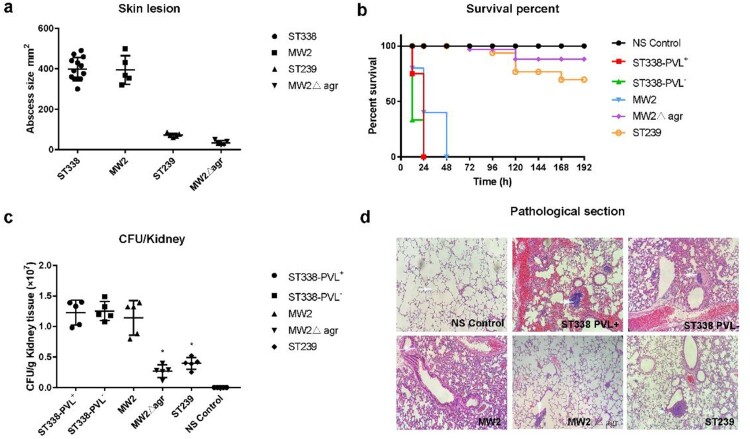
ST59 is the predominant pathotype of community-associated methicillin-resistant (CA-MRSA) in China. As a variant of ST59, there is relatively little known about the detailed information of ST338. To address this issue, here, we described thirteen ST338 CA-MRSA strains isolated from severe bloodstream infection cases, and focused on their epidemiology, genetic features and virulence potential. Phylogenetic analysis showed the earliest isolated strain of this study is likely a predecessor of recent ST338 lineage (after year of 2014). Furthermore, the phylogenetic reconstruction and time estimation suggested that ST338 evolved from ST59 in 1991. Notably, the carrying patten of virulence factors of all ST338 strains were similar, and the genomic islands νSaα, νSaγ and SaPI and the core virulence factors like and were detected in ST338 isolates. However, all ST338 isolates lacked some adhesion factors such as , , , and . Additionally, among these ST338 strains, one PVL-negative ST338 isolate was detected. Experiment on mice nose and human alveolar epithelial cell showed that the nasal colonization ability of ST338 was weaker than that of CA-MRSA MW2. In a mouse bloodstream infection model and skin infection model, PVL+ and PVL- strains had the similar virulence, which was dependent on upregulation of toxin genes rather than the presence of mobile genetic elements such as ΦSa2 carrying PVL. Our findings provide important insight into the epidemiology and pathogenicity of the novel and highly virulent ST338-SCC Vb clone.
ST59是中国社区获得性耐甲氧西林金黄色葡萄球菌(CA-MRSA)的主要致病型。作为ST59的一个变体,关于ST338的详细信息相对知之甚少。为解决这一问题,在此我们描述了从严重血流感染病例中分离出的13株ST338 CA-MRSA菌株,并重点研究了它们的流行病学、遗传特征和毒力潜力。系统发育分析表明,本研究中最早分离的菌株可能是近期ST338谱系(2014年之后)的前身。此外,系统发育重建和时间估计表明,ST338于1991年从ST59进化而来。值得注意的是,所有ST338菌株的毒力因子携带模式相似,并且在ST338分离株中检测到基因组岛νSaα、νSaγ和SaPI以及核心毒力因子如 和 。然而,所有ST338分离株都缺乏一些粘附因子,如 、 、 、 和 。此外,在这些ST338菌株中,检测到一株PVL阴性的ST338分离株。对小鼠鼻腔和人肺泡上皮细胞的实验表明,ST338的鼻腔定植能力弱于CA-MRSA MW2。在小鼠血流感染模型和皮肤感染模型中,PVL+和PVL-菌株具有相似的毒力,这取决于毒素基因的上调,而不是携带PVL的移动遗传元件如ΦSa2的存在。我们的研究结果为新型高毒力ST338-SCC Vb克隆的流行病学和致病性提供了重要见解。