Vaccine and Gene Therapy Institute, Oregon Health and Science University, Beaverton, Oregon, USA.
Vaccine and Gene Therapy Institute, Oregon Health and Science University, Beaverton, Oregon, USA
mBio. 2021 Apr 6;12(2):e00621-21. doi: 10.1128/mBio.00621-21.
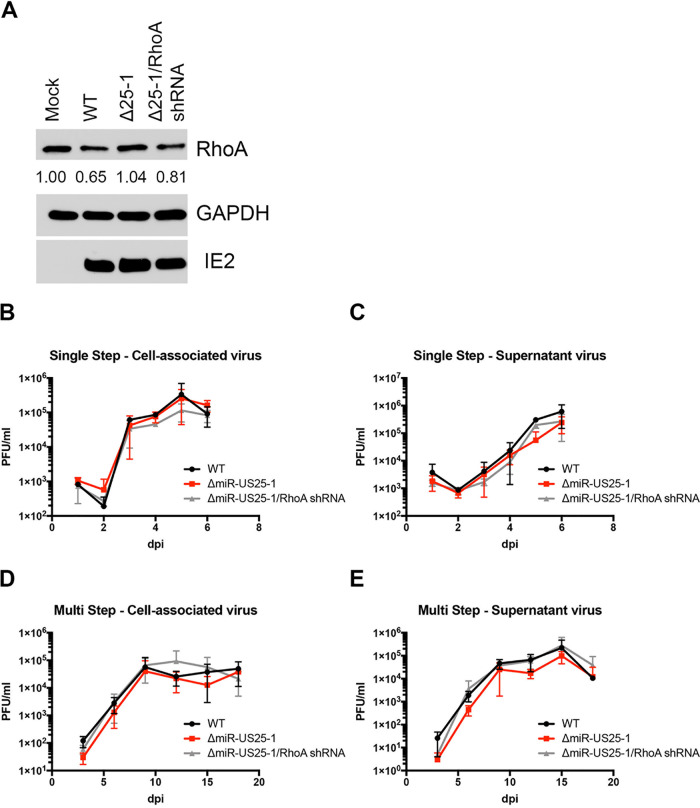
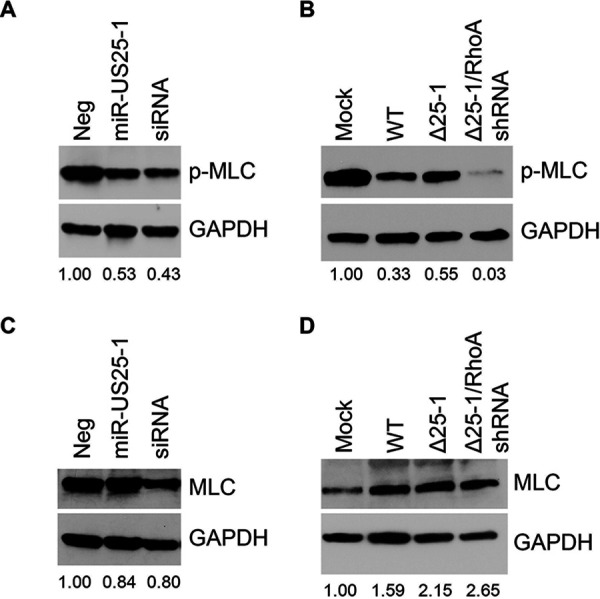
Human cytomegalovirus (HCMV) microRNAs play essential roles in latency and reactivation in CD34 hematopoietic progenitor cells (HPCs) via regulation of viral and cellular gene expression. In the present study, we show that HCMV miR-US25-1 targets RhoA, a small GTPase required for CD34 HPC self-renewal, proliferation, and hematopoiesis. Expression of miR-US25-1 impairs signaling through the nonmuscle myosin II light chain, which leads to a block in cytokinesis and an inhibition of proliferation. Moreover, infection with an HCMV mutant lacking miR-US25-1 resulted in increased proliferation of CD34 HPCs and a decrease in the proportion of genome-containing cells at the end of latency culture. These observations provide a mechanism by which HCMV limits proliferation to maintain latent viral genomes in CD34 HPCs. Each herpesvirus family establishes latency in a unique cell type. Since herpesvirus genomes are maintained as episomes, the virus needs to devise mechanisms to retain the latent genome during cell division. Alphaherpesviruses overcome this obstacle by infecting nondividing neurons, while gammaherpesviruses tether their genome to the host chromosome in dividing B cells. The betaherpesvirus human cytomegalovirus (HCMV) establishes latency in CD34 hematopoietic progenitor cells (HPCs), but the mechanism used to maintain the viral genome is unknown. In this report, we demonstrate that HCMV miR-US25-1 downregulates expression of RhoA, a key cell cycle regulator, which results in inhibition of CD34 HPC proliferation by blocking mitosis. Mutation of miR-US25-1 during viral infection results in enhanced cellular proliferation and a decreased frequency of genome-containing CD34 HPCs. These results reveal a novel mechanism through which HCMV is able to regulate cell division to prevent viral genome loss during proliferation.
人巨细胞病毒(HCMV)microRNAs 通过调节病毒和细胞基因表达,在 CD34 造血祖细胞(HPC)中发挥潜伏和再激活的重要作用。在本研究中,我们表明 HCMV miR-US25-1 靶向 RhoA,这是一种小 GTPase,对于 CD34 HPC 的自我更新、增殖和造血至关重要。miR-US25-1 的表达会损害非肌肉肌球蛋白 II 轻链的信号转导,导致胞质分裂受阻和增殖抑制。此外,感染缺乏 miR-US25-1 的 HCMV 突变体导致 CD34 HPC 的增殖增加,潜伏培养结束时含基因组细胞的比例降低。这些观察结果提供了一种机制,通过该机制,HCMV 限制增殖以维持 CD34 HPC 中的潜伏病毒基因组。每个疱疹病毒家族都在独特的细胞类型中建立潜伏。由于疱疹病毒基因组作为附加体维持,病毒需要设计机制在细胞分裂过程中保留潜伏基因组。α疱疹病毒通过感染非分裂神经元克服了这一障碍,而γ疱疹病毒在分裂的 B 细胞中将其基因组固定在宿主染色体上。β疱疹病毒人巨细胞病毒(HCMV)在 CD34 造血祖细胞(HPC)中建立潜伏,但维持病毒基因组的机制尚不清楚。在本报告中,我们证明 HCMV miR-US25-1 下调 RhoA 的表达,RhoA 是一种关键的细胞周期调节剂,通过阻断有丝分裂抑制 CD34 HPC 的增殖。病毒感染过程中 miR-US25-1 的突变导致细胞增殖增强,含基因组 CD34 HPC 的频率降低。这些结果揭示了一种新的机制,通过该机制,HCMV 能够调节细胞分裂,以防止增殖过程中病毒基因组丢失。