Hsg Bochum - Hochschule für Gesundheit, Bochum, Germany.
GMS J Med Educ. 2021 Feb 15;38(3):Doc65. doi: 10.3205/zma001461. eCollection 2021.
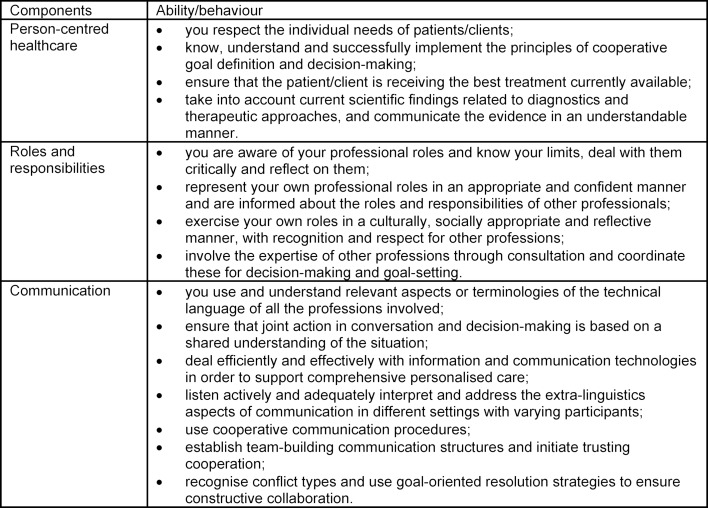
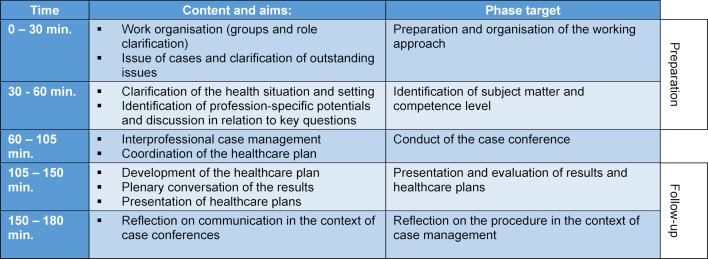
Interprofessional case conferences support future team-based approaches to healthcare, and inevitably require targeted communication between the various participants. However, the success of communication during a case conference must be learnt explicitly. The subject of conversation is often the only outcome of the case conference that is discussed in plenary or small groups. Communication processes are hardly taken into account. However, integrating process orientation and making communication relevant to goal achievement is mandatory in order to teach in a competence-oriented fashion in this area. The aim of this article is to present an empirically sound framework for teaching case conferences, with the help of which conversation processes can be practiced, evaluated and analysed in interprofessional case conferences. With the aid of literature analysis, insights from empirical conversation research and the International Classification of Functioning and Health (ICF), we have developed an empirically and theoretically sound framework for interprofessional case conferences. This is intended to support the training of communication skills and to serve as a basis for assessing them. In practice, it has been shown that embedding case conferences in higher education curricula is feasible and effective for a group size of 200 students. The framework has proven itself in verbal training while aligning itself with concepts of sharing for the negotiation of leadership, goals and decisions. In addition, it could also be used as a theoretical construct for the "interprofessional objective structured clinical examination" (iOSCE) at graduation from the module "Interprofessional Case Conference" at the Hochschule für Gesundheit. The topics of interprofessional practice (IPP) and communication are now the subject of curricula in the health professions, both nationally and internationally. In addition, various competence settings are available that can support didactic orientation. However, the authors believe that there are no concrete imperatives for competence-oriented implementation in teaching and examination. In the area of communication teaching, one can integrate empirically sound concepts instead of induction into degree course for the health professions, in order to provide a basis for the further development of communicative competence in this field.
跨专业病例讨论会支持未来基于团队的医疗方法,并且不可避免地需要各个参与者之间进行有针对性的沟通。然而,病例讨论会上的沟通成功必须通过明确的学习来实现。讨论的主题通常是病例讨论会上唯一的讨论结果,无论是在全体会议上还是在小组讨论中。很少考虑沟通过程。然而,为了以能力为导向的方式在这一领域进行教学,必须将过程导向和使沟通与目标达成相关联。本文的目的是借助一个经验证的框架来教授病例讨论,该框架可用于在跨专业病例讨论会上练习、评估和分析对话过程。通过文献分析、实证对话研究的见解以及国际功能、残疾和健康分类(ICF),我们为跨专业病例讨论开发了一个经验证和理论上合理的框架。该框架旨在支持沟通技巧的培训,并作为评估的基础。在实践中,已经证明将病例讨论纳入高等教育课程对于 200 名学生的小组规模是可行且有效的。该框架在口头培训中证明了自己,同时与领导力、目标和决策的协商共享概念保持一致。此外,它还可以作为模块“跨专业病例讨论”毕业时“跨专业客观结构化临床考试”(iOSCE)的理论构建。跨专业实践(IPP)和沟通这两个主题现在都是国内外健康专业课程的主题。此外,还有各种能力设置可以支持教学方向。然而,作者认为,在教学和考试方面,没有针对以能力为导向的实施的具体要求。在沟通教学方面,可以将经验证的概念而不是归纳法纳入健康专业的学位课程,以提供在该领域进一步发展沟通能力的基础。