Demers Marika, Fung Karen, Subramanian Sandeep K, Lemay Martin, Robert Maxime T
Division of Biokinesiology and Physical Therapy, University of Southern California, Los Angeles, CA, United States.
Centre for Interdisciplinary Research in Rehabilitation and Social Integration, Department of Rehabilitation, Faculty of Medicine, Université Laval, Quebec, QC, Canada.
JMIR Serious Games. 2021 Apr 7;9(2):e23822. doi: 10.2196/23822.
Increasing evidence supports the use of virtual reality systems to improve upper limb motor functions in individuals with cerebral palsy. While virtual reality offers the possibility to include key components to promote motor learning, it remains unclear if and how motor learning principles are incorporated into the development of rehabilitation interventions using virtual reality.
The objective of this study was to determine the extent to which motor learning principles are integrated into virtual reality interventions targeting upper limb function in individuals with cerebral palsy.
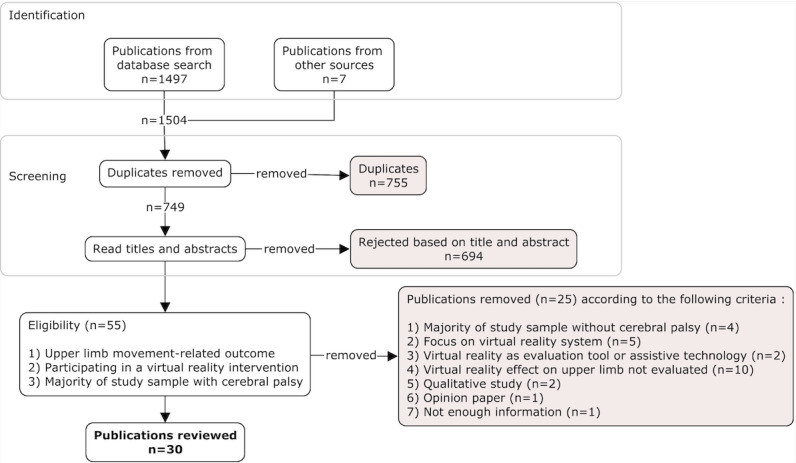
A systematic review was conducted according to the PRISMA (Preferred Reporting Items for Systematic Reviews and Meta-Analyses) guidelines. The search was performed in 10 databases using a combination of keywords related to cerebral palsy, virtual reality, video games, and rehabilitation. Studies were divided into 2 categories: commercial video game platforms and devices and custom virtual reality systems. Study quality was assessed using the modified Downs and Black checklist.
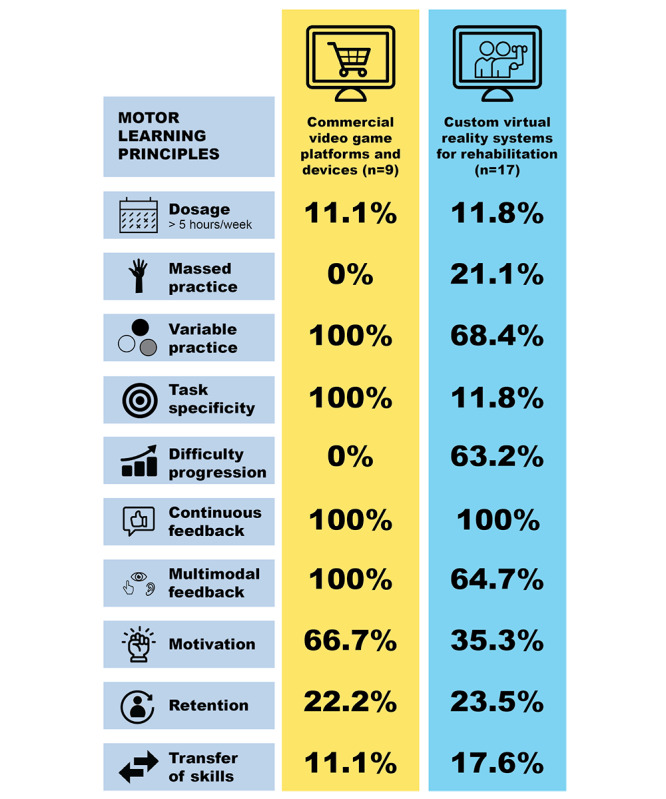
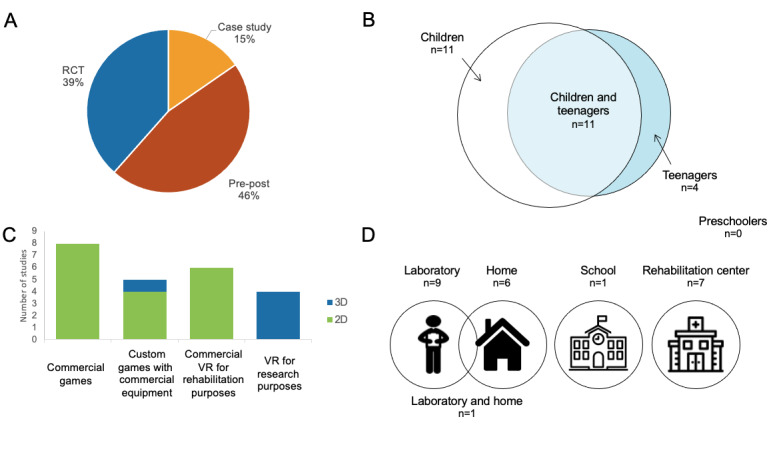
The initial search yielded 1497 publications. A total of 26 studies from 30 publications were included, with most studies classified as "fair" according to the modified Downs and Black checklist. The majority of studies provided enhanced feedback and variable practice and used functionally relevant and motivating virtual tasks. The dosage varied greatly (total training time ranged from 300 to 3360 minutes), with only 6 studies reporting the number of movement repetitions per session. The difficulty progression and the assessment of skills retention and transfer were poorly incorporated, especially for the commercial video games.
Motor learning principles should be better integrated into the development of future virtual reality systems for optimal upper limb motor recovery in individuals with cerebral palsy.
PROSPERO International Prospective Register of Systematic Reviews CRD42020151982; https://www.crd.york.ac.uk/prospero/display_record.php?ID=CRD42020151982.
越来越多的证据支持使用虚拟现实系统来改善脑瘫患者的上肢运动功能。虽然虚拟现实提供了纳入促进运动学习的关键要素的可能性,但运动学习原则是否以及如何被纳入使用虚拟现实的康复干预措施的开发中仍不清楚。
本研究的目的是确定运动学习原则在针对脑瘫患者上肢功能的虚拟现实干预措施中的整合程度。
根据PRISMA(系统评价和Meta分析的首选报告项目)指南进行系统评价。在10个数据库中进行搜索,使用与脑瘫、虚拟现实、视频游戏和康复相关的关键词组合。研究分为两类:商业视频游戏平台和设备以及定制虚拟现实系统。使用改良的唐斯和布莱克清单评估研究质量。
初步搜索产生了1497篇出版物。共纳入了30篇出版物中的26项研究,根据改良的唐斯和布莱克清单,大多数研究被归类为“中等”。大多数研究提供了增强的反馈和可变练习,并使用了功能相关且具有激励性的虚拟任务。剂量差异很大(总训练时间从300分钟到3360分钟不等),只有6项研究报告了每次训练的运动重复次数。难度进展以及技能保持和转移的评估纳入较少,尤其是对于商业视频游戏。
运动学习原则应更好地纳入未来虚拟现实系统的开发中,以实现脑瘫患者上肢运动的最佳恢复。
PROSPERO国际前瞻性系统评价注册库CRD42020151982;https://www.crd.york.ac.uk/prospero/display_record.php?ID=CRD42020151982 。