Department of Fish, Wildlife, and Conservation Biology, Colorado State University, Fort Collins, Colorado, USA.
Edward Grey Institute, Department of Zoology, University of Oxford, Oxford, UK.
Conserv Biol. 2021 Dec;35(6):1777-1786. doi: 10.1111/cobi.13740. Epub 2021 Jul 5.
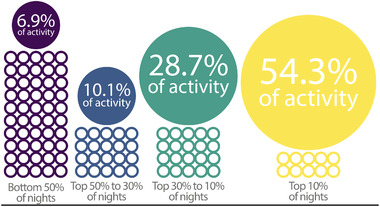
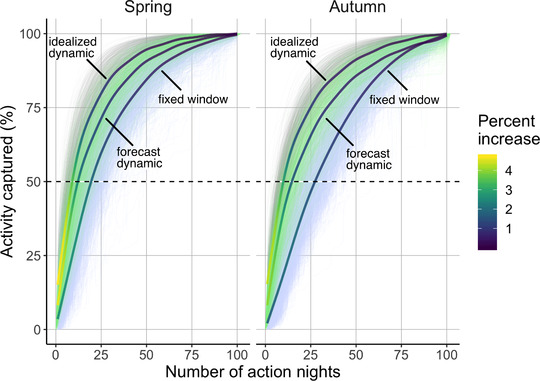
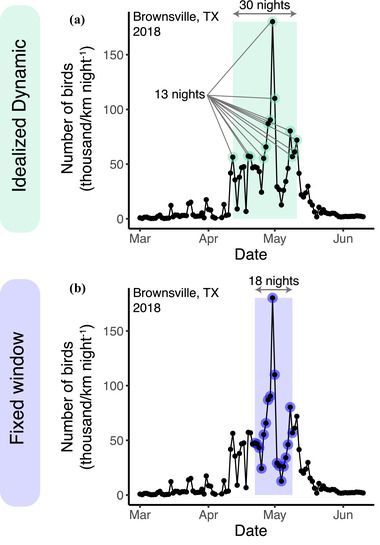
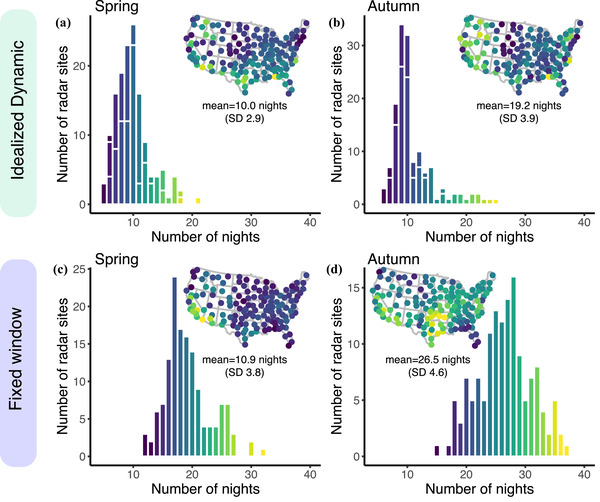
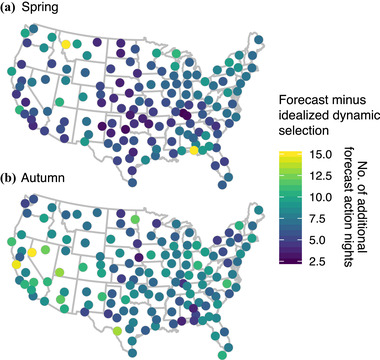
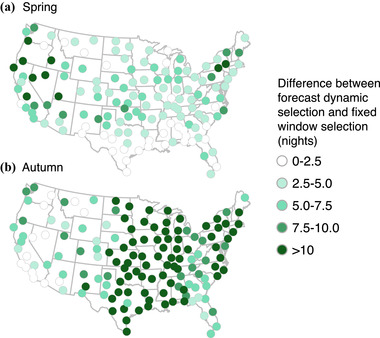
Near-term ecological forecasting has the potential to mitigate negative impacts of human modifications on wildlife by directing efficient action through relevant and timely predictions. We used the U.S. avian migration system to highlight ecological forecasting applications for aeroconservation. We used millions of observations from 143 weather surveillance radars to construct and evaluate a migration forecasting system for nocturnal bird migration over the contiguous United States. We identified the number of nights of mitigation required to reduce the risk of aerial hazards to 50% of avian migrants passing a given area in spring and autumn based on dynamic forecasts of migration activity. We also investigated an alternative approach, that is, employing a fixed conservation strategy based on time windows that historically capture 50% of migratory passage. In practice, during both spring and autumn, dynamic forecasts required fewer action nights compared with fixed window selection at all locations (spring: mean of 7.3 more alert days; fall: mean of 12.8 more alert days). This pattern resulted in part from the pulsed nature of bird migration captured in the radar data, where the majority (54.3%) of birds move on 10% of a migration season's nights. Our results highlight the benefits of near-term ecological forecasting and the potential advantages of dynamic mitigation strategies over static ones, especially in the face of increasing risks to migrating birds from light pollution, wind energy infrastructure, and collisions with structures.
短期生态预测有可能通过相关且及时的预测来指导有效行动,从而减轻人类对野生动物的改造带来的负面影响。我们使用美国鸟类迁徙系统来突出生态预测在航空保护方面的应用。我们利用来自 143 个天气监视雷达的数百万次观测,构建并评估了一个在美国大陆进行夜间鸟类迁徙的预测系统。我们根据迁徙活动的动态预测,确定了减少在春季和秋季通过特定区域的鸟类迁徙中遭遇航空危险的风险所需的减轻风险的夜间数量,使其降低到 50%。我们还研究了另一种方法,即根据历史上捕获 50%的迁徙通道的时间窗口,采用固定的保护策略。实际上,在春季和秋季,与固定窗口选择相比,动态预测在所有地点都需要更少的行动之夜(春季:平均多 7.3 个警戒日;秋季:平均多 12.8 个警戒日)。这种模式部分是由于雷达数据中捕获的鸟类迁徙的脉冲性质造成的,其中 54.3%的鸟类在迁徙季节的 10%的夜间迁徙。我们的研究结果突出了短期生态预测的优势,以及动态缓解策略相对于静态策略的潜在优势,尤其是在面对光污染、风能基础设施和与建筑物碰撞等因素对迁徙鸟类日益增加的风险时。