Facultad de Filosofía y Letras (FFyL), Instituto de Lingüística, Universidad de Buenos Aires (UBA), Buenos Aires, Argentina.
Facultad de Ciencias Exactas y Naturales (FCEyN), Departamento de Fisiología, Biología Molecular y Celular (DFBMC), Instituto de Biociencias, Biotecnología y Biología Traslacional (iB3), Universidad de Buenos Aires (UBA), Buenos Aires, Argentina.
PLoS One. 2021 Apr 7;16(4):e0249661. doi: 10.1371/journal.pone.0249661. eCollection 2021.
Conflicts of interest in biomedical research can influence research results and drive research agendas away from public health priorities. Previous agenda-setting studies share two shortfalls: they only account for direct connections between academic institutions and firms, as well as potential bias based on researchers' personal beliefs. This paper's goal is to determine the key actors and contents of the prevailing health and biomedical sciences (HBMS) research agenda, overcoming these shortfalls.
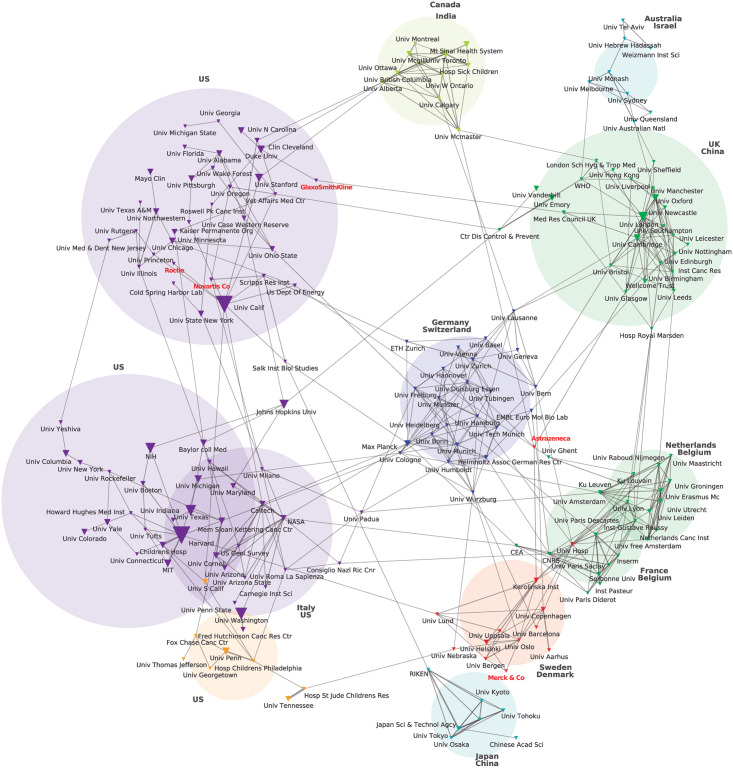
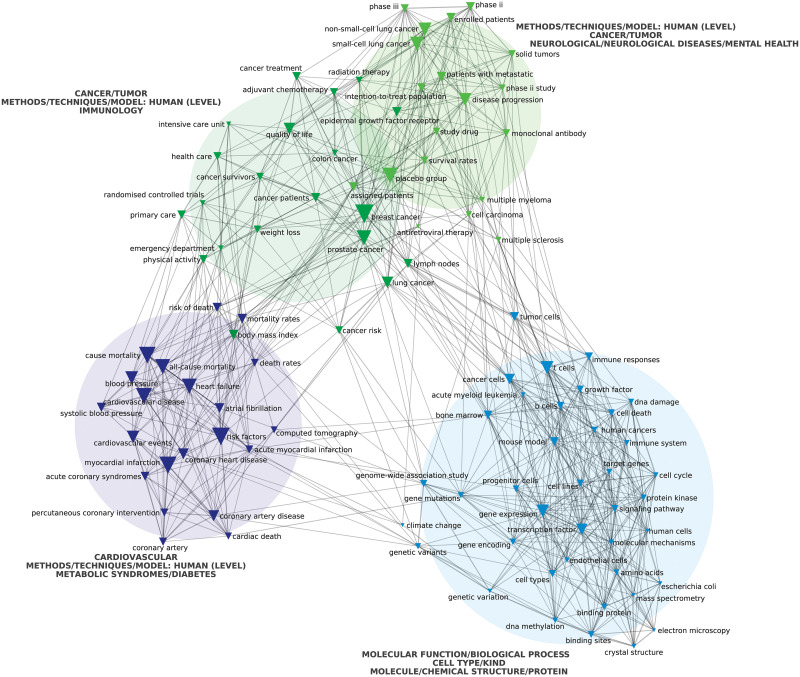
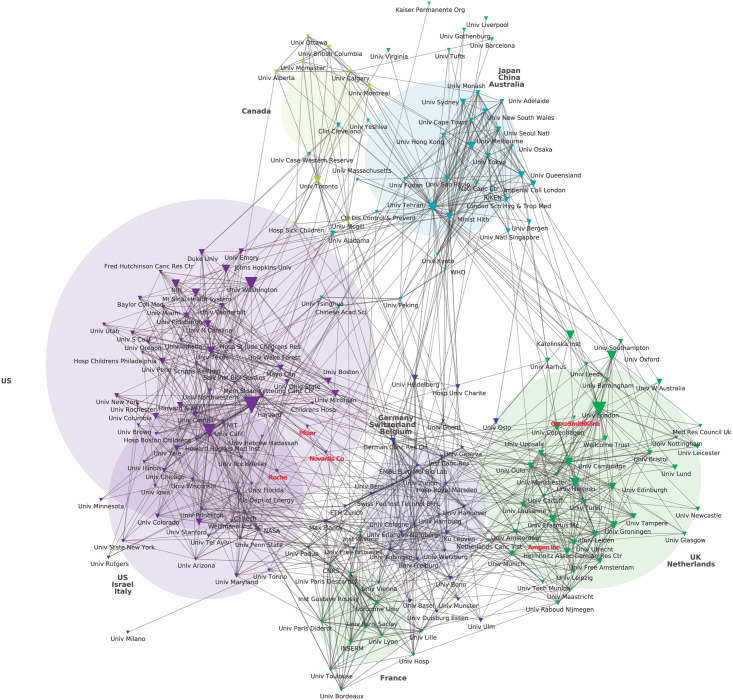
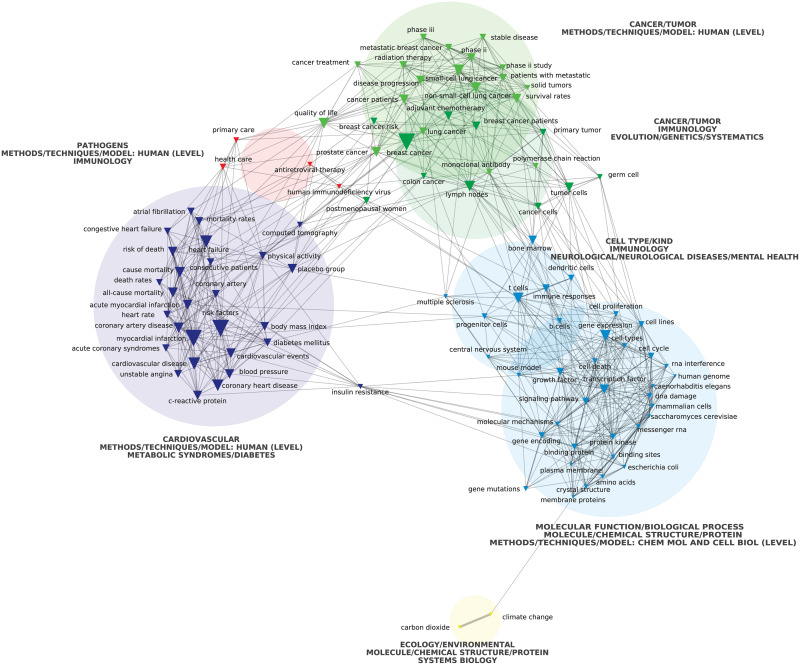
We performed a bibliometric and lexical analysis of 95,415 scientific articles published between 1999 and 2018 in the highest impact factor journals within HBMS, using the Web of Science database and the CorText platform. HBMS's prevailing knowledge network of institutions was proxied with network maps where nodes represent affiliations and edges the most frequent co-authorships. The content of the prevailing HBMS research agenda was depicted through network maps of prevalent multi-terms found in titles, keywords, and abstracts.
The HBMS research agendas of large private firms and leading academic institutions are intertwined. The prevailing HBMS agenda is mostly based on molecular biology (40% of the most frequent multi-terms), with an inclination towards cancer and cardiovascular research (15 and 8% of the most frequent multi-terms, respectively). Studies on pathogens and biological vectors related to recent epidemics are marginal (1% of the most frequent multi-terms). Content of the prevailing HBMS research agenda prioritizes research on pharmacological intervention over research on socio-environmental factors influencing disease onset or progression and overlooks, among others, the study of infectious diseases.
Pharmaceutical corporations contribute to set HBMS's prevailing research agenda, which is mainly focused on a few diseases and research topics. A more balanced research agenda, together with epistemological approaches that consider socio-environmental factors associated with disease spreading, could contribute to being better prepared to prevent and treat more diverse pathologies and to improve overall health outcomes.
生物医学研究中的利益冲突会影响研究结果,并使研究议程偏离公共卫生重点。之前的议程设置研究存在两个缺陷:它们只考虑了学术机构和公司之间的直接联系,以及基于研究人员个人信仰的潜在偏见。本文旨在确定当前健康和生物医学科学(HBMS)研究议程的主要参与者和内容,以克服这些缺陷。
我们使用 Web of Science 数据库和 CorText 平台,对 1999 年至 2018 年间 HBMS 中影响因子最高的期刊上发表的 95415 篇科学文章进行了文献计量学和词汇分析。使用网络地图来代理 HBMS 中机构的主要知识网络,其中节点代表隶属关系,边代表最频繁的合著关系。通过标题、关键词和摘要中常见多词的网络地图来描述当前 HBMS 研究议程的内容。
大型私营公司和领先学术机构的 HBMS 研究议程相互交织。当前 HBMS 议程主要基于分子生物学(最常见多词的 40%),偏向癌症和心血管研究(最常见多词的 15%和 8%)。与最近的流行病相关的病原体和生物载体研究较少(最常见多词的 1%)。当前 HBMS 研究议程的内容优先考虑药物干预研究,而不是研究影响疾病发生或进展的社会环境因素,除其他外,还忽视了传染病的研究。
制药公司有助于制定 HBMS 的主导研究议程,该议程主要集中在少数几种疾病和研究课题上。一个更加平衡的研究议程,以及考虑与疾病传播相关的社会环境因素的认识论方法,有助于更好地准备预防和治疗更多样化的病理,并改善整体健康结果。