Department of Interventional Radiology, The First Affiliated Hospital of Zhengzhou University, No. 1 Jianshe East Road, Zhengzhou City, 450000, Henan Province, China.
Department of Interventional Radiology, The Affiliated Hospital of Traditional Chinese Medicine of Southwest Medical University, Luzhou, 646000, China.
BMC Cancer. 2021 Apr 7;21(1):366. doi: 10.1186/s12885-021-08099-7.
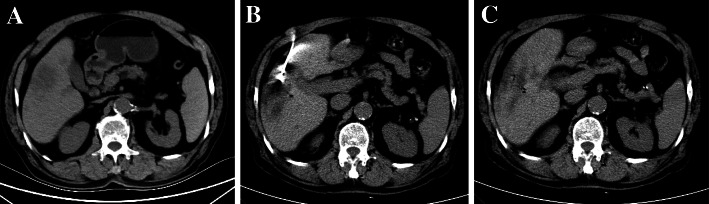
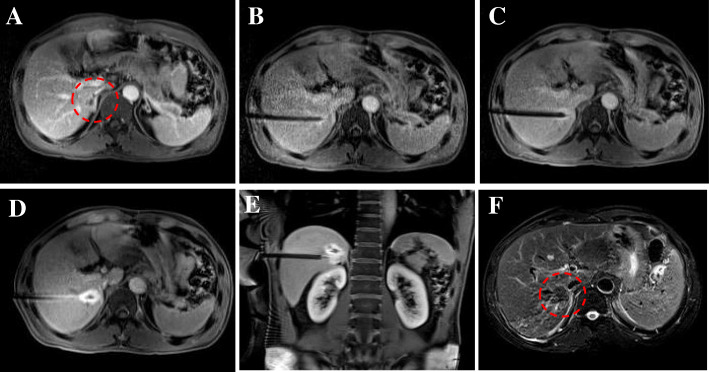
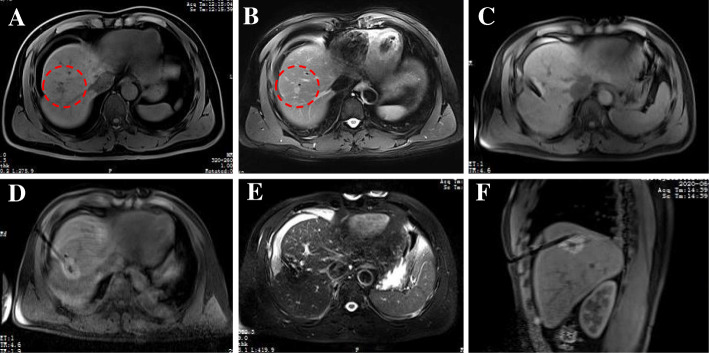
Given their widespread availability and relatively low cost, percutaneous thermal ablation is commonly performed under the guidance of computed tomography (CT) or ultrasound (US). However, such imaging modalities may be restricted due to insufficient image contrast and limited tumor visibility, which results in imperfect intraoperative treatment or an increased risk of damage to critical anatomical structures. Currently, magnetic resonance (MR) guidance has been proven to be a possible solution to overcome the above shortcomings, as it provides more reliable visualization of the target tumor and allows for multiplanar capabilities, making it the modality of choice. Unfortunately, MR-guided ablation is limited to specialized centers, and the cost is relatively high. Is ablation therapy under MR guidance better than that under CT guidance? This study retrospectively compared the efficacy of CT-guided and MR-guided microwave ablation (MWA) for the treatment of hepatocellular carcinoma (HCC ≤ 5.0 cm).
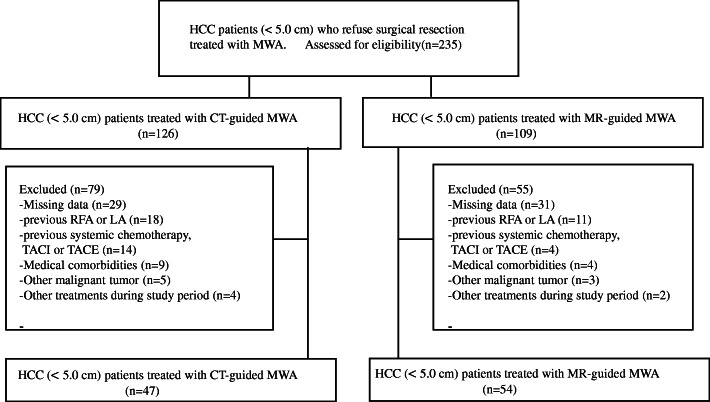
In this retrospective study, 47 patients and 54 patients received MWA under the guidance of CT and MR, respectively. The inclusion criteria were a single HCC ≤ 5.0 cm or a maximum of three. The local tumor progression (LTP), overall survival (OS), prognostic factors for local progression, and safety of this technique were assessed.
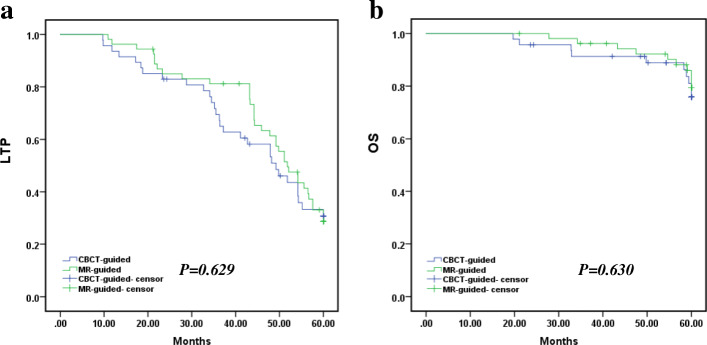
All procedures were technically successful. The complication rates of the two groups were remarkably different with respect to incidences of liver abscess and pleural effusion (P < 0.05). The mean LTP was 44.264 months in the CT-guided group versus 47.745 months in the MR-guided group of HCC (P = 0.629, log-rank test). The mean OS was 56.772 months in the patients who underwent the CT-guided procedure versus 58.123 months in those who underwent the MR-guided procedure (P = 0.630, log-rank test). Multivariate Cox regression analysis further illustrated that tumor diameter (< 3 cm) and the number of lesions (single) were important factors affecting LTP and OS.
Both CT-guided and MR-guided MWA are comparable therapies for the treatment of HCC (< 5 cm), and there was no difference in survival between the two groups. However, MR-guided MWA could reduce the incidence of complications.
由于经皮热消融术具有广泛的可用性和相对较低的成本,因此通常在计算机断层扫描(CT)或超声(US)的引导下进行。然而,由于图像对比度不足和肿瘤可见性有限,这些成像方式可能会受到限制,从而导致术中治疗不完美或关键解剖结构损伤的风险增加。目前,磁共振(MR)引导已被证明是克服上述缺点的一种可能的解决方案,因为它提供了对目标肿瘤更可靠的可视化,并允许进行多平面能力,使其成为首选的方式。不幸的是,MR 引导消融仅限于专业中心,而且成本相对较高。MR 引导下的消融治疗是否优于 CT 引导下的治疗?本研究回顾性比较了 CT 引导和 MR 引导微波消融(MWA)治疗肝细胞癌(HCC≤5.0cm)的疗效。
在这项回顾性研究中,分别有 47 名患者和 54 名患者接受了 CT 引导和 MR 引导下的 MWA。纳入标准为单个 HCC≤5.0cm 或最多三个。评估了该技术的局部肿瘤进展(LTP)、总生存率(OS)、局部进展的预测因素和安全性。
所有手术均技术成功。两组的并发症发生率在肝脓肿和胸腔积液的发生率方面存在显著差异(P<0.05)。CT 引导组 HCC 的平均 LTP 为 44.264 个月,MR 引导组为 47.745 个月(P=0.629,对数秩检验)。CT 引导组的平均 OS 为 56.772 个月,MR 引导组为 58.123 个月(P=0.630,对数秩检验)。多变量 Cox 回归分析进一步表明,肿瘤直径(<3cm)和病变数量(单个)是影响 LTP 和 OS 的重要因素。
CT 引导和 MR 引导的 MWA 都是治疗 HCC(<5cm)的等效疗法,两组之间的生存率没有差异。然而,MR 引导的 MWA 可以降低并发症的发生率。