Department of Interventional Radiology, First Affiliated Hospital of Zhengzhou University, No. 1 Jianshe East Road, Zhengzhou City, 450000, Henan Province, China.
BMC Cancer. 2021 May 17;21(1):562. doi: 10.1186/s12885-021-08298-2.
Percutaneous magnetic resonance-guided (MR-guided) MWA procedures have traditionally been performed under local anesthesia (LA) and sedation. However, pain control is often difficult to manage, especially in some cases when the tumor is large or in a specific location, such as near the abdominal wall or close to the hepatic dome. This study retrospectively compared the results of general anesthesia (GA) and local anesthesia (LA) for MR-guided microwave ablation (MWA) in patients with hepatocellular carcinoma (HCC ≤ 5.0 cm) to investigate whether different anesthesia methods lead to different clinical outcomes.
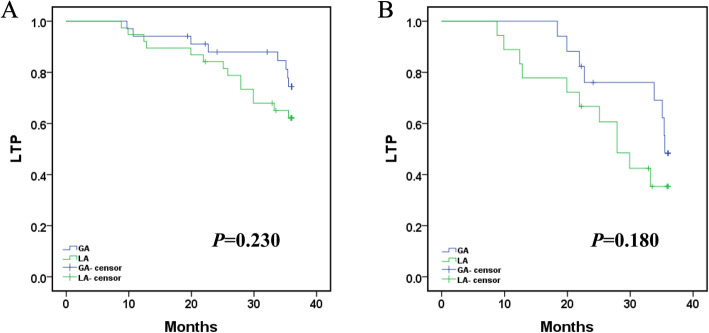
The results of the analysis include procedure-related complications, imaging response, and the time to complete two sets of procedures. According to the type of anesthesia, the Kaplan-Meier method was used to compare the local tumor progression (LTP) of the two groups who underwent MR-guided MWA.
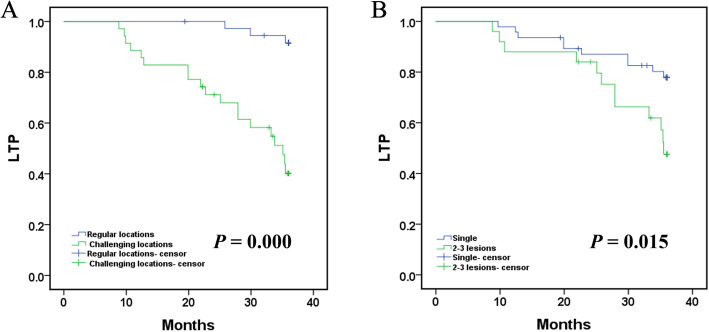
All patients achieved technical success. The mean ablation duration of each patient in the GA group and LA group was remarkably different (P = 0.012). Both groups had no difference in complications or LTP (both P > 0.05). Notably, the tumor location (challenging locations) and the number of lesions (2-3 lesions) could be the main factors affecting LTP (p = 0.000, p = 0.015). Univariate Cox proportional hazard regression indicated that using different anesthesia methods (GA and LA) was not associated with longer LTP (P = 0.237), while tumor location (challenging locations) and the number of lesions (2-3 lesions) were both related to shorter LTP (P = 0.000, P = 0.020, respectively). Additionally, multivariate Cox regression further revealed that the tumor location (regular locations) and the number of lesions (single) could independently predict better LTP (P = 0.000, P = 0.005, respectively).
No correlation was observed between GA and LA for LTP after MR-guided MWA. However, tumors in challenging locations and the number of lesions (2-3 lesions) appear to be the main factors affecting LTP.
经皮磁共振引导(MR 引导)微波消融(MWA)程序传统上是在局部麻醉(LA)和镇静下进行的。然而,疼痛控制往往难以管理,特别是在某些情况下,如肿瘤较大或位于特定位置,如靠近腹壁或靠近肝顶。本研究回顾性比较了全身麻醉(GA)和局部麻醉(LA)在 MR 引导微波消融(MWA)治疗肝细胞癌(HCC≤5.0cm)患者中的结果,以探讨不同麻醉方法是否会导致不同的临床结果。
分析结果包括与程序相关的并发症、影像学反应以及完成两组程序的时间。根据麻醉类型,采用 Kaplan-Meier 法比较两组接受 MR 引导 MWA 的患者的局部肿瘤进展(LTP)。
所有患者均获得技术成功。GA 组和 LA 组每位患者的平均消融时间差异显著(P=0.012)。两组并发症或 LTP 无差异(均 P>0.05)。值得注意的是,肿瘤位置(挑战性位置)和病灶数量(2-3 个病灶)可能是影响 LTP 的主要因素(p=0.000,p=0.015)。单因素 Cox 比例风险回归表明,使用不同麻醉方法(GA 和 LA)与较长的 LTP 无关(P=0.237),而肿瘤位置(挑战性位置)和病灶数量(2-3 个病灶)均与较短的 LTP 相关(P=0.000,P=0.020)。此外,多因素 Cox 回归进一步表明,肿瘤位置(规则位置)和病灶数量(单发)可独立预测更好的 LTP(P=0.000,P=0.005)。
MR 引导 MWA 后 GA 和 LA 与 LTP 之间无相关性。然而,位于挑战性位置的肿瘤和病灶数量(2-3 个病灶)似乎是影响 LTP 的主要因素。