The Steve and Cindy Rasmussen Institute for Genomic Medicine, Abigail Wexner Research Institute At Nationwide Children's Hospital, 575 Children's Crossroad, Columbus, OH, 43215 , USA.
Department of Pathology, Northwestern University Feinberg School of Medicine, Chicago, IL , USA.
Acta Neuropathol Commun. 2021 Apr 7;9(1):61. doi: 10.1186/s40478-021-01164-z.
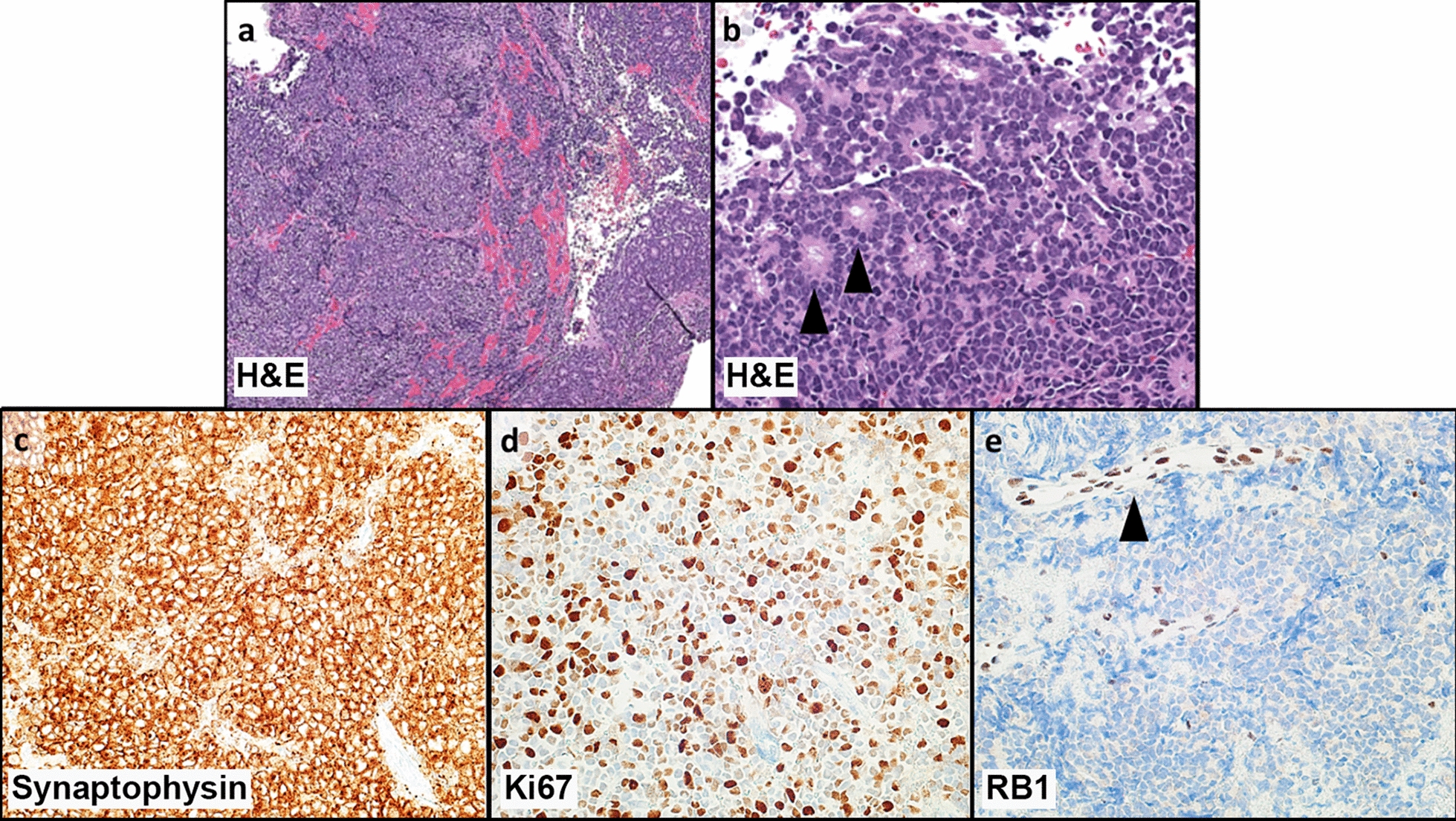
Retinoblastoma is a childhood cancer of the retina involving germline or somatic alterations of the RB Transcriptional Corepressor 1 gene, RB1. Rare cases of sellar-suprasellar region retinoblastoma without evidence of ocular or pineal tumors have been described. A nine-month-old male presented with a sellar-suprasellar region mass. Histopathology showed an embryonal tumor with focal Flexner-Wintersteiner-like rosettes and loss of retinoblastoma protein (RB1) expression by immunohistochemistry. DNA array-based methylation profiling confidently classified the tumor as pineoblastoma group A/intracranial retinoblastoma. The patient was subsequently enrolled on an institutional translational cancer research protocol and underwent comprehensive molecular profiling, including paired tumor/normal exome and genome sequencing and RNA-sequencing of the tumor. Additionally, Pacific Biosciences (PacBio) Single Molecule Real Time (SMRT) sequencing was performed from comparator normal and disease-involved tissue to resolve complex structural variations. RNA-sequencing revealed multiple fusions clustered within 13q14.1-q21.3, including a novel in-frame fusion of RB1-SIAH3 predicted to prematurely truncate the RB1 protein. SMRT sequencing revealed a complex structural rearrangement spanning 13q14.11-q31.3, including two somatic structural variants within intron 17 of RB1. These events corresponded to the RB1-SIAH3 fusion and a novel RB1 rearrangement expected to correlate with the complete absence of RB1 protein expression. Comprehensive molecular analysis, including DNA array-based methylation profiling and sequencing-based methodologies, were critical for classification and understanding the complex mechanism of RB1 inactivation in this diagnostically challenging tumor.
视网膜母细胞瘤是一种儿童期视网膜癌症,涉及 RB 转录核心抑制因子 1 基因(RB1)的种系或体细胞改变。已经描述了罕见的无眼部或松果体肿瘤证据的鞍上-蝶鞍区视网膜母细胞瘤病例。一名 9 个月大的男性出现鞍上-蝶鞍区肿块。组织病理学显示为具有局灶性 Flexner-Wintersteiner 样玫瑰花结的胚胎性肿瘤,免疫组织化学显示视网膜母细胞瘤蛋白(RB1)表达缺失。基于 DNA 芯片的甲基化分析可明确将肿瘤归类为松果体母细胞瘤 A/颅内视网膜母细胞瘤。随后,该患者被纳入机构转化癌症研究方案,并进行了全面的分子分析,包括配对肿瘤/正常外显子和基因组测序以及肿瘤的 RNA 测序。此外,还对太平洋生物科学公司(Pacific Biosciences)的单分子实时(SMRT)测序进行了比较正常和疾病相关组织,以解决复杂的结构变异。RNA 测序揭示了多个融合簇集中在 13q14.1-q21.3 内,包括一个新的 RB1-SIAH3 内含子融合,预计会提前截断 RB1 蛋白。SMRT 测序揭示了跨越 13q14.11-q31.3 的复杂结构重排,包括 RB1 内含子 17 内的两个体细胞结构变异。这些事件与 RB1-SIAH3 融合和一种新的 RB1 重排相对应,预计与 RB1 蛋白完全缺失表达相关。全面的分子分析,包括 DNA 芯片甲基化分析和基于测序的方法,对于分类和理解该具有挑战性的诊断肿瘤中 RB1 失活的复杂机制至关重要。