Nuffield Department of Surgical Sciences, University of Oxford, John Radcliffe Hospital, Oxford, UK.
Patrick G Johnston Centre for Cancer Research, Queen's University of Belfast, Belfast, UK.
Br J Cancer. 2021 Aug;125(3):324-336. doi: 10.1038/s41416-021-01330-z. Epub 2021 Apr 7.
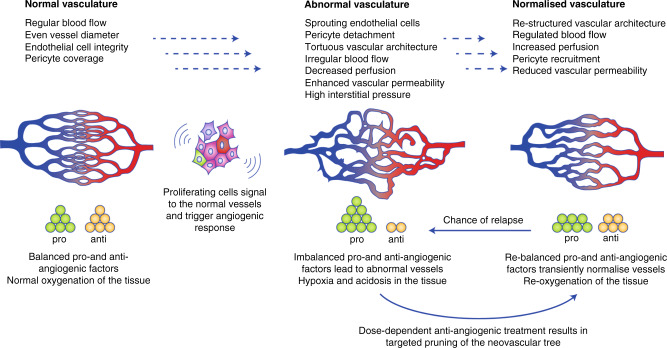
A functional vascular system is indispensable for drug delivery and fundamental for responsiveness of the tumour microenvironment to such medication. At the same time, the progression of a tumour is defined by the interactions of the cancer cells with their surrounding environment, including neovessels, and the vascular network continues to be the major route for the dissemination of tumour cells in cancer, facilitating metastasis. So how can this apparent conflict be reconciled? Vessel normalisation-in which redundant structures are pruned and the abnormal vasculature is stabilised and remodelled-is generally considered to be beneficial in the course of anti-cancer treatments. A causality between normalised vasculature and improved response to medication and treatment is observed. For this reason, it is important to discern the consequence of vessel normalisation on the tumour microenvironment and to modulate the vasculature advantageously. This article will highlight the challenges of controlled neovascular remodelling and outline how vascular normalisation can shape disease management.
功能性血管系统对于药物输送至关重要,也是肿瘤微环境对这种药物治疗产生反应的基础。与此同时,肿瘤的进展是由癌细胞与其周围环境(包括新生血管)的相互作用所定义的,血管网络仍然是癌细胞在癌症中扩散的主要途径,促进了转移。那么,如何调和这种明显的矛盾呢?血管正常化——即冗余结构被修剪,异常血管得到稳定和重塑——通常被认为在抗癌治疗过程中是有益的。人们观察到,正常化的血管与对药物治疗的反应改善之间存在因果关系。因此,了解血管正常化对肿瘤微环境的影响并有利地调节血管非常重要。本文将重点介绍控制新生血管重塑的挑战,并概述血管正常化如何影响疾病管理。