Mouga Susana, Castelhano João, Café Cátia, Sousa Daniela, Duque Frederico, Oliveira Guiomar, Castelo-Branco Miguel
CIBIT - Coimbra Institute for Biomedical Imaging and Translational Research, University of Coimbra, Coimbra, Portugal.
ICNAS - Institute of Nuclear Sciences Applied to Health, University of Coimbra, Coimbra, Portugal.
Front Psychiatry. 2021 Mar 22;12:640599. doi: 10.3389/fpsyt.2021.640599. eCollection 2021.
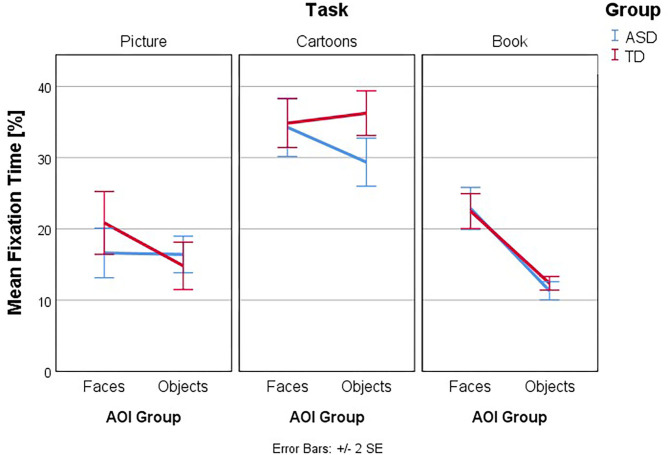
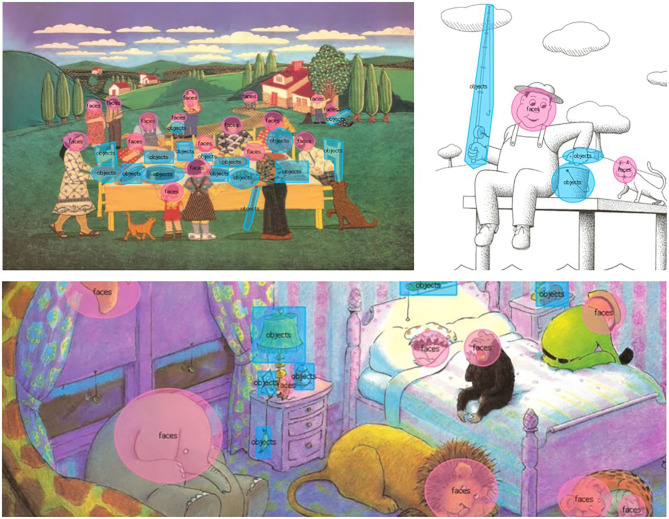
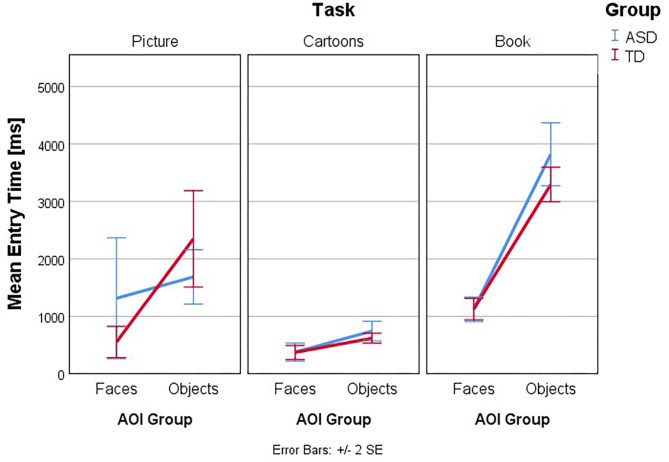
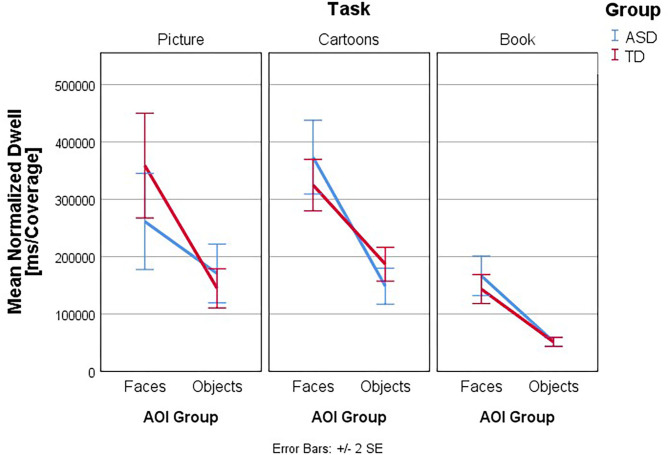
Social attention deficits represent a central impairment of patients suffering from autism spectrum disorder (ASD), but the nature of such deficits remains controversial. We compared visual attention regarding social (faces) vs. non-social stimuli (objects), in an ecological diagnostic context, in 46 children and adolescents divided in two groups: ASD ( = 23) and typical neurodevelopment (TD) ( = 23), matched for chronological age and intellectual performance. Eye-tracking measures of visual scanning, while exploring and describing scenes from three different tasks from the Autism Diagnostic Observation Schedule (ADOS), were analyzed: "Description of a Picture," "Cartoons," and "Telling a Story from a Book." Our analyses revealed a three-way interaction between Group, Task, and Social vs. Object Stimuli. We found a striking main effect of group and a task dependence of attentional allocation: while the TD attended first and longer to faces, ASD participants became similar to TD when they were asked to look at pictures while telling a story. Our results suggest that social attention allocation is task dependent, raising the question whether spontaneous attention deficits can be rescued by guiding goal-directed actions.
社交注意力缺陷是自闭症谱系障碍(ASD)患者的核心损伤,但此类缺陷的本质仍存在争议。我们在生态诊断环境中,比较了46名儿童和青少年在面对社交刺激(面部)与非社交刺激(物体)时的视觉注意力。这些儿童和青少年被分为两组:ASD组(n = 23)和典型神经发育(TD)组(n = 23),两组在实际年龄和智力表现上相匹配。在使用自闭症诊断观察量表(ADOS)中的三个不同任务探索和描述场景时,对视觉扫描的眼动追踪测量进行了分析:“图片描述”“卡通”和“绘本讲故事”。我们的分析揭示了组、任务以及社交与物体刺激之间的三向交互作用。我们发现了显著的组间主效应以及注意力分配的任务依赖性:虽然TD组首先且更长时间地注视面部,但当要求ASD参与者在讲故事时看图片时,他们的表现变得与TD组相似。我们的结果表明社交注意力分配依赖于任务,这就提出了一个问题,即自发注意力缺陷是否可以通过引导目标导向行为来挽救。