Liu Guangjie, Yang Xingyu, Xue Tao, Chen Shujun, Wu Xin, Yan Zeya, Wang Zilan, Wu Da, Chen Zhouqing, Wang Zhong
Department of Neurosurgery & Brain and Nerve Research Laboratory, The First Affiliated Hospital of Soochow University, Suzhou, China.
Department of Neurology, The First Affiliated Hospital of Soochow University, Suzhou, China.
Front Neurol. 2021 Mar 22;12:633781. doi: 10.3389/fneur.2021.633781. eCollection 2021.
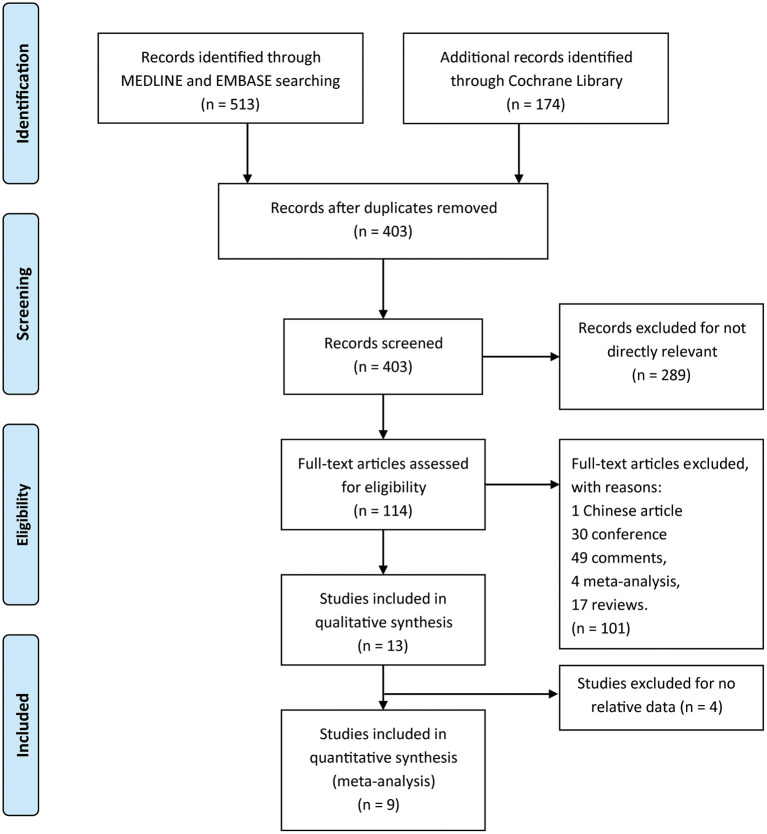
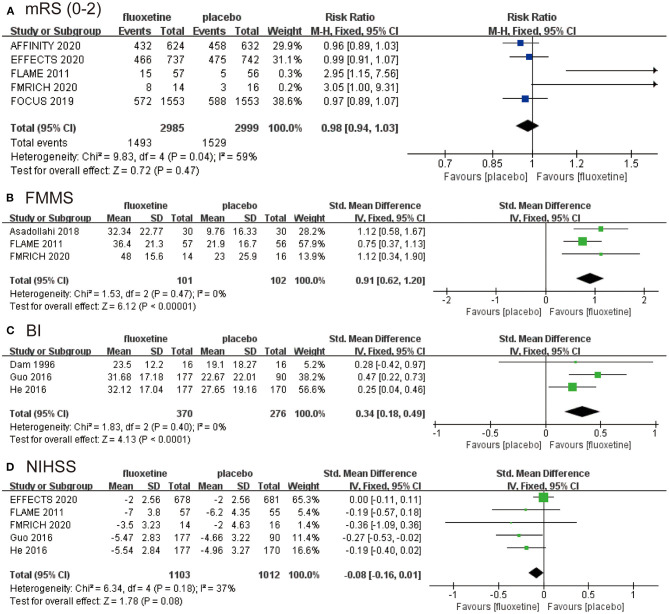
Fluoxetine is a drug commonly used to treat mental disorders, such as depression and obsessive-compulsive disorder, and some studies have shown that fluoxetine can improve motor and function recovery after stroke. Therefore, we performed a meta-analysis to investigate the efficacy and safety of fluoxetine in the treatment of post-stroke neurological recovery. PubMed, Embase, and Cochrane Library were searched for randomized controlled trials (RCTs) that were performed to assess the efficacy and safety of fluoxetine for functional and motor recovery in subacute stroke patients up to October 2020. Review Manager 5.3 software was used to assess the data. The risk ratio (RR) and standardized mean difference (SMD) were analyzed and calculated with a fixed effects model. We pooled 6,788 patients from nine RCTs. The primary endpoint was modified Rankin Scale (mRS). Fluoxetine did not change the proportion of mRS ≤ 2 ( = 0.47). The secondary endpoints were Fugl-Meyer Motor Scale (FMMS), Barthel Index (BI), and National Institutes of Health Stroke Scale (NIHSS). Fluoxetine improved the FMMS ( < 0.00001) and BI( < 0.0001) and showed a tendency of improving NIHSS ( = 0.08). In addition, we found that fluoxetine reduced the rate of new-onset depression ( < 0.0001) and new antidepressants ( < 0.0001). In post-stroke treatment, fluoxetine did not improve participants' mRS and NIHSS but improved FMMS and BI. This difference could result from heterogeneities between the trials: different treatment duration, clinical scales sensitivity, patient age, delay of inclusion, and severity of the deficit.
氟西汀是一种常用于治疗精神障碍(如抑郁症和强迫症)的药物,一些研究表明,氟西汀可以改善中风后的运动和功能恢复。因此,我们进行了一项荟萃分析,以研究氟西汀在治疗中风后神经功能恢复方面的疗效和安全性。检索了PubMed、Embase和Cochrane图书馆,查找截至2020年10月进行的评估氟西汀对亚急性中风患者功能和运动恢复疗效及安全性的随机对照试验(RCT)。使用Review Manager 5.3软件评估数据。采用固定效应模型分析和计算风险比(RR)和标准化均数差(SMD)。我们汇总了来自9项RCT的6788例患者。主要终点是改良Rankin量表(mRS)。氟西汀并未改变mRS≤2的比例(RR = 0.47)。次要终点是Fugl-Meyer运动量表(FMMS)、Barthel指数(BI)和美国国立卫生研究院卒中量表(NIHSS)。氟西汀改善了FMMS(P < 0.00001)和BI(P < 0.0001),并显示出改善NIHSS的趋势(P = 0.08)。此外,我们发现氟西汀降低了新发抑郁症的发生率(P < 0.0001)和新使用抗抑郁药的比例(P < 0.0001)。在中风后治疗中,氟西汀未改善参与者的mRS和NIHSS,但改善了FMMS和BI。这种差异可能是由于试验之间的异质性导致的:不同的治疗持续时间、临床量表敏感性、患者年龄、纳入延迟和缺陷严重程度。