Auer Andrea, Ding Xing, Bandarenka Aliaksandr S, Kunze-Liebhäuser Julia
Institute of Physical Chemistry, University Innsbruck, Innrain 52c, Innsbruck, 6020, Austria.
Physics of Energy Conversion and Storage (ECS), Physics Department, Technical University of Munich, James-Franck-Straße 1, 85748 Garching, Germany.
J Phys Chem C Nanomater Interfaces. 2021 Mar 11;125(9):5020-5028. doi: 10.1021/acs.jpcc.0c09289. Epub 2021 Mar 1.
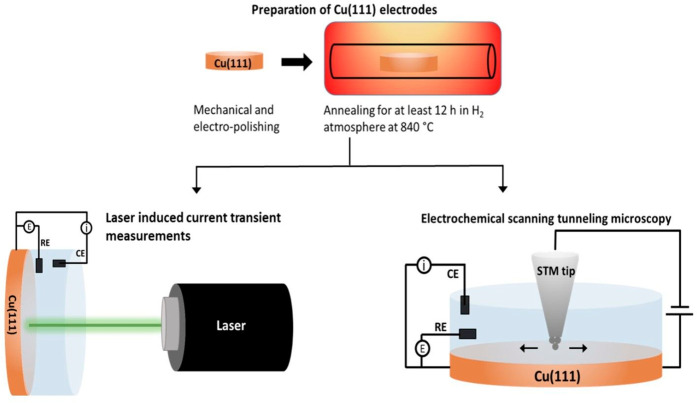
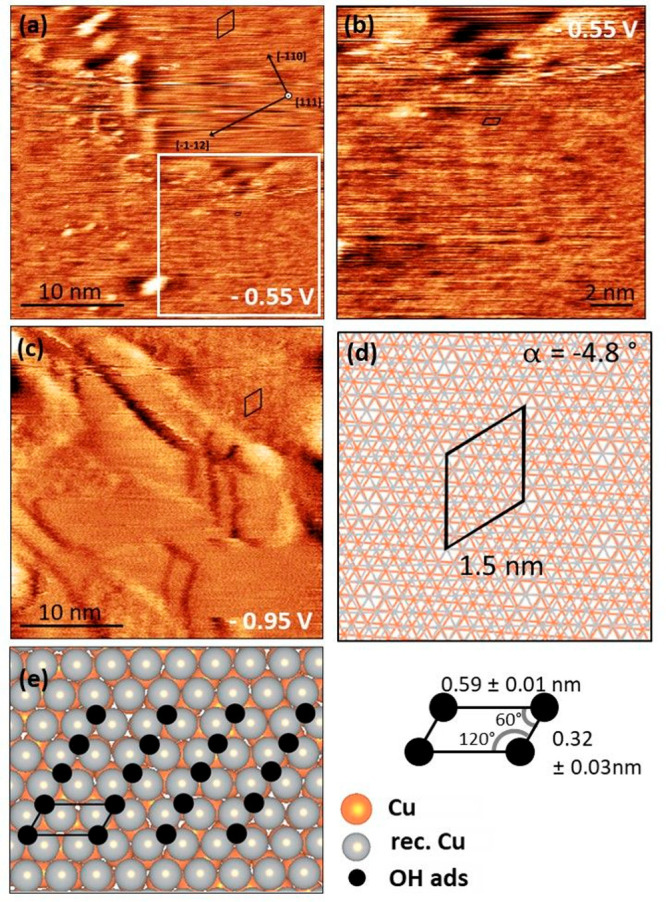
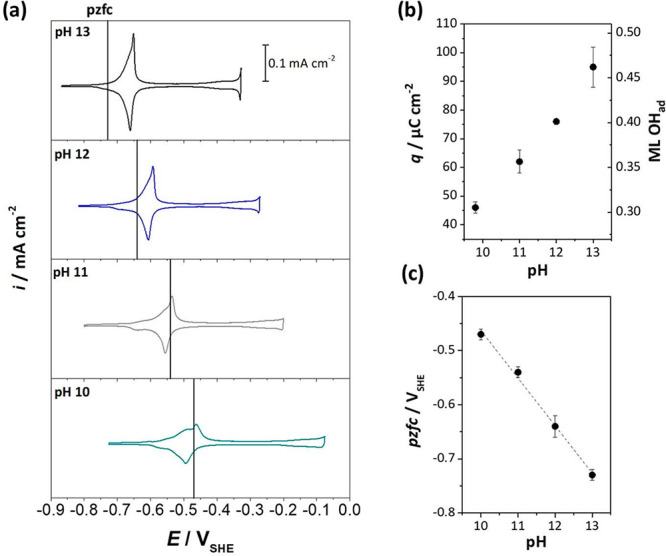
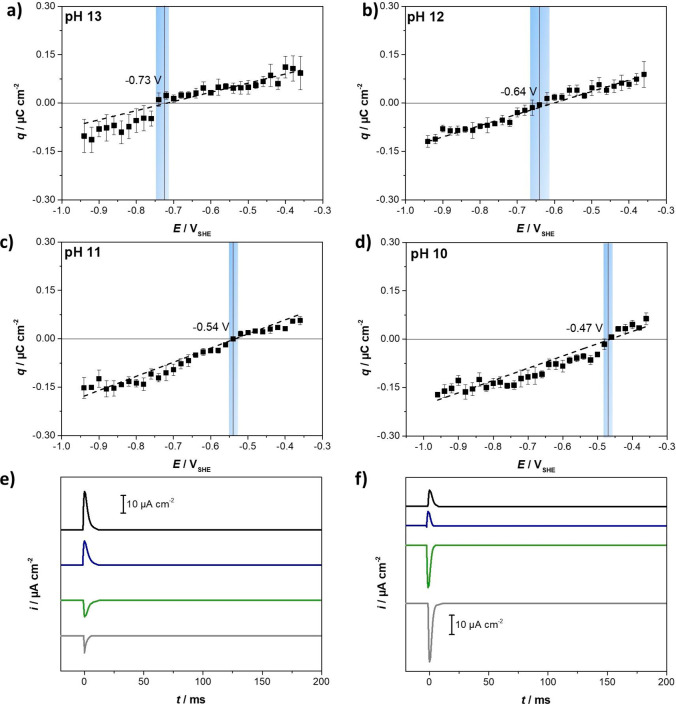
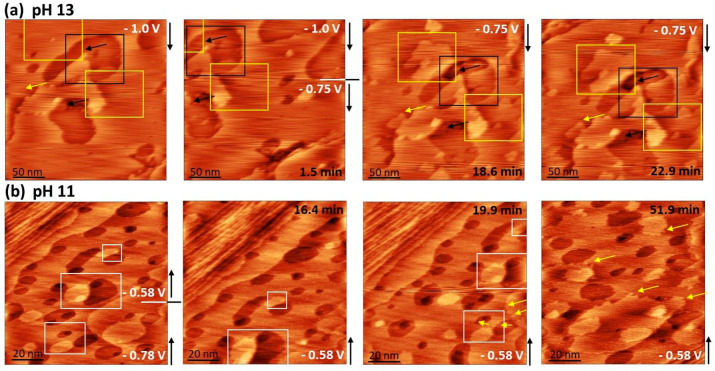
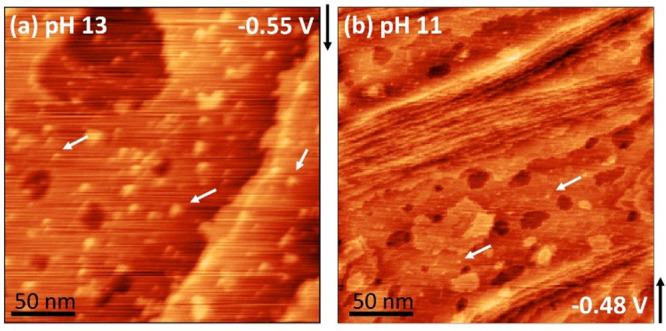
Copper (Cu) is a unique electrocatalyst, which is able to efficiently oxidize CO at very low overpotentials and reduce CO to valuable fuels with reasonable Faradaic efficiencies. Yet, knowledge of its electrochemical properties at the solid/liquid interface is still scarce. Here, we present the first two-stranded correlation of the potential of zero free charge (pzfc) of Cu(111) in alkaline electrolyte at different pH values through application of nanosecond laser pulses and the corresponding interfacial structure changes by electrochemical scanning tunneling microscopy imaging. The pzfc of Cu(111) at pH 13 is identified at -0.73 V in the apparent double layer region, prior to the onset of hydroxide adsorption. It shifts by (88 ± 4) mV to more positive potentials per decreasing pH unit. At the pzfc, Cu(111) shows structural dynamics at both pH 13 and pH 11, which can be understood as the onset of surface restructuring. At higher potentials, full reconstruction and electric field dependent OH adsorption occurs, which causes a remarkable decrease in the atomic density of the first Cu layer. The expansion of the Cu-Cu distance to 0.3 nm generates a hexagonal Moiré pattern, on which the adsorbed OH forms a commensurate (1 × 2) adlayer structure with a steady state coverage of 0.5 monolayers at pH 13. Our experimental findings shed light on the true charge distribution and its interrelation with the atomic structure of the electrochemical interface of Cu.
铜(Cu)是一种独特的电催化剂,它能够在非常低的过电位下有效地氧化一氧化碳,并以合理的法拉第效率将一氧化碳还原为有价值的燃料。然而,关于其在固/液界面的电化学性质的了解仍然很少。在这里,我们通过应用纳秒激光脉冲以及电化学扫描隧道显微镜成像研究了不同pH值碱性电解质中Cu(111)的零自由电荷电位(pzfc)的首个双链相关性以及相应的界面结构变化。在pH值为13时,Cu(111)的pzfc在表观双层区域的-0.73 V处被确定,此时氢氧化物吸附尚未开始。随着pH值每降低一个单位,它向更正的电位移动(88±4) mV。在pzfc时,Cu(111)在pH值为13和pH值为11时均表现出结构动力学,这可以理解为表面重构的开始。在更高的电位下,会发生完全重构和电场依赖的OH吸附,这会导致第一铜层的原子密度显著降低。Cu-Cu距离扩展到0.3 nm会产生六边形莫尔条纹图案,在该图案上吸附的OH在pH值为13时形成了覆盖率为0.5单层的相称(1×2)吸附层结构。我们的实验结果揭示了铜电化学界面的真实电荷分布及其与原子结构的相互关系。