Department of Internal Medicine, Azienda Ospedaliero-Universitaria, Ospedale Civile di Baggiovara, 1135 Via Giardini, 41126, Modena, Italy.
Departamento de Gastroenterología, Escuela de Medicina, Pontificia Universidad Católica de Chile, Santiago, Chile.
Adv Ther. 2021 May;38(5):2130-2158. doi: 10.1007/s12325-021-01690-1. Epub 2021 Apr 7.
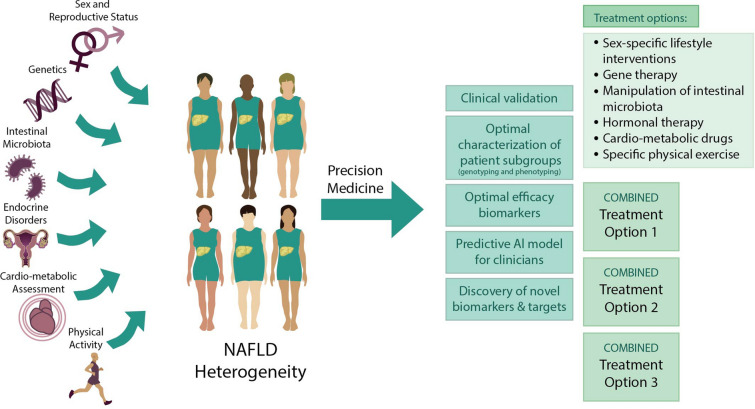
Precision medicine defines the attempt to identify the most effective approaches for specific subsets of patients based on their genetic background, clinical features, and environmental factors. Nonalcoholic fatty liver disease (NAFLD) encompasses the alcohol-like spectrum of liver disorders (steatosis, steatohepatitis with/without fibrosis, and cirrhosis and hepatocellular carcinoma) in the nonalcoholic patient. Recently, disease renaming to MAFLD [metabolic (dysfunction)-associated fatty liver disease] and positive criteria for diagnosis have been proposed. This review article is specifically devoted to envisaging some clues that may be useful to implementing a precision medicine-oriented approach in research and clinical practice. To this end, we focus on how sex and reproductive status, genetics, intestinal microbiota diversity, endocrine and metabolic status, as well as physical activity may interact in determining NAFLD/MAFLD heterogeneity. All these factors should be considered in the individual patient with the aim of implementing an individualized therapeutic plan. The impact of considering NAFLD heterogeneity on the development of targeted therapies for NAFLD subgroups is also extensively discussed.
精准医学定义了一种尝试,即在基于患者遗传背景、临床特征和环境因素的情况下,为特定的亚组患者确定最有效的治疗方法。非酒精性脂肪性肝病 (NAFLD) 涵盖了非酒精性患者中类似于酒精的一系列肝脏疾病(脂肪变性、脂肪性肝炎伴/不伴纤维化、肝硬化和肝细胞癌)。最近,提出了对疾病进行重新命名为 MAFLD(代谢相关脂肪性肝病)和阳性诊断标准。这篇综述文章专门致力于设想一些可能有助于在研究和临床实践中实施精准医学方法的线索。为此,我们重点关注性别和生殖状态、遗传、肠道微生物多样性、内分泌和代谢状态以及体力活动如何相互作用,以确定 NAFLD/MAFLD 的异质性。所有这些因素都应在个体患者中考虑,目的是实施个体化的治疗计划。还广泛讨论了考虑 NAFLD 异质性对 NAFLD 亚组靶向治疗发展的影响。