Institute of Clinical Medicine, University of Turku, Turku, Finland.
Department of Psychology, Åbo Akademi University, Turku, Finland.
BMC Public Health. 2021 Apr 8;21(1):684. doi: 10.1186/s12889-021-10643-w.
We investigated if people's response to the official recommendations during the COVID-19 pandemic is associated with conspiracy beliefs related to COVID-19, a distrust in the sources providing information on COVID-19, and an endorsement of complementary and alternative medicine (CAM).
The sample consisted of 1325 Finnish adults who filled out an online survey marketed on Facebook. Structural regression analysis was used to investigate whether: 1) conspiracy beliefs, a distrust in information sources, and endorsement of CAM predict people's response to the non-pharmaceutical interventions (NPIs) implemented by the government during the COVID-19 pandemic, and 2) conspiracy beliefs, a distrust in information sources, and endorsement of CAM are related to people's willingness to take a COVID-19 vaccine.
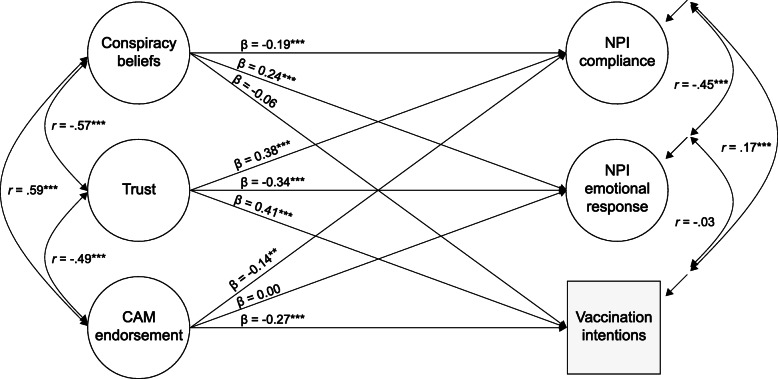
Individuals with more conspiracy beliefs and a lower trust in information sources were less likely to have a positive response to the NPIs. Individuals with less trust in information sources and more endorsement of CAM were more unwilling to take a COVID-19 vaccine. Distrust in information sources was the strongest and most consistent predictor in all models. Our analyses also revealed that some of the people who respond negatively to the NPIs also have a lower likelihood to take the vaccine. This association was partly related to a lower trust in information sources.
Distrusting the establishment to provide accurate information, believing in conspiracy theories, and endorsing treatments and substances that are not part of conventional medicine, are all associated with a more negative response to the official guidelines during COVID-19. How people respond to the guidelines, however, is more strongly and consistently related to the degree of trust they feel in the information sources, than to their tendency to hold conspiracy beliefs or endorse CAM. These findings highlight the need for governments and health authorities to create communication strategies that build public trust.
我们研究了人们对 COVID-19 大流行期间的官方建议的反应是否与与 COVID-19 相关的阴谋论信仰、对提供 COVID-19 信息的来源的不信任以及对补充和替代医学(CAM)的认可有关。
该样本由 1325 名芬兰成年人组成,他们在 Facebook 上填写了在线调查。结构回归分析用于研究以下问题:1)阴谋论信仰、对信息来源的不信任和对 CAM 的认可是否预测人们对 COVID-19 大流行期间政府实施的非药物干预措施(NPIs)的反应,以及 2)阴谋论信仰、对信息来源的不信任和对 CAM 的认可是否与人们接种 COVID-19 疫苗的意愿有关。
具有更多阴谋论信仰和对信息来源的信任度较低的个体对 NPIs 的反应不太可能是积极的。对信息来源的信任度较低且对 CAM 的认可程度较高的个体不太愿意接种 COVID-19 疫苗。对信息来源的不信任是所有模型中最强和最一致的预测因素。我们的分析还表明,一些对 NPIs 反应消极的人接种疫苗的可能性也较低。这种关联部分与对信息来源的信任度较低有关。
不信任当局提供准确信息、相信阴谋论以及认可非常规医学的治疗方法和物质,所有这些都与 COVID-19 期间对官方指南的反应更消极有关。然而,人们对指南的反应与他们对信息来源的信任程度更密切相关,而不是与他们持有阴谋论信仰或认可 CAM 的倾向更密切相关。这些发现强调了政府和卫生当局制定建立公众信任的沟通策略的必要性。