Pavela Banai Irena, Banai Benjamin, Mikloušić Igor
Department of Psychology, University of Zadar, Obala k. Petra Krešimira IV, 2, 23 000 Zadar, Croatia.
Banai Analitika, Zadar, Croatia.
Curr Psychol. 2022;41(10):7448-7458. doi: 10.1007/s12144-021-01898-y. Epub 2021 May 26.
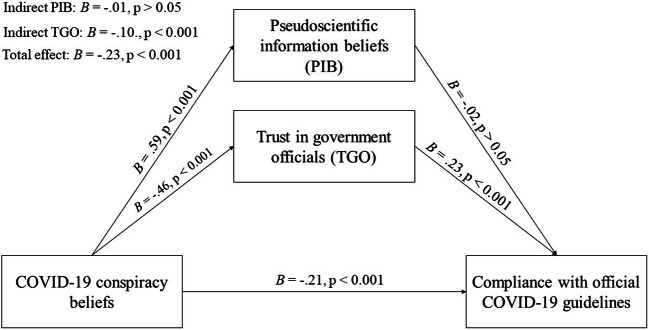
The COVID -19 pandemic represents a global health crisis, so adherence to government guidelines and public health advice is critical in reducing transmission rates. Despite this, it has been reported that a minority of people do not comply with the governmental guidelines. When considering the reasons why some people do not comply with preventive measures, previous studies have shown that beliefs in COVID-19 conspiracy theories negatively predict responsible pandemic-related behaviour. This, in turn, could seriously undermine success in combating the pandemic. Our aim was, therefore, to further investigate the relationship between conspiracy beliefs and adherence to official COVID-19 medical guidelines by including mediating roles of beliefs in pseudoscientific information and trust in government officials. A total of 1882 adults from Croatia provided sociodemographic information and completed several scales related to COVID-19 conspiracy beliefs, beliefs in pseudoscientific information, trust in government officials, and adherence to official COVID-19 guidelines. A multiple mediation analysis revealed a direct negative effect of COVID-19 conspiracy beliefs on compliance with the preventive measures. In addition, conspiracy beliefs were indirectly related to compliance via trust in government officials. The present study builds upon emerging research showing that conspiracy beliefs may have significant social consequences and pose a potential risk to public health. Practical implications of these findings are discussed further.
The online version contains supplementary material available at 10.1007/s12144-021-01898-y.
新冠疫情是一场全球健康危机,因此遵守政府指导方针和公共卫生建议对于降低传播率至关重要。尽管如此,据报道仍有少数人不遵守政府指导方针。在考虑一些人不遵守预防措施的原因时,先前的研究表明,对新冠阴谋论的相信会对与疫情相关的负责行为产生负面预测。反过来,这可能会严重破坏抗击疫情的成效。因此,我们的目的是通过纳入对伪科学信息的相信和对政府官员的信任的中介作用,进一步研究阴谋论信念与遵守官方新冠医疗指导方针之间的关系。来自克罗地亚的1882名成年人提供了社会人口统计学信息,并完成了与新冠阴谋论信念、对伪科学信息的相信、对政府官员的信任以及遵守官方新冠指导方针相关的几个量表。多重中介分析显示,新冠阴谋论信念对遵守预防措施有直接负面影响。此外,阴谋论信念通过对政府官员的信任与遵守情况间接相关。本研究建立在新出现的研究基础之上,该研究表明阴谋论信念可能会产生重大社会后果,并对公众健康构成潜在风险。这些发现的实际意义将进一步讨论。
在线版本包含可在10.1007/s12144-021-01898-y获取的补充材料。