
角膜共焦显微镜可区分炎症性神经病变与糖尿病性神经病变。
Corneal confocal microscopy differentiates inflammatory from diabetic neuropathy.
作者信息
Fleischer Michael, Lee Inn, Erdlenbruch Friedrich, Hinrichs Lena, Petropoulos Ioannis N, Malik Rayaz A, Hartung Hans-Peter, Kieseier Bernd C, Kleinschnitz Christoph, Stettner Mark
机构信息
Department of Neurology and Center for Translational and Behavioral Neurosciences (C-TNBS), University Hospital Essen, University Duisburg-Essen, Essen, Germany.
Department of Neurology, Medical Faculty, Heinrich-Heine-University, Düsseldorf, Germany.
出版信息
J Neuroinflammation. 2021 Apr 8;18(1):89. doi: 10.1186/s12974-021-02130-1.
BACKGROUND
Immune-mediated neuropathies, such as chronic inflammatory demyelinating polyneuropathy (CIDP) are treatable neuropathies. Among individuals with diabetic neuropathy, it remains a challenge to identify those individuals who develop CIDP. Corneal confocal microscopy (CCM) has been shown to detect corneal nerve fiber loss and cellular infiltrates in the sub-basal layer of the cornea. The objective of the study was to determine whether CCM can distinguish diabetic neuropathy from CIDP and whether CCM can detect CIDP in persons with coexisting diabetes.
METHODS
In this multicenter, case-control study, participants with CIDP (n = 55) with (n = 10) and without (n = 45) diabetes; participants with diabetes (n = 58) with (n = 28) and without (n = 30) diabetic neuropathy, and healthy controls (n = 58) underwent CCM. Corneal nerve fiber density (CNFD), corneal nerve fiber length (CNFL), corneal nerve branch density (CNBD), and dendritic and non-dendritic cell density, with or without nerve fiber contact were quantified.
RESULTS
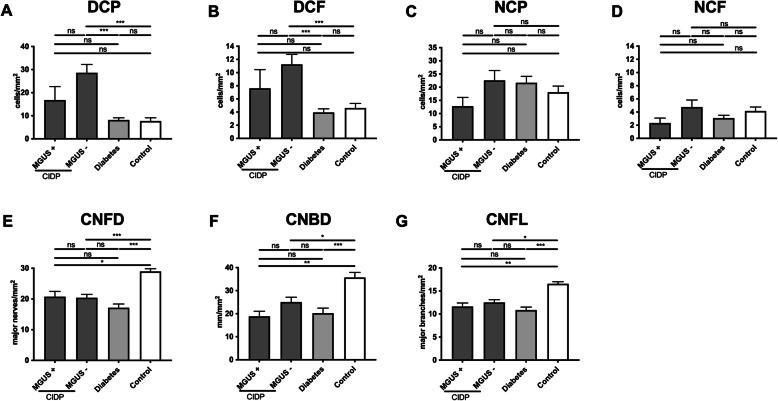
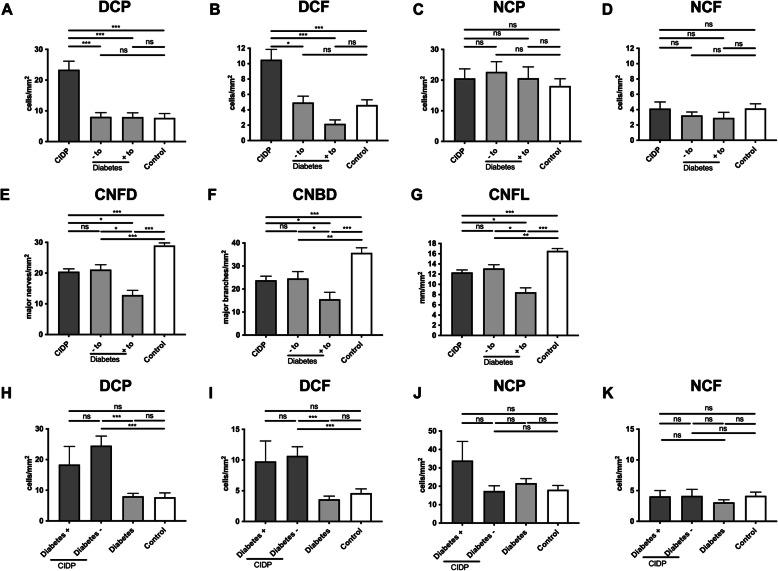
Dendritic cell density in proximity to corneal nerve fibers was significantly higher in participants with CIDP with and without diabetes compared to participants with diabetic neuropathy and controls. CNFD, CNFL, and CNBD were equally reduced in participants with CIDP, diabetic neuropathy, and CIDP with diabetes.
CONCLUSIONS
An increase in dendritic cell density identifies persons with CIDP. CCM may, therefore, be useful to differentiate inflammatory from non-inflammatory diabetic neuropathy.
背景
免疫介导的神经病变,如慢性炎症性脱髓鞘性多发性神经病变(CIDP)是可治疗的神经病变。在糖尿病性神经病变患者中,识别出那些发展为CIDP的个体仍然是一项挑战。角膜共焦显微镜检查(CCM)已被证明可检测角膜神经纤维的丧失以及角膜基底膜下层的细胞浸润。本研究的目的是确定CCM能否区分糖尿病性神经病变和CIDP,以及CCM能否在合并糖尿病的患者中检测出CIDP。
方法
在这项多中心病例对照研究中,患有CIDP的参与者(n = 55),其中有糖尿病的(n = 10)和无糖尿病的(n = 45);患有糖尿病的参与者(n = 58),其中有糖尿病性神经病变的(n = 28)和无糖尿病性神经病变的(n = 30),以及健康对照者(n = 58)均接受了CCM检查。对角膜神经纤维密度(CNFD)、角膜神经纤维长度(CNFL)、角膜神经分支密度(CNBD)以及有或无神经纤维接触的树突状和非树突状细胞密度进行了量化。
结果
与患有糖尿病性神经病变的参与者和对照者相比,患有或未患有糖尿病的CIDP参与者中靠近角膜神经纤维的树突状细胞密度显著更高。CIDP参与者、糖尿病性神经病变参与者以及合并糖尿病的CIDP参与者的CNFD、CNFL和CNBD均同样降低。
结论
树突状细胞密度增加可识别出患有CIDP的个体。因此,CCM可能有助于区分炎症性和非炎症性糖尿病性神经病变。

 Zotero 插件