• 文献检索
  • 文档翻译
  • 深度研究
  • 学术资讯
  • Suppr Zotero 插件Zotero 插件
  • 邀请有礼
  • 套餐&价格
  • 历史记录
应用&插件
Suppr Zotero 插件Zotero 插件浏览器插件Mac 客户端Windows 客户端微信小程序
定价
高级版会员购买积分包购买API积分包
服务
文献检索文档翻译深度研究API 文档MCP 服务
关于我们
关于 Suppr公司介绍联系我们用户协议隐私条款
关注我们

Suppr 超能文献

核心技术专利:CN118964589B侵权必究
粤ICP备2023148730 号-1Suppr @ 2026

文献检索

告别复杂PubMed语法,用中文像聊天一样搜索,搜遍4000万医学文献。AI智能推荐,让科研检索更轻松。

立即免费搜索

文件翻译

保留排版,准确专业,支持PDF/Word/PPT等文件格式,支持 12+语言互译。

免费翻译文档

深度研究

AI帮你快速写综述,25分钟生成高质量综述,智能提取关键信息,辅助科研写作。

立即免费体验

压力之下:与锥蝽亚科微生境适应相关的表型趋异和趋同。

Under pressure: phenotypic divergence and convergence associated with microhabitat adaptations in Triatominae.

机构信息

Núcleo de Medicina Tropical, Faculdade de Medicina, Universidade de Brasília, Brasília, Brazil.

Faculty of Infectious and Tropical Diseases, London School of Hygiene and Tropical Medicine, London, UK.

出版信息

Parasit Vectors. 2021 Apr 8;14(1):195. doi: 10.1186/s13071-021-04647-z.

DOI:10.1186/s13071-021-04647-z
PMID:33832518
原文链接:https://pmc.ncbi.nlm.nih.gov/articles/PMC8034103/
Abstract

BACKGROUND

Triatomine bugs, the vectors of Chagas disease, associate with vertebrate hosts in highly diverse ecotopes. It has been proposed that occupation of new microhabitats may trigger selection for distinct phenotypic variants in these blood-sucking bugs. Although understanding phenotypic variation is key to the study of adaptive evolution and central to phenotype-based taxonomy, the drivers of phenotypic change and diversity in triatomines remain poorly understood.

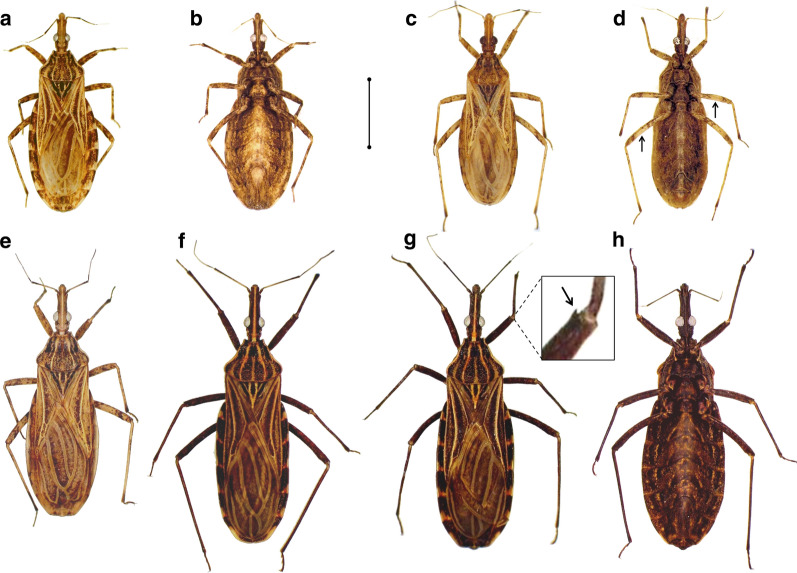
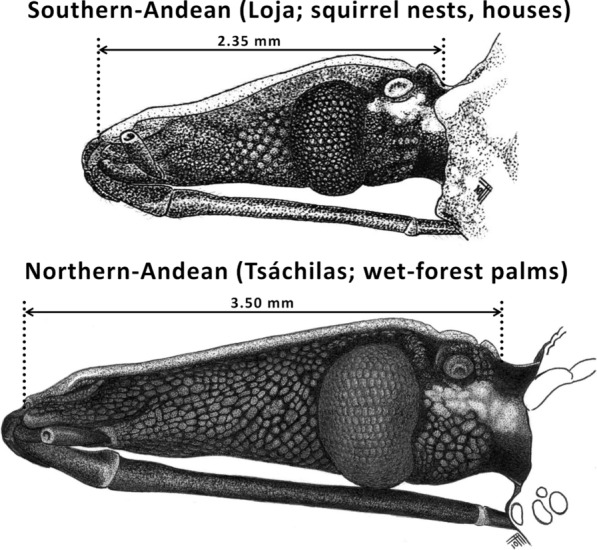
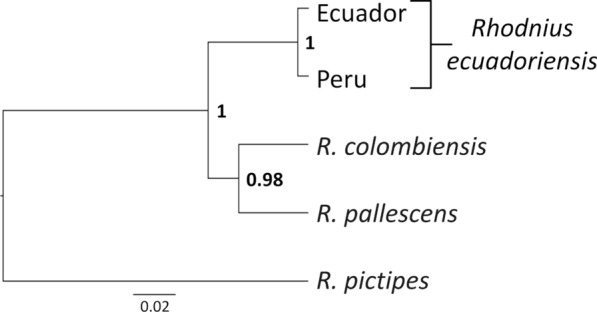
METHODS/RESULTS: We combined a detailed phenotypic appraisal (including morphology and morphometrics) with mitochondrial cytb and nuclear ITS2 DNA sequence analyses to study Rhodnius ecuadoriensis populations from across the species' range. We found three major, naked-eye phenotypic variants. Southern-Andean bugs primarily from vertebrate-nest microhabitats (Ecuador/Peru) are typical, light-colored, small bugs with short heads/wings. Northern-Andean bugs from wet-forest palms (Ecuador) are dark, large bugs with long heads/wings. Finally, northern-lowland bugs primarily from dry-forest palms (Ecuador) are light-colored and medium-sized. Wing and (size-free) head shapes are similar across Ecuadorian populations, regardless of habitat or phenotype, but distinct in Peruvian bugs. Bayesian phylogenetic and multispecies-coalescent DNA sequence analyses strongly suggest that Ecuadorian and Peruvian populations are two independently evolving lineages, with little within-lineage phylogeographic structuring or differentiation.

CONCLUSIONS

We report sharp naked-eye phenotypic divergence of genetically similar Ecuadorian R. ecuadoriensis (nest-dwelling southern-Andean vs palm-dwelling northern bugs; and palm-dwelling Andean vs lowland), and sharp naked-eye phenotypic similarity of typical, yet genetically distinct, southern-Andean bugs primarily from vertebrate-nest (but not palm) microhabitats. This remarkable phenotypic diversity within a single nominal species likely stems from microhabitat adaptations possibly involving predator-driven selection (yielding substrate-matching camouflage coloration) and a shift from palm-crown to vertebrate-nest microhabitats (yielding smaller bodies and shorter and stouter heads). These findings shed new light on the origins of phenotypic diversity in triatomines, warn against excess reliance on phenotype-based triatomine-bug taxonomy, and confirm the Triatominae as an informative model system for the study of phenotypic change under ecological pressure .

摘要

背景

克氏锥虫的传播媒介,即三锥虫,在高度多样化的生态位中与脊椎动物宿主相关联。有人提出,占据新的小生境可能会导致这些吸血昆虫产生不同的表型变异。尽管理解表型变异是研究适应性进化的关键,也是基于表型的分类学的核心,但三锥虫的表型变化和多样性的驱动因素仍知之甚少。

方法/结果:我们结合了详细的表型评估(包括形态和形态测量学)以及线粒体 cytb 和核 ITS2 DNA 序列分析,研究了分布在该物种范围内的厄瓜多尔罗氏锥虫种群。我们发现了三个主要的、肉眼可见的表型变体。主要来自脊椎动物巢穴小生境(厄瓜多尔/秘鲁)的南部安第斯山脉的虫子是典型的、浅色的、小个头/短翅膀的虫子。来自潮湿森林棕榈树(厄瓜多尔)的北部安第斯山脉的虫子是深色的、大个头/长翅膀的虫子。最后,主要来自干燥森林棕榈树(厄瓜多尔)的北部低地虫子是浅色的中型虫子。无论栖息地或表型如何,厄瓜多尔种群的翅膀和(大小无关的)头部形状都相似,但秘鲁种群的翅膀和(大小无关的)头部形状不同。贝叶斯系统发育和多物种合并 DNA 序列分析强烈表明,厄瓜多尔和秘鲁的种群是两个独立进化的谱系,谱系内的地理结构或分化很小。

结论

我们报告了厄瓜多尔罗氏锥虫(巢穴栖息的南部安第斯山脉与棕榈栖息的北部虫子;以及棕榈栖息的安第斯山脉与低地)肉眼可见的显著表型分化,以及主要来自脊椎动物巢穴(而非棕榈)小生境的典型但遗传上不同的南部安第斯山脉虫子的肉眼可见的相似表型。在一个单一的命名物种内出现如此显著的表型多样性,可能源于微生境适应,可能涉及捕食者驱动的选择(产生与基质相匹配的伪装颜色),以及从棕榈树冠到脊椎动物巢穴小生境的转变(产生更小的身体和更短、更结实的头部)。这些发现为三锥虫表型多样性的起源提供了新的线索,提醒人们不要过度依赖基于表型的三锥虫分类学,并证实了三锥虫科是研究生态压力下表型变化的一个有意义的模型系统。

https://cdn.ncbi.nlm.nih.gov/pmc/blobs/438a/8034103/511c2928d737/13071_2021_4647_Fig10_HTML.jpg
https://cdn.ncbi.nlm.nih.gov/pmc/blobs/438a/8034103/8817d7288053/13071_2021_4647_Fig1_HTML.jpg
https://cdn.ncbi.nlm.nih.gov/pmc/blobs/438a/8034103/49401f4f770d/13071_2021_4647_Fig2_HTML.jpg
https://cdn.ncbi.nlm.nih.gov/pmc/blobs/438a/8034103/1ad0d570366f/13071_2021_4647_Fig3_HTML.jpg
https://cdn.ncbi.nlm.nih.gov/pmc/blobs/438a/8034103/dfe50d73b724/13071_2021_4647_Fig4_HTML.jpg
https://cdn.ncbi.nlm.nih.gov/pmc/blobs/438a/8034103/f5ef2c425811/13071_2021_4647_Fig5_HTML.jpg
https://cdn.ncbi.nlm.nih.gov/pmc/blobs/438a/8034103/ca0189562bc9/13071_2021_4647_Fig6_HTML.jpg
https://cdn.ncbi.nlm.nih.gov/pmc/blobs/438a/8034103/842fa266e6fc/13071_2021_4647_Fig7_HTML.jpg
https://cdn.ncbi.nlm.nih.gov/pmc/blobs/438a/8034103/149c568950a3/13071_2021_4647_Fig8_HTML.jpg
https://cdn.ncbi.nlm.nih.gov/pmc/blobs/438a/8034103/5c928c11ff3c/13071_2021_4647_Fig9_HTML.jpg
https://cdn.ncbi.nlm.nih.gov/pmc/blobs/438a/8034103/511c2928d737/13071_2021_4647_Fig10_HTML.jpg
https://cdn.ncbi.nlm.nih.gov/pmc/blobs/438a/8034103/8817d7288053/13071_2021_4647_Fig1_HTML.jpg
https://cdn.ncbi.nlm.nih.gov/pmc/blobs/438a/8034103/49401f4f770d/13071_2021_4647_Fig2_HTML.jpg
https://cdn.ncbi.nlm.nih.gov/pmc/blobs/438a/8034103/1ad0d570366f/13071_2021_4647_Fig3_HTML.jpg
https://cdn.ncbi.nlm.nih.gov/pmc/blobs/438a/8034103/dfe50d73b724/13071_2021_4647_Fig4_HTML.jpg
https://cdn.ncbi.nlm.nih.gov/pmc/blobs/438a/8034103/f5ef2c425811/13071_2021_4647_Fig5_HTML.jpg
https://cdn.ncbi.nlm.nih.gov/pmc/blobs/438a/8034103/ca0189562bc9/13071_2021_4647_Fig6_HTML.jpg
https://cdn.ncbi.nlm.nih.gov/pmc/blobs/438a/8034103/842fa266e6fc/13071_2021_4647_Fig7_HTML.jpg
https://cdn.ncbi.nlm.nih.gov/pmc/blobs/438a/8034103/149c568950a3/13071_2021_4647_Fig8_HTML.jpg
https://cdn.ncbi.nlm.nih.gov/pmc/blobs/438a/8034103/5c928c11ff3c/13071_2021_4647_Fig9_HTML.jpg
https://cdn.ncbi.nlm.nih.gov/pmc/blobs/438a/8034103/511c2928d737/13071_2021_4647_Fig10_HTML.jpg

相似文献

1
Under pressure: phenotypic divergence and convergence associated with microhabitat adaptations in Triatominae.压力之下:与锥蝽亚科微生境适应相关的表型趋异和趋同。
Parasit Vectors. 2021 Apr 8;14(1):195. doi: 10.1186/s13071-021-04647-z.
2
The triatomines of northern Peru, with emphasis on the ecology and infection by trypanosomes of Rhodnius ecuadoriensis (Triatominae).秘鲁北部的锥蝽,重点研究厄瓜多尔红猎蝽(锥蝽亚科)的生态学及锥虫感染情况。
Mem Inst Oswaldo Cruz. 2002 Mar;97(2):175-83. doi: 10.1590/s0074-02762002000200005.
3
Ecological factors related to the widespread distribution of sylvatic Rhodnius ecuadoriensis populations in southern Ecuador.与厄瓜多尔南部林栖 Rhodnius ecuadoriensis 种群广泛分布有关的生态因素。
Parasit Vectors. 2012 Jan 13;5:17. doi: 10.1186/1756-3305-5-17.
4
Field ecology of sylvatic Rhodnius populations (Heteroptera, Triatominae): risk factors for palm tree infestation in western Ecuador.野生红猎蝽种群(半翅目,锥蝽亚科)的野外生态学:厄瓜多尔西部棕榈树受侵染的风险因素
Trop Med Int Health. 2005 Dec;10(12):1258-66. doi: 10.1111/j.1365-3156.2005.01511.x.
5
Influence of ecological factors on the presence of a triatomine species associated with the arboreal habitat of a host of Trypanosoma cruzi.生态因素对与克氏锥虫宿主栖息在树上有关的三锥虫物种存在的影响。
Parasit Vectors. 2018 Oct 29;11(1):567. doi: 10.1186/s13071-018-3138-4.
6
The ecotopes and evolution of triatomine bugs (triatominae) and their associated trypanosomes.锥蝽(锥蝽亚科)及其相关锥虫的生态环境与进化
Mem Inst Oswaldo Cruz. 2000 Jul-Aug;95(4):557-65. doi: 10.1590/s0074-02762000000400019.
7
Would tropical climatic variations impact the genetic variability of triatomines: Rhodnius ecuadoriensis, principal vector of Chagas disease in Ecuador?热带气候变化是否会影响恰加斯病在厄瓜多尔的主要传播媒介——埃及伊蚊的遗传变异性?
Acta Trop. 2020 Sep;209:105530. doi: 10.1016/j.actatropica.2020.105530. Epub 2020 May 19.
8
Genetic, cytogenetic and morphological trends in the evolution of the Rhodnius (Triatominae: Rhodniini) trans-Andean group.罗得尼锥蝽(锥蝽亚科:罗得尼锥蝽属)跨安第斯种群进化中的遗传、细胞遗传和形态学趋势。
PLoS One. 2014 Feb 3;9(2):e87493. doi: 10.1371/journal.pone.0087493. eCollection 2014.
9
Pioneer study of population genetics of Rhodnius ecuadoriensis (Hemiptera: Reduviidae) from the central coastand southern Andean regions of Ecuador.厄瓜多尔中部海岸和安第斯山脉南部地区的厄瓜多尔红猎蝽(半翅目:猎蝽科)种群遗传学的先驱研究。
Infect Genet Evol. 2017 Sep;53:116-127. doi: 10.1016/j.meegid.2017.05.019. Epub 2017 May 22.
10
2b-RAD genotyping for population genomic studies of Chagas disease vectors: Rhodnius ecuadoriensis in Ecuador.用于恰加斯病病媒群体基因组研究的2b-RAD基因分型:厄瓜多尔的厄瓜多尔红猎蝽
PLoS Negl Trop Dis. 2017 Jul 19;11(7):e0005710. doi: 10.1371/journal.pntd.0005710. eCollection 2017 Jul.

引用本文的文献

1
Lack of Genetic Differentiation of Five Triatomine Species Belonging to the Subcomplex (Hemiptera, Reduviidae).属于该亚复合体的五种锥蝽物种缺乏遗传分化(半翅目,猎蝽科)。
Insects. 2025 Aug 8;16(8):822. doi: 10.3390/insects16080822.
2
Where you live shapes who you are: morphological changes in urban .你居住的地方塑造了你:城市中的形态变化
Front Insect Sci. 2025 Jun 2;5:1593921. doi: 10.3389/finsc.2025.1593921. eCollection 2025.
3
The Body of Chagas Disease Vectors.恰加斯病病媒群体

本文引用的文献

1
Drivers of molecular and morphometric variation in Triatoma brasiliensis (Hemiptera: Triatominae): the resolution of geometric morphometrics for populational structuring on a microgeographical scale.Triatoma brasiliensis(半翅目:三锥科)分子和形态计量变异的驱动因素:几何形态计量学在小地理尺度上对种群结构的解析。
Parasit Vectors. 2020 Sep 7;13(1):455. doi: 10.1186/s13071-020-04340-7.
2
Would tropical climatic variations impact the genetic variability of triatomines: Rhodnius ecuadoriensis, principal vector of Chagas disease in Ecuador?热带气候变化是否会影响恰加斯病在厄瓜多尔的主要传播媒介——埃及伊蚊的遗传变异性?
Acta Trop. 2020 Sep;209:105530. doi: 10.1016/j.actatropica.2020.105530. Epub 2020 May 19.
3
Pathogens. 2025 Jan 20;14(1):98. doi: 10.3390/pathogens14010098.
4
Sometimes, the size matters: Wing geometric morphometrics as a tool to assess domiciliation by Triatoma sordida (Stäl 1859).有时,大小很重要: wing geometric morphometrics 作为评估 Triatoma sordida (Stäl 1859) 栖息地的工具。
Rev Soc Bras Med Trop. 2024 Aug 9;57:e007092024. doi: 10.1590/0037-8682-0516-2023. eCollection 2024.
5
Geometric morphometry of the complex (Hemiptera, Triatominae): patterns of intraspecific and interspecific allometry and their taxonomic implications.锥蝽复合体(半翅目,锥蝽亚科)的几何形态测量学:种内和种间异速生长模式及其分类学意义
Zookeys. 2024 May 23;1202:213-228. doi: 10.3897/zookeys.1202.108157. eCollection 2024.
6
Transmission ecology of Trypanosoma cruzi by Rhodnius prolixus (Reduviidae: Triatominae) infesting palm-tree species in the Colombian Orinoco, indicates risks to human populations.锥蝽(Reduviidae: Triatominae)传播克氏锥虫的生态,在哥伦比亚奥里诺科地区的棕榈树上滋生,对人类健康构成威胁。
PLoS Negl Trop Dis. 2024 Feb 20;18(2):e0011981. doi: 10.1371/journal.pntd.0011981. eCollection 2024 Feb.
7
Geographic Distribution of the Genus Berg, 1879 in the Neotropic with Emphasis on Vectors.1879年伯格属在新热带界的地理分布,重点关注病媒。
Trop Med Infect Dis. 2023 May 11;8(5):272. doi: 10.3390/tropicalmed8050272.
8
Ecological Niche Modelling Approaches: Challenges and Applications in Vector-Borne Diseases.生态位建模方法:在媒介传播疾病中的挑战与应用
Trop Med Infect Dis. 2023 Mar 25;8(4):187. doi: 10.3390/tropicalmed8040187.
9
Multidisciplinary approach detects speciation within the kissing bug Panstrongylus rufotuberculatus populations (Hemiptera, Heteroptera, Reduviidae).多学科方法检测出红火蚁种群(半翅目,异翅目,红蝽科)中的物种形成。
Mem Inst Oswaldo Cruz. 2022 Feb 2;116:e210259. doi: 10.1590/0074-02760210259. eCollection 2022.
10
Do the new triatomine species pose new challenges or strategies for monitoring Chagas disease? An overview from 1979-2021.新的锥蝽物种是否给查加斯病监测带来新的挑战或策略?1979 年至 2021 年的概述。
Mem Inst Oswaldo Cruz. 2021 May 31;116:e210015. doi: 10.1590/0074-02760210015. eCollection 2021.
Transcriptome-based molecular systematics: Rhodnius montenegrensis (Triatominae) and its position within the Rhodnius prolixus-Rhodnius robustus cryptic-species complex.
基于转录组的分子系统学:黑足耳蝠(三锥虫科)及其在罗得尼乌斯·普罗利克斯-罗得尼乌斯·鲁伯图斯隐种复合体中的位置。
Parasit Vectors. 2019 Jun 17;12(1):305. doi: 10.1186/s13071-019-3558-9.
4
BEAST 2.5: An advanced software platform for Bayesian evolutionary analysis.BEAST 2.5:一个用于贝叶斯进化分析的高级软件平台。
PLoS Comput Biol. 2019 Apr 8;15(4):e1006650. doi: 10.1371/journal.pcbi.1006650. eCollection 2019 Apr.
5
Marginal Likelihoods in Phylogenetics: A Review of Methods and Applications.系统发生学中的边际似然法:方法与应用综述。
Syst Biol. 2019 Sep 1;68(5):681-697. doi: 10.1093/sysbio/syz003.
6
Influence of ecological factors on the presence of a triatomine species associated with the arboreal habitat of a host of Trypanosoma cruzi.生态因素对与克氏锥虫宿主栖息在树上有关的三锥虫物种存在的影响。
Parasit Vectors. 2018 Oct 29;11(1):567. doi: 10.1186/s13071-018-3138-4.
7
Phylogeography and demographic history of the Chagas disease vector Rhodnius nasutus (Hemiptera: Reduviidae) in the Brazilian Caatinga biome.巴西卡廷加生物群区恰加斯病传播媒介 Rhodnius nasutus(半翅目:红蝽科)的系统地理学和种群历史。
PLoS Negl Trop Dis. 2018 Sep 24;12(9):e0006731. doi: 10.1371/journal.pntd.0006731. eCollection 2018 Sep.
8
Model Selection and Parameter Inference in Phylogenetics Using Nested Sampling.使用嵌套抽样进行系统发育学中的模型选择和参数推断。
Syst Biol. 2019 Mar 1;68(2):219-233. doi: 10.1093/sysbio/syy050.
9
MEGA X: Molecular Evolutionary Genetics Analysis across Computing Platforms.MEGA X:跨越计算平台的分子进化遗传学分析。
Mol Biol Evol. 2018 Jun 1;35(6):1547-1549. doi: 10.1093/molbev/msy096.
10
Posterior Summarization in Bayesian Phylogenetics Using Tracer 1.7.贝叶斯系统发生学中使用 Tracer 1.7 进行的后验总结
Syst Biol. 2018 Sep 1;67(5):901-904. doi: 10.1093/sysbio/syy032.