Hernandez-Castro Luis E, Paterno Marta, Villacís Anita G, Andersson Björn, Costales Jaime A, De Noia Michele, Ocaña-Mayorga Sofía, Yumiseva Cesar A, Grijalva Mario J, Llewellyn Martin S
Institute of Biodiversity, Animal Health and Comparative Medicine, University of Glasgow, Glasgow, United Kingdom.
Department of Biology, University of Padua, Padua, Italy.
PLoS Negl Trop Dis. 2017 Jul 19;11(7):e0005710. doi: 10.1371/journal.pntd.0005710. eCollection 2017 Jul.
Rhodnius ecuadoriensis is the main triatomine vector of Chagas disease, American trypanosomiasis, in Southern Ecuador and Northern Peru. Genomic approaches and next generation sequencing technologies have become powerful tools for investigating population diversity and structure which is a key consideration for vector control. Here we assess the effectiveness of three different 2b restriction site-associated DNA (2b-RAD) genotyping strategies in R. ecuadoriensis to provide sufficient genomic resolution to tease apart microevolutionary processes and undertake some pilot population genomic analyses.
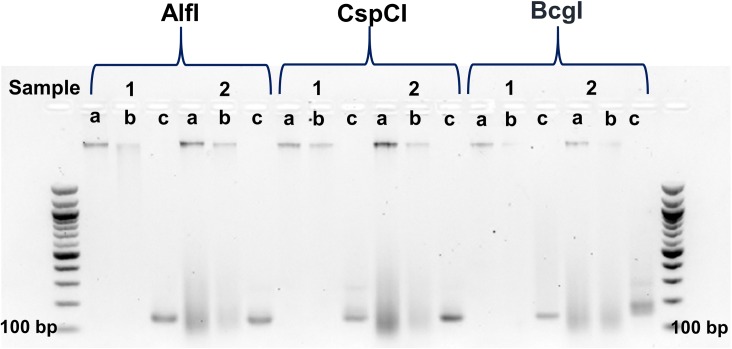
METHODOLOGY/PRINCIPAL FINDINGS: The 2b-RAD protocol was carried out in-house at a non-specialized laboratory using 20 R. ecuadoriensis adults collected from the central coast and southern Andean region of Ecuador, from June 2006 to July 2013. 2b-RAD sequencing data was performed on an Illumina MiSeq instrument and analyzed with the STACKS de novo pipeline for loci assembly and Single Nucleotide Polymorphism (SNP) discovery. Preliminary population genomic analyses (global AMOVA and Bayesian clustering) were implemented. Our results showed that the 2b-RAD genotyping protocol is effective for R. ecuadoriensis and likely for other triatomine species. However, only BcgI and CspCI restriction enzymes provided a number of markers suitable for population genomic analysis at the read depth we generated. Our preliminary genomic analyses detected a signal of genetic structuring across the study area.
CONCLUSIONS/SIGNIFICANCE: Our findings suggest that 2b-RAD genotyping is both a cost effective and methodologically simple approach for generating high resolution genomic data for Chagas disease vectors with the power to distinguish between different vector populations at epidemiologically relevant scales. As such, 2b-RAD represents a powerful tool in the hands of medical entomologists with limited access to specialized molecular biological equipment.
厄瓜多尔罗蛉是南美洲锥虫病(又称美洲锥虫病)在厄瓜多尔南部和秘鲁北部的主要锥蝽传播媒介。基因组学方法和新一代测序技术已成为研究种群多样性和结构的有力工具,而种群多样性和结构是病媒控制的关键考量因素。在此,我们评估了三种不同的2b限制性内切酶位点关联DNA(2b-RAD)基因分型策略在厄瓜多尔罗蛉中的有效性,以提供足够的基因组分辨率来梳理微观进化过程,并开展一些初步的种群基因组分析。
方法/主要发现:2006年6月至2013年7月从厄瓜多尔中部海岸和安第斯地区南部采集了20只厄瓜多尔罗蛉成虫,在一个非专业实验室内部开展了2b-RAD实验方案。在Illumina MiSeq仪器上进行2b-RAD测序数据,并使用STACKS从头组装流程进行分析,以进行位点组装和单核苷酸多态性(SNP)发现。实施了初步的种群基因组分析(全局AMOVA和贝叶斯聚类)。我们的结果表明,2b-RAD基因分型方案对厄瓜多尔罗蛉有效,可能对其他锥蝽物种也有效。然而,在我们生成的读取深度下,只有BcgI和CspCI限制性内切酶提供了适合种群基因组分析的标记数量。我们的初步基因组分析在整个研究区域检测到了遗传结构信号。
结论/意义:我们的研究结果表明,2b-RAD基因分型是一种经济高效且方法简单的方法,可为恰加斯病病媒生成高分辨率基因组数据,并有能力在流行病学相关尺度上区分不同的病媒种群。因此,2b-RAD是医学昆虫学家手中的有力工具,这些昆虫学家难以获得专业分子生物学设备。