
新冠病毒感染中早期炎症与年龄及无症状疾病的关联
Association of Early Inflammation with Age and Asymptomatic Disease in COVID-19.
作者信息
Xie Chunmei, Li Qing, Li Linhai, Peng Xiaohua, Ling Zhijian, Xiao Bin, Feng Jingjing, Chen Zhenhong, Chang De, Xie Lixin, Dela Cruz Charles S, Sharma Lokesh
机构信息
Department of Blood Transfusion, Guangzhou 8th People's Hospital, Guangzhou Medical University, Guangzhou, 510440, People's Republic of China.
College of Pulmonary and Critical Care Medicine, Chinese PLA General Hospital, Beijing, 100083, People's Republic of China.
出版信息
J Inflamm Res. 2021 Mar 30;14:1207-1216. doi: 10.2147/JIR.S304190. eCollection 2021.
BACKGROUND
Disease severity in COVID-19 ranges from asymptomatic infection to severe disease and death, especially in older subjects. The risk for severe infection and death has been reported to be 2X in those between 30 and 40 years, 3X in those between 40 and 50 years, and 4X in those between 50 and 65 years, compared to the reference group of 18-29 years.
OBJECTIVE
To investigate the early changes in host immune responses that are altered with age and the difference in the early host inflammatory response that dictates a symptomatic versus asymptomatic course of COVID-19.
PATIENTS AND METHODS
COVID-19 subjects were identified by screening at the airport upon arrival from a foreign destination to China. Patients were either asymptomatic or had a mild disease when the first oro-pharyngeal (OP) swab samples were collected. Patients were quarantined and blood and throat swabs were collected during the course of the disease, allowing identification of the earliest host response to COVID-19. These patients were followed until their OP sample turned COVID-19 negative.
RESULTS
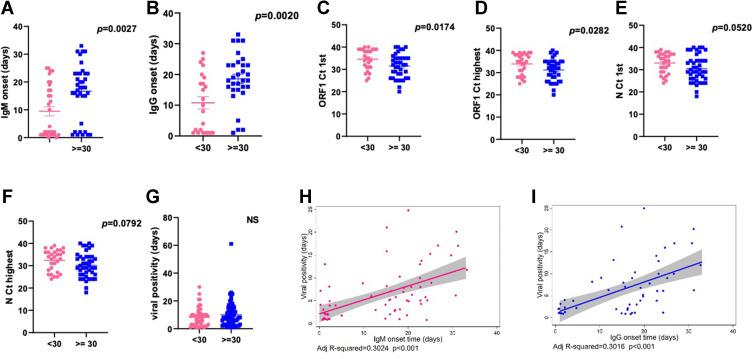
Data were obtained from 126 PCR-confirmed COVID-19 patients. The blood samples were obtained within 48 days of qPCR confirmation of viral infection. Older subjects (>30 years) had significantly elevated levels of anti-inflammatory cytokine IL-10, a significant decrease in the percentage of CD8+ T cells, and expansion in NKT cell fraction. This was associated with significantly elevated viral load and a delayed humoral response in older subjects. Compared to symptomatic subjects, asymptomatic patients had an early increase in pro-inflammatory cytokine IL-2, while a decrease in both T regulatory cells and anti-inflammatory cytokine IL-10. Further, asymptomatic disease was associated with early humoral response and faster viral clearance.
CONCLUSION
Early inflammatory response potentially plays a critical role for host-defense in COVID-19. The impaired early inflammatory response was associated with older age while a robust early inflammation was associated with asymptomatic disease.
背景
新型冠状病毒肺炎(COVID-19)的疾病严重程度从无症状感染到严重疾病甚至死亡不等,在老年患者中尤为如此。据报道,与18 - 29岁的参照组相比,30至40岁人群发生严重感染和死亡的风险是参照组的2倍,40至50岁人群是3倍,50至65岁人群是4倍。
目的
研究随年龄变化而改变的宿主免疫反应的早期变化,以及决定COVID-19有症状与无症状病程的早期宿主炎症反应的差异。
患者与方法
通过对从国外抵达中国的人员在机场进行筛查来确定COVID-19患者。在采集首次口咽拭子样本时,患者要么无症状,要么患有轻症。患者被隔离,并在病程中采集血液和咽拭子,以便确定宿主对COVID-19的最早反应。这些患者被随访至其口咽拭子样本的COVID-19检测结果转为阴性。
结果
数据来自126例经PCR确诊的COVID-19患者。血液样本在病毒感染经qPCR确认后的48天内采集。老年受试者(>30岁)的抗炎细胞因子白细胞介素-10(IL-10)水平显著升高,CD8 + T细胞百分比显著降低,自然杀伤T细胞(NKT)比例增加。这与老年受试者病毒载量显著升高和体液反应延迟有关。与有症状的受试者相比,无症状患者的促炎细胞因子白细胞介素-2(IL-2)早期升高,而调节性T细胞和抗炎细胞因子IL-10均降低。此外,无症状疾病与早期体液反应和更快的病毒清除有关。
结论
早期炎症反应可能在COVID-19的宿主防御中起关键作用。早期炎症反应受损与年龄较大有关,而强烈的早期炎症与无症状疾病有关。


 Zotero 插件