College of Pulmonary and Critical Care Medicine, 8th Medical Center of Chinese PLA General Hospital, Beijing, China.
Department of Pulmonary and Critical Care Medicine, 7th Medical Center of Chinese PLA General Hospital, Beijing, China.
Front Immunol. 2023 Aug 14;14:1116131. doi: 10.3389/fimmu.2023.1116131. eCollection 2023.
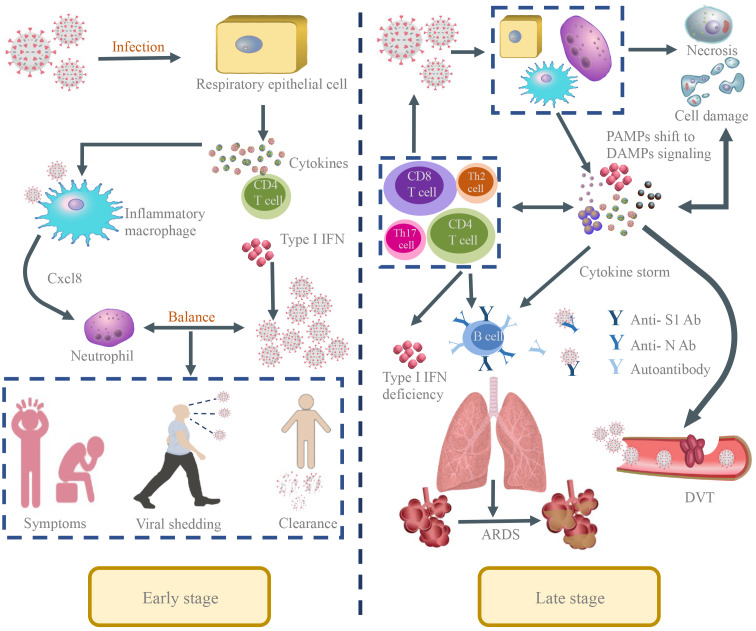
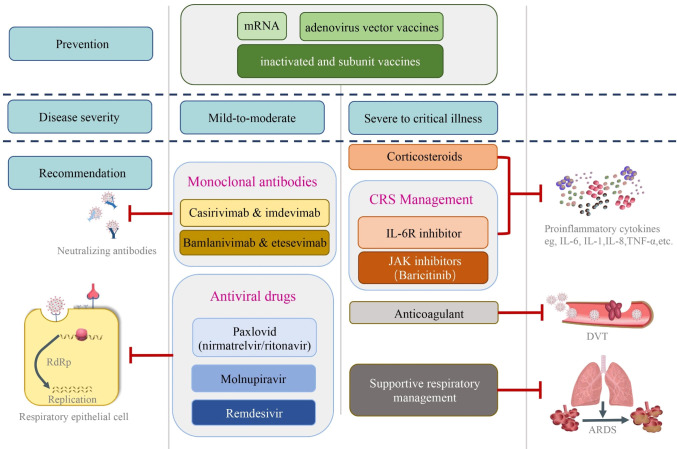
An unprecedented global pandemic caused by a novel coronavirus named SARS-CoV-2 has created a severe healthcare threat and become one of the biggest challenges to human health and the global economy. As of July 2023, over 767 million confirmed cases of COVID-19 have been diagnosed, including more than 6.95 million deaths. The S protein of this novel coronavirus binds to the ACE2 receptor to enter the host cells with the help of another transmembrane protease TMPRSS2. Infected subjects that can mount an appropriate host immune response can quickly inhibit the spread of infection into the lower respiratory system and the disease may remain asymptomatic or a mild infection. The inability to mount a strong initial response can allow the virus to replicate unchecked and manifest as severe acute pneumonia or prolonged disease that may manifest as systemic disease manifested as viremia, excessive inflammation, multiple organ failure, and secondary bacterial infection among others, leading to delayed recovery, hospitalization, and even life-threatening consequences. The clinical management should be targeted to specific pathogenic mechanisms present at the specific phase of the disease. Here we summarize distinct phases of COVID-19 pathogenesis and appropriate therapeutic paradigms associated with the specific phase of COVID-19.
一种新型冠状病毒(SARS-CoV-2)引发的史无前例的全球大流行,给全球医疗保健带来了严重威胁,成为人类健康和全球经济的最大挑战之一。截至 2023 年 7 月,已诊断出超过 7.67 亿例 COVID-19 确诊病例,包括超过 695 万人死亡。这种新型冠状病毒的 S 蛋白与 ACE2 受体结合,在另一种跨膜蛋白酶 TMPRSS2 的帮助下进入宿主细胞。能够产生适当宿主免疫反应的感染者可以迅速抑制感染向下呼吸道的传播,疾病可能保持无症状或轻度感染。无法产生强烈初始反应会导致病毒不受控制地复制,并表现为严重急性肺炎或持续时间较长的疾病,可能表现为全身性疾病,表现为病毒血症、过度炎症、多器官衰竭和继发性细菌感染等,导致恢复延迟、住院治疗,甚至危及生命的后果。临床管理应针对疾病特定阶段存在的特定致病机制。在这里,我们总结了 COVID-19 发病机制的不同阶段以及与 COVID-19 特定阶段相关的适当治疗范例。