Evans Nicholas, Martinez Edgar, Petrosillo Nicola, Nichols Jacob, Islam Ebtesam, Pruitt Kevin, Almodovar Sharilyn
Texas Tech University Health Sciences Center, Department of Immunology & Molecular Microbiology, Lubbock, TX, USA.
National Institute for Infectious Diseases L. Spallanzani, IRCCS, Rome, Italy.
HIV AIDS (Auckl). 2021 Mar 31;13:361-375. doi: 10.2147/HIV.S300055. eCollection 2021.
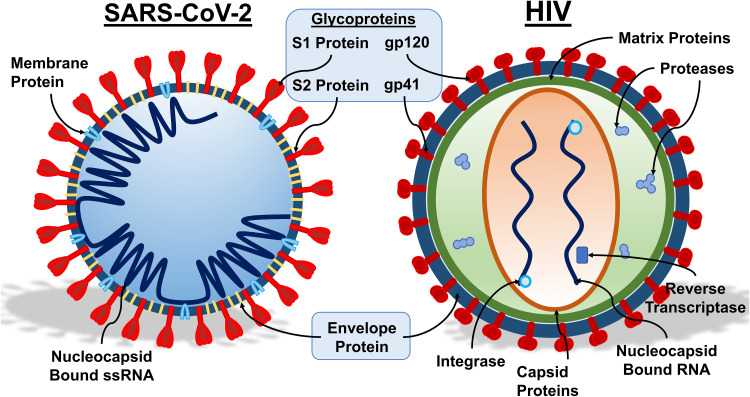
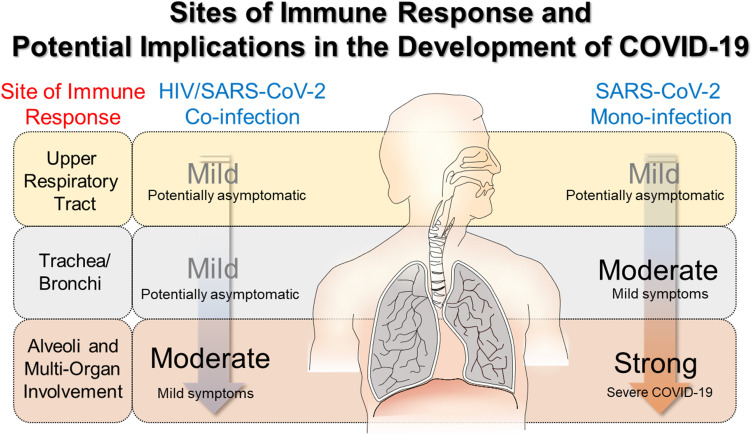
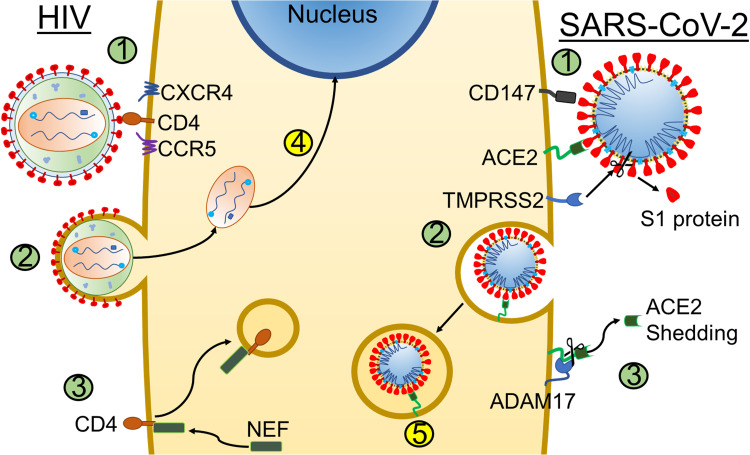
Paramount efforts worldwide are seeking to increase understanding of the basic virology of SARS-CoV-2, characterize the spectrum of complications associated with COVID-19, and develop vaccines that can protect from new and recurrent infections with SARS-CoV-2. While we continue learning about this new virus, it is clear that 1) the virus is spread via the respiratory route, primarily by droplets and contact with contaminated surfaces and fomites, as well as by aerosol formation during invasive respiratory procedures; 2) the airborne route is still controversial; and 3) that those infected can spread the virus without necessarily developing COVID-19 (ie, asymptomatic). With the number of SARS-CoV-2 infections increasing globally, the possibility of co-infections and/or co-morbidities is becoming more concerning. Co-infection with Human Immunodeficiency Virus (HIV) is one such example of polyparasitism of interest. This military-themed comparative review of SARS-CoV-2 and HIV details their virology and describes them figuratively as separate enemy armies. HIV, an old enemy dug into trenches in individuals already infected, and SARS-CoV-2 the new army, attempting to attack and capture territories, tissues and organs, in order to provide resources for their expansion. This analogy serves to aid in discussion of three main areas of focus and draw attention to how these viruses may cooperate to gain the upper hand in securing a host. Here we compare their target, the key receptors found on those tissues, viral lifecycles and tactics for immune response surveillance. The last focus is on the immune response to infection, addressing similarities in cytokines released. While the majority of HIV cases can be successfully managed with antiretroviral therapy nowadays, treatments for SARS-CoV-2 are still undergoing research given the novelty of this army.
全球都在全力以赴,力求增进对严重急性呼吸综合征冠状病毒2(SARS-CoV-2)基本病毒学的了解,明确与冠状病毒病(COVID-19)相关的并发症谱,并研发能够预防SARS-CoV-2新感染和复发性感染的疫苗。在我们持续了解这种新型病毒的过程中,有几点已十分明确:1)该病毒通过呼吸道传播,主要是通过飞沫、接触受污染的表面和污染物传播,以及在侵入性呼吸操作过程中形成气溶胶传播;2)空气传播途径仍存在争议;3)感染者能够传播病毒,且不一定会发展为COVID-19(即无症状感染)。随着全球SARS-CoV-2感染病例数量的增加,合并感染和/或合并症的可能性愈发令人担忧。人类免疫缺陷病毒(HIV)合并感染就是这类值得关注的多重寄生现象的一个例子。这篇以军事为主题对SARS-CoV-2和HIV进行的比较性综述详细介绍了它们的病毒学,并将它们形象地描述为两支独立的敌军。HIV是一支盘踞在已感染个体体内的老敌军,而SARS-CoV-2则是试图发起攻击并占领领地、组织和器官以获取扩张资源的新军。这种类比有助于讨论三个主要关注领域,并提醒人们注意这些病毒如何相互协作以在宿主争夺战中占据上风。在此,我们比较它们的目标、这些组织上发现的关键受体、病毒生命周期以及免疫反应监测策略。最后一个关注点是对感染的免疫反应,探讨所释放细胞因子的相似之处。虽然如今大多数HIV病例可通过抗逆转录病毒疗法成功控制,但鉴于SARS-CoV-2这支新军的新颖性,针对它的治疗仍在研究之中。