Nzamwita Pascal, Biracyaza Emmanuel
Department of Community Health, School of Public Health, University of Rwanda, Kigali, Rwanda.
Department of Prevention, ADIS Healthcare Foundation (AHF) Rwanda, Kigali, Rwanda.
HIV AIDS (Auckl). 2021 Apr 1;13:377-388. doi: 10.2147/HIV.S301045. eCollection 2021.
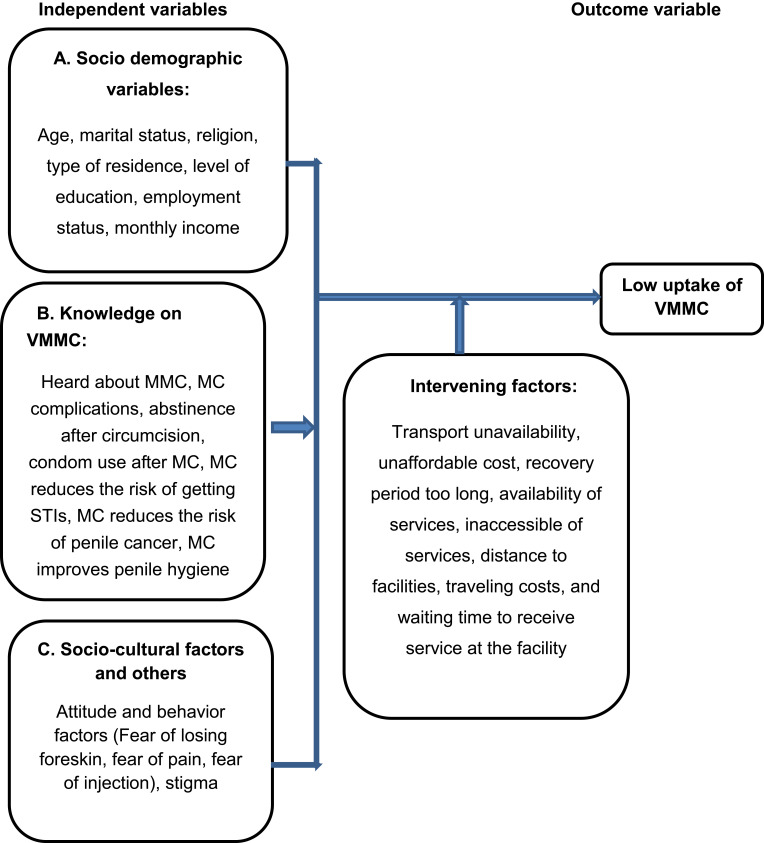
Voluntary medical male circumcision (VMMC) is an effective biomedical intervention against HIV in developed and developing countries. However, there is low uptake of VMMC due to various factors, which hinders achievement of health-policy goals to increase uptake. Numerous campaigns offering the procedure free of charge exist in developing countries, but such initiatives seem to bear little fruit in attracting men to these services. This study assessed risk factors associated with the low uptake of VMMC among men in Nyanza district, Southern Province, Rwanda.
A cross-sectional study was conducted among adult males in Nyanza. A total of 438 men participated in individual interviews. Bivariate and multivariate logistic regression models were used with 95% confidence intervals and ≤0.05 was taken as statistically significant.
Our results indicated that a low update of VMMC was highly prevalent (35.8%). A majority (84.7%) of participants had heard about VMMC, its complications, advantages in preventiing penile cancer, sexually transmitted infections, and HIV, condom use after circumcision, abstinence for 6 weeks after circumcision, and improving penile hygiene. Religion and education were significant factors in low uptake. Catholics were less likely to undergo VMMC than Muslims (OR 7.19, 95% CI 1.742-29.659; =0.01). Those of other faiths were less likely to undergo VMMC than Muslims (OR 6.035, 95% CI 1.731-21.039; =0.005). Participants with secondary education were less likely to undergo VMMC than those with primary education only (OR 1.4, 95% CI 0.74-2.64; =0.03). Having no formal education decreased the odds of being uncircumcised (OR 0.37, 95% CI 0.14-0.977; =0.045) when compared to those with primary education.
Uptake of VMMC remains low in Nyanza, but most men had sufficient knowledge about it. Education, religion, and marital status were major factors in the low uptake. Programs targeting peer influences and parents need to be prioritized.
在发达国家和发展中国家,自愿男性医学包皮环切术(VMMC)是一项预防艾滋病病毒的有效生物医学干预措施。然而,由于各种因素,VMMC的接受率较低,这阻碍了实现提高接受率的卫生政策目标。发展中国家开展了许多免费提供该手术的活动,但这些举措在吸引男性接受这些服务方面似乎收效甚微。本研究评估了卢旺达南部省尼亚扎区男性中VMMC接受率低的相关风险因素。
在尼亚扎对成年男性进行了一项横断面研究。共有438名男性参与了个人访谈。使用双变量和多变量逻辑回归模型,置信区间为95%,以≤0.05为具有统计学意义。
我们的结果表明,VMMC的低接受率非常普遍(35.8%)。大多数(84.7%)参与者听说过VMMC、其并发症、预防阴茎癌、性传播感染和艾滋病病毒的优势、包皮环切术后使用避孕套、包皮环切术后禁欲6周以及改善阴茎卫生。宗教和教育是接受率低的重要因素。天主教徒接受VMMC的可能性低于穆斯林(比值比7.19,95%置信区间1.742 - 29.659;P = 0.01)。其他信仰的人接受VMMC的可能性低于穆斯林(比值比6.035,95%置信区间1.731 - 21.039;P = 0.005)。接受过中等教育的参与者接受VMMC的可能性低于仅接受过小学教育的参与者(比值比1.4,95%置信区间0.74 - 2.64;P = 0.03)。与接受过小学教育的人相比,未接受过正规教育的人未进行包皮环切的几率降低(比值比0.37,95%置信区间0.14 - 0.977;P = 0.045)。
尼亚扎区VMMC的接受率仍然较低,但大多数男性对其有足够的了解。教育、宗教和婚姻状况是接受率低的主要因素。针对同伴影响和父母的项目需要优先考虑。