Yang Huajun, Zhang Yifan, Chen Hongqun, Zhu Yingwu, Li Yuan, Ouyang Fu, Chu Lan, Liu Daishun
Department of Neurology, Affiliated Hospital of Guizhou Medical University, Guizhou Medical University, Guiyang, China.
Department of Respiratory Medicine, The First People's Hospital of Zunyi, The Third Affiliated Hospital of Zunyi Medical University, Zunyi, China.
Front Mol Neurosci. 2021 Mar 23;14:613887. doi: 10.3389/fnmol.2021.613887. eCollection 2021.
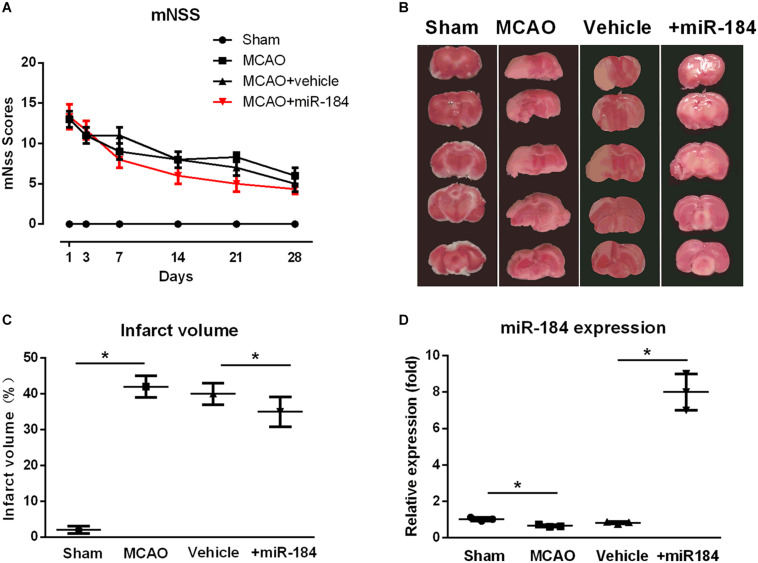
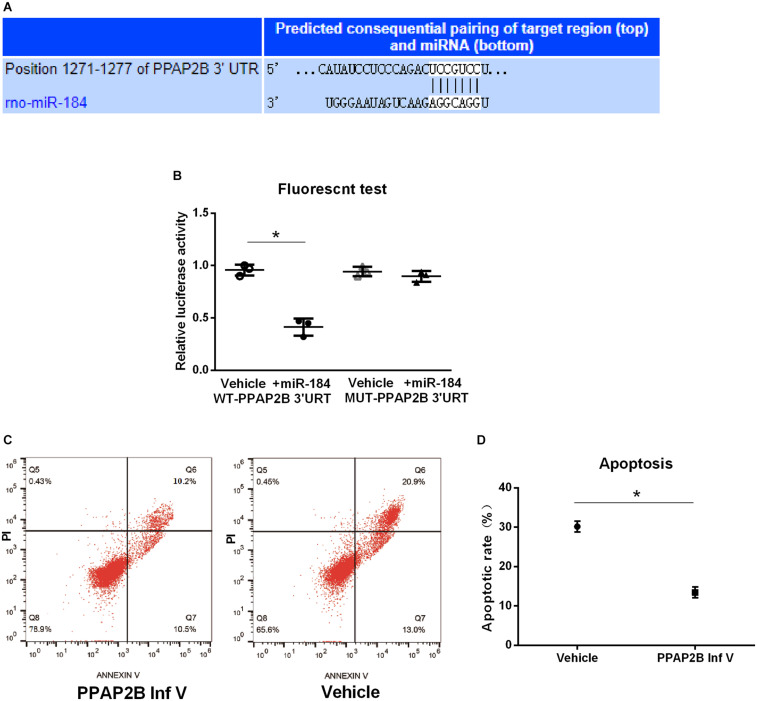
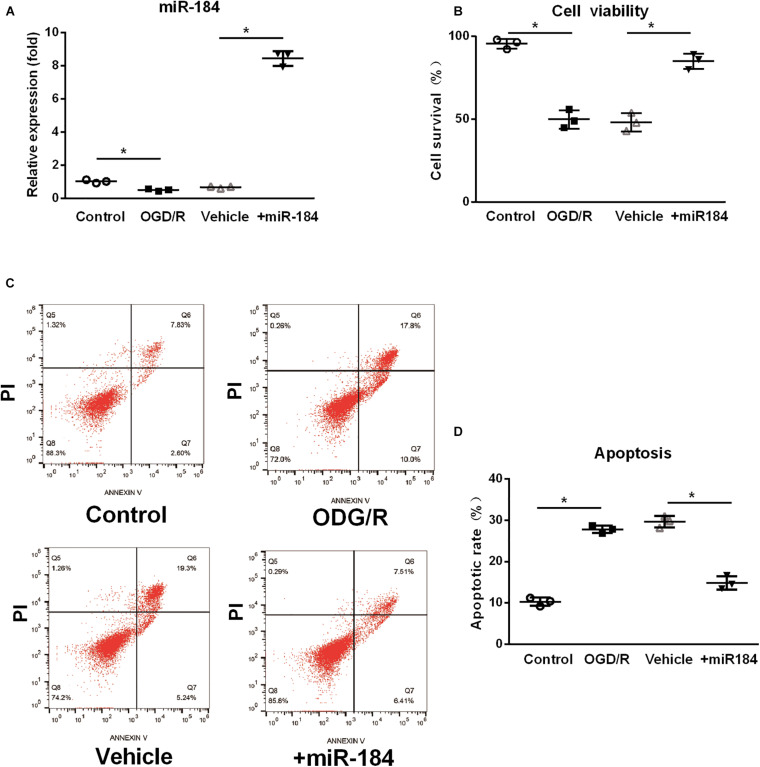
Our previous study revealed that miR-184 expression is significantly altered in the brain following ischemic stroke in rats. However, it is unknown whether this alteration in miR-184 expression contributes to brain injury after ischemic stroke. Here, we aim to address the potential of miR-184 to impact nerve injury following ischemia and reperfusion. Rats received ICV injection of miR-184 adenovirus or empty vector and were subjected to right middle cerebral artery occlusion (MCAO) to establish an ischemic stroke model. We cultured SH-SY5Y cells under oxygen-glucose deprivation/reoxygenation (OGD/R) and transfected them with miR-184 lentivirus to explore the primary mechanisms. To evaluate miR-184 expression, neurological function deficits, the cerebral infarct volume, cell viability, and apoptosis, qRT-PCR analysis of miR-184 expression, the modified neurological severity score (mNSS) system, TTC staining, the CCK-8 assay, flow cytometry, and dual-luciferase reporter assays were utilized. We found that miR-184 expression was downregulated and that the cerebral infarct volume and mNSSs were increased following ischemic stroke; however, increasing the level of miR-184 alleviated brain damage. Overexpression of miR-184 resulted in increased viability and reduced apoptosis of SH-SY5Y cells following OGD/R . We identified the phosphatidic acid phosphatase type 2B (PPAP2B) gene as a direct target gene of miR-184. In summary, our results reveal that attenuation of miR-184 levels in ischemic stroke contributes to ischemic injury through targeting PPAP2B mRNA-mediated apoptosis, which may be a promising therapeutic target for ischemic stroke.
我们之前的研究表明,大鼠缺血性中风后,大脑中miR-184的表达会发生显著变化。然而,尚不清楚miR-184表达的这种变化是否会导致缺血性中风后的脑损伤。在此,我们旨在探讨miR-184对缺血再灌注后神经损伤的影响。给大鼠脑室内注射miR-184腺病毒或空载体,然后进行右侧大脑中动脉闭塞(MCAO)以建立缺血性中风模型。我们在氧糖剥夺/复氧(OGD/R)条件下培养SH-SY5Y细胞,并用miR-184慢病毒转染它们,以探究其主要机制。为了评估miR-184的表达、神经功能缺损、脑梗死体积、细胞活力和凋亡情况,我们采用了miR-184表达的qRT-PCR分析、改良神经功能缺损评分(mNSS)系统、TTC染色、CCK-8检测、流式细胞术和双荧光素酶报告基因检测。我们发现,缺血性中风后miR-184表达下调,脑梗死体积和mNSS增加;然而,提高miR-184水平可减轻脑损伤。miR-184过表达导致OGD/R后SH-SY5Y细胞活力增加,凋亡减少。我们确定磷脂酸磷酸酶2B(PPAP2B)基因是miR-184的直接靶基因。总之,我们的结果表明,缺血性中风中miR-184水平的降低通过靶向PPAP2B mRNA介导的凋亡导致缺血性损伤,这可能是缺血性中风一个有前景的治疗靶点。