Zhang Jin, Yuan Guangjie, Lu Huan, Liu Guangyuan
College of Electronic and Information Engineering, Southwest University, Chongqing, China.
Institute of Affective Computing and Information Processing, Southwest University, Chongqing, China.
Comput Intell Neurosci. 2021 Mar 22;2021:6631616. doi: 10.1155/2021/6631616. eCollection 2021.
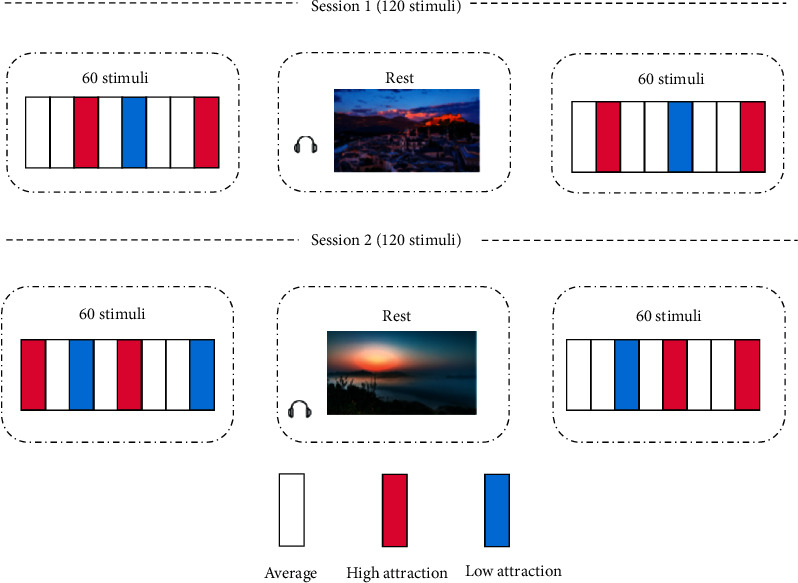
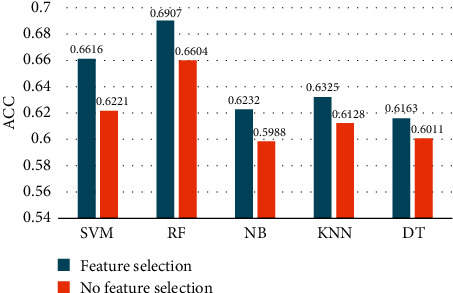
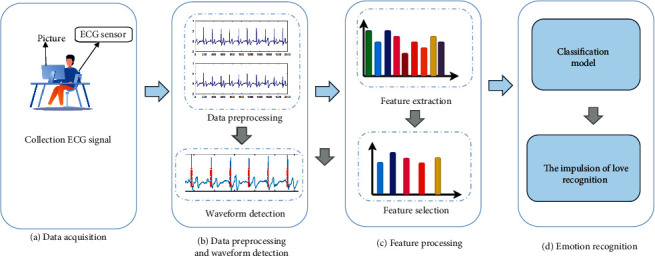
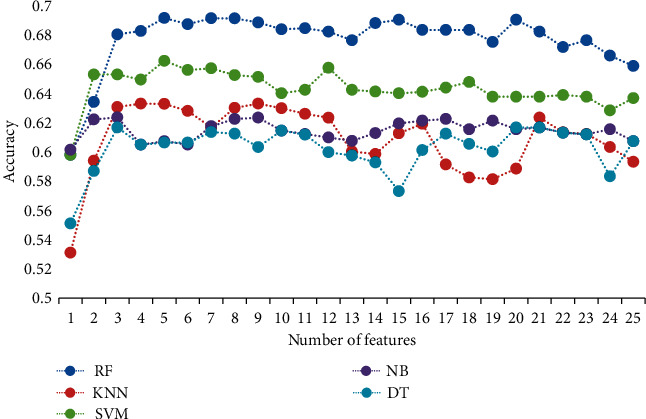
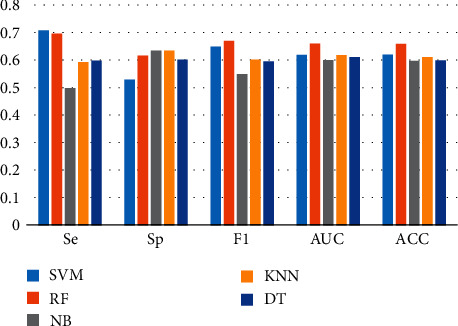
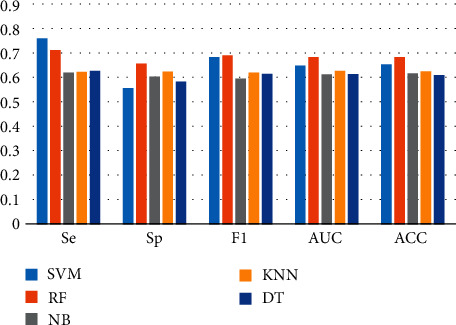
The impulse of love at first sight (ILFS) is a well known but rarely studied phenomenon. Despite the privacy of these emotions, knowing how attractive one finds a partner may be beneficial for building a future relationship in an open society, where partners are accepting each other. Therefore, this study adopted the electrocardiograph (ECG) signal collection method, which has been widely used in wearable devices, to collect signals and conduct corresponding recognition analysis. First, we used photos to induce ILFS and obtained ECG signals from 46 healthy students (24 women and 22 men) in a laboratory. Second, we extracted the time- and frequency-domain features of the ECG signals and performed a nonlinear analysis. We subsequently used a feature selection algorithm and a set of classifiers to classify the features. Combined with the sequence floating forward selection and random forest algorithms, the identification accuracy of the ILFS was 69.07%. The sensitivity, specificity, F1, and area under the curve of the other parameters were all greater than 0.6. The classification of ECG signals according to their characteristics demonstrated that the signals could be recognized. Through the information provided by the ECG signals, it can be determined whether the participant possesses the desire to fall in love, helping to determine the right partner in the fastest time; this is conducive to establishing a romantic relationship.
一见钟情的冲动(ILFS)是一种广为人知但鲜有研究的现象。尽管这些情感较为私密,但在一个伴侣相互接纳的开放社会中,了解自己对伴侣的吸引力程度可能有助于建立未来的恋爱关系。因此,本研究采用了在可穿戴设备中广泛应用的心电图(ECG)信号采集方法来采集信号并进行相应的识别分析。首先,我们利用照片诱发一见钟情的冲动,并在实验室中从46名健康学生(24名女性和22名男性)身上获取了心电图信号。其次,我们提取了心电图信号的时域和频域特征,并进行了非线性分析。随后,我们使用特征选择算法和一组分类器对这些特征进行分类。结合序列浮动前向选择和随机森林算法,一见钟情冲动的识别准确率为69.07%。其他参数的敏感性、特异性、F1值和曲线下面积均大于0.6。根据心电图信号的特征进行分类表明,这些信号是可以被识别的。通过心电图信号提供的信息,可以确定参与者是否有恋爱的欲望,有助于在最快的时间内找到合适的伴侣;这有利于建立浪漫的恋爱关系。