Federal State Institution "National Medical Research Center of Cardiology" of the Ministry of Healthcare of the Russian Federation, Moscow, RU.
Children's Diagnostics and Treatment Center after N.A. Semashko, Moscow, RU.
Glob Heart. 2021 Mar 25;16(1):21. doi: 10.5334/gh.825.
Telehealth strategies are increasingly used to support people at high cardiovascular risk long-term, but is it unclear if these interventions are effective at improving cardiovascular risk.
To evaluate the effects of a telemedicine technology-based program on risk factor control and body composition in patients at high cardiovascular risk.
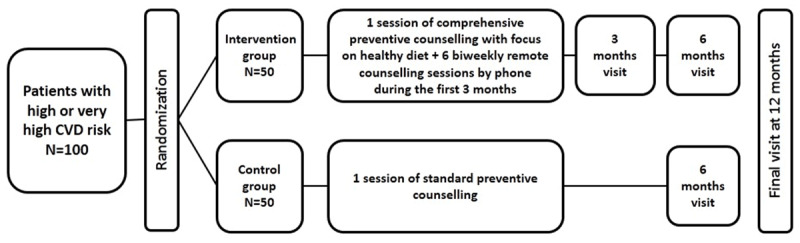
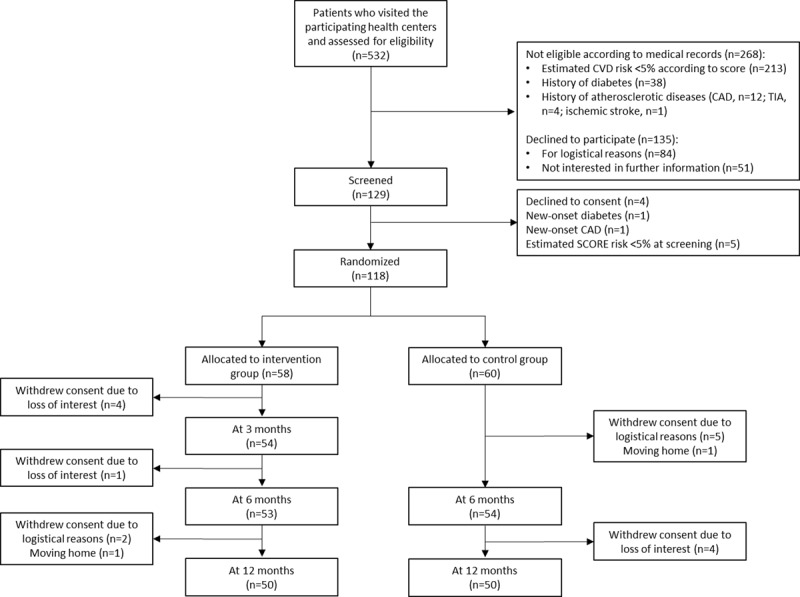
This is a population based randomized controlled trial. 100 patients at high and very high cardiovascular risk were randomly assigned to a telemedicine technology-based program consisting of: Comprehensive counseling on risk factors delivered by a physician; biweekly remote support via phone delivered by a trained nurse during the first three months after enrollment; and a control group receiving routine care with individual single-session counseling on patients' current risk factors without further support. The follow-up period was 1 year.
Mean age of participants was 59.9 ± 4.5 years, 80% were women. Weight (-0.582; p < 0.001), waist circumference (-0.429; p = 0.01), body mass index (-0.216; p < 0.001) diastolic blood pressure (-0.881; p = 0.04), total cholesterol (-0.149; p = 0.01) and LDL cholesterol (-0.123; p = 0.003) were lower in the intervention group compared to the control group after 12-month. Body fat mass was also lower (-0.352; p = 0.01) and lean mass was higher (0.92; p = 0.03) in the intervention group. Anxiety scores (-2.5; p < 0.002) and depression scores (-2.6; p < 0.001) were also lower in the intervention group.
Among older people at high cardiovascular risk, the addition of telehealth strategies using remote support by phone calls over a period of 3 month resulted in small but significant improvements of cardiovascular risk factors, body composition, anxiety, and depression which are maintained long-term. Such telehealth strategies may offer an advantage over standard institution-based interventions.
远程医疗策略越来越多地被用于长期支持心血管高危人群,但目前尚不清楚这些干预措施是否能有效改善心血管风险。
评估基于远程医疗技术的方案对心血管高危患者的危险因素控制和身体成分的影响。
这是一项基于人群的随机对照试验。将 100 名处于高心血管风险和极高心血管风险的患者随机分配到基于远程医疗技术的方案组:由医生提供全面的危险因素咨询;在入组后的前 3 个月,由经过培训的护士每两周通过电话提供远程支持;对照组接受常规护理,仅对患者当前的危险因素进行单次个体咨询,没有进一步的支持。随访期为 1 年。
参与者的平均年龄为 59.9 ± 4.5 岁,80%为女性。与对照组相比,干预组的体重(-0.582;p < 0.001)、腰围(-0.429;p = 0.01)、体重指数(-0.216;p < 0.001)、舒张压(-0.881;p = 0.04)、总胆固醇(-0.149;p = 0.01)和 LDL 胆固醇(-0.123;p = 0.003)均较低。干预组的体脂肪量也较低(-0.352;p = 0.01),瘦体重较高(0.92;p = 0.03)。干预组的焦虑评分(-2.5;p < 0.002)和抑郁评分(-2.6;p < 0.001)也较低。
在高心血管风险的老年人中,使用电话远程支持的远程医疗策略持续 3 个月,可显著改善心血管危险因素、身体成分、焦虑和抑郁,且这些改善长期持续。这种远程医疗策略可能比标准的机构干预更有优势。