1 Department of Epidemiology, University Medical Centre Groningen, University of Groningen, The Netherlands.
2 Department of Internal Medicine, Mongolian National University of Medical Sciences, Ulaanbaatar, Mongolia.
Eur J Prev Cardiol. 2019 Jun;26(9):905-916. doi: 10.1177/2047487319833283. Epub 2019 Feb 21.
To investigate prospectively the association of body fat percentage (BF%) estimates using various equations from bioelectrical impedance analysis (BIA) with cardiovascular events, compared with body mass index (BMI) and waist circumference.
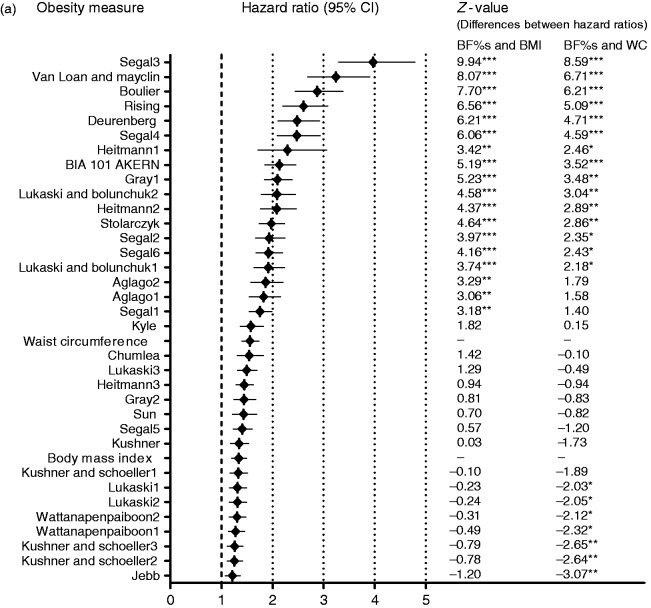
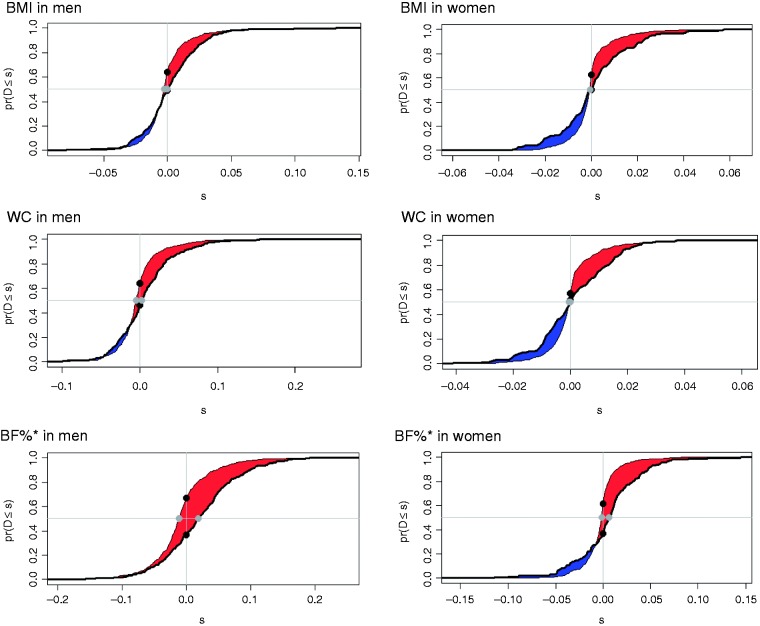
We used data of 34 BIA-BF%-equations that were used for estimation of BF% in 6486 (men = 3194, women = 3294) subjects. During a median follow-up of 8.3 years, 510 (7.9%) cardiovascular events (363 in men; 147 in women) occurred. In men, the crude hazard ratio (95% confidence interval) for BF% from the best predicting BIA-BF%-equation was 3.97 (3.30-4.78) against 2.13 (1.85-2.45) for BF% from the BIA device's BIA-BF%-equation, 1.34 (1.20-1.49) for BMI and 1.49 (1.40-1.73) for waist circumference per log-1-SD increase of all. In women, the hazard ratios for best predicting BIA-BF%-equation, BIA device estimation, BMI and waist circumference were 3.80 (2.85-4.99), 1.89 (1.57-2.28), 1.35 (1.21-1.51) and 1.52 (1.31-1.75), respectively. After adjustments for age, Framingham cardiovascular disease risk score and creatinine excretion - a marker of muscle mass - BF%s and BMI remained independently associated with cardiovascular events in both men and women, while waist circumference was independently associated with cardiovascular events in men, but not in women. According to discrimination ability (C-index) and additive predictive value (net reclassification index and integrated discrimination index) on obesity measures to the Framingham cardiovascular disease risk score, BF% was superior to BMI and waist circumference in both men and women.
BF% was independently associated with future cardiovascular events. Body fat estimates from the best-predicting BIA-BF%-equations can be a more predictive measurement in cardiovascular risk assessment than BMI or waist circumference.
前瞻性研究使用生物电阻抗分析(BIA)的各种方程估计体脂肪百分比(BF%)与心血管事件的关联,与体重指数(BMI)和腰围相比。
我们使用了在 6486 名受试者(男性=3194,女性=3294)中用于估计 BF%的 34 种 BIA-BF%方程的数据。在中位数为 8.3 年的随访期间,发生了 510 例(7.9%)心血管事件(男性 363 例,女性 147 例)。在男性中,来自最佳预测 BIA-BF%-方程的 BF%的粗危险比(95%置信区间)为 3.97(3.30-4.78),而来自 BIA 设备 BIA-BF%-方程的 BF%为 2.13(1.85-2.45),BMI 为 1.34(1.20-1.49),每增加一个 log-1-SD 的腰围为 1.49(1.40-1.73)。在女性中,最佳预测 BIA-BF%-方程、BIA 设备估计、BMI 和腰围的危险比分别为 3.80(2.85-4.99)、1.89(1.57-2.28)、1.35(1.21-1.51)和 1.52(1.31-1.75)。在调整年龄、弗雷明汉心血管疾病风险评分和肌酐排泄(肌肉质量的标志物)后,BF%和 BMI 仍然与男性和女性的心血管事件独立相关,而腰围与男性的心血管事件独立相关,但与女性无关。根据肥胖测量值(C 指数)和附加预测值(净重新分类指数和综合鉴别指数)对 Framingham 心血管疾病风险评分的区分能力,BF%在男性和女性中均优于 BMI 和腰围。
BF%与未来心血管事件独立相关。来自最佳预测 BIA-BF%-方程的体脂肪估计值在心血管风险评估中比 BMI 或腰围更具预测性。