Department of Mental Health and Psychiatry, The Second Affiliated Hospital of Soochow University, Suzhou, Jiangsu, China 215006.
Department of Psychiatry, Affiliated Hospital of Guizhou Medical University, Guiyang, Guizhou, China 550025.
Biomed Res Int. 2021 Mar 23;2021:5542545. doi: 10.1155/2021/5542545. eCollection 2021.
Recent studies suggest a correlation between the reduced Sirt-1 expression with Alzheimer's diseases (AD) and depression, respectively, suggesting a possible pathogenic role of the altered Sirt-1 expression in neuronal degenerative diseases, such as AD and depression. However, the molecular mechanisms underlying how Sirt-1 reduction impairs neuronal functions remain unknown.
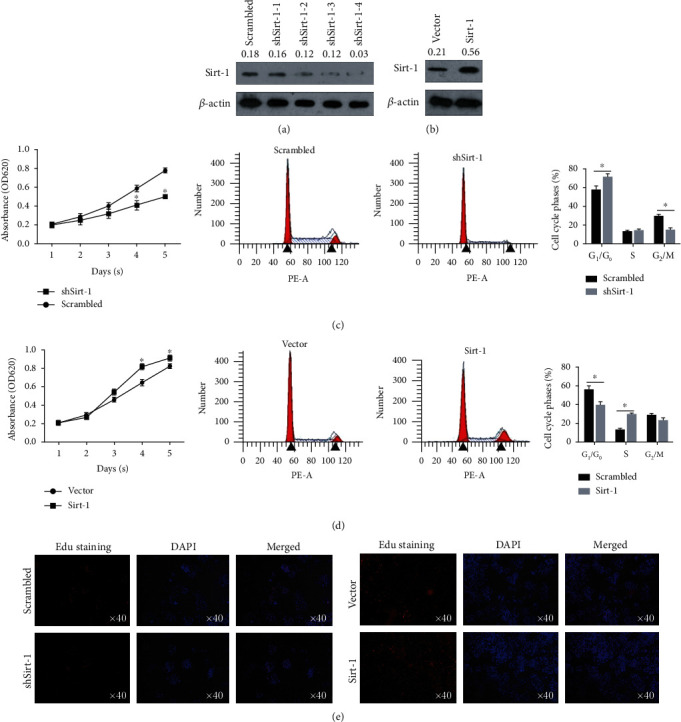
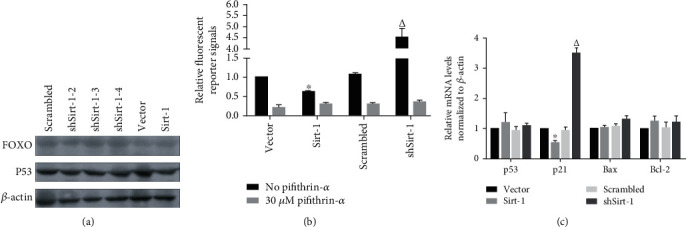
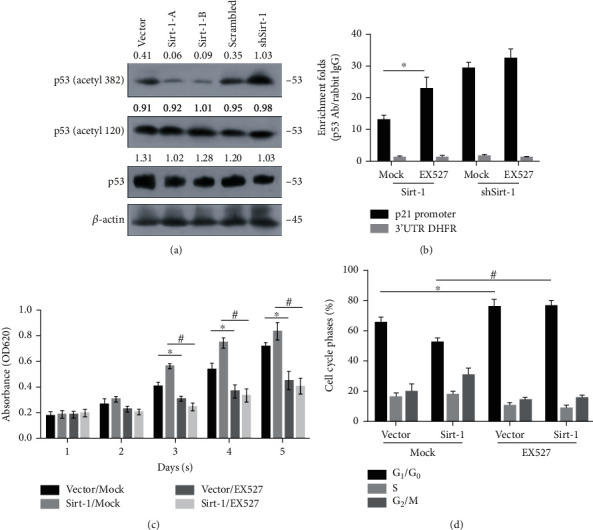
We used the SK-N-SH neuroblastoma cells to study the role of Sirt-1 expression on physiological roles in neuronal cells. Gain of Sirt-1 was achieved by transiently transfecting Sirt-1 expression plasmid. Sirt-1-specific shRNA was used to elucidate the role of Sirt-1 loss of function. CCK-8 (Cell Counting Kit-8) assay and flow cytometry were used to evaluate cell proliferation. Semiquantitative western blotting was used to detect relative protein levels. A further luciferase reporter gene assay was employed to examine the effect of Sirt-1 expression on the transcriptional activity of p53. RT-qPCR was used to determine the mRNA levels of p21, Bax, and Bcl-2, which were the downstream target genes of p53.
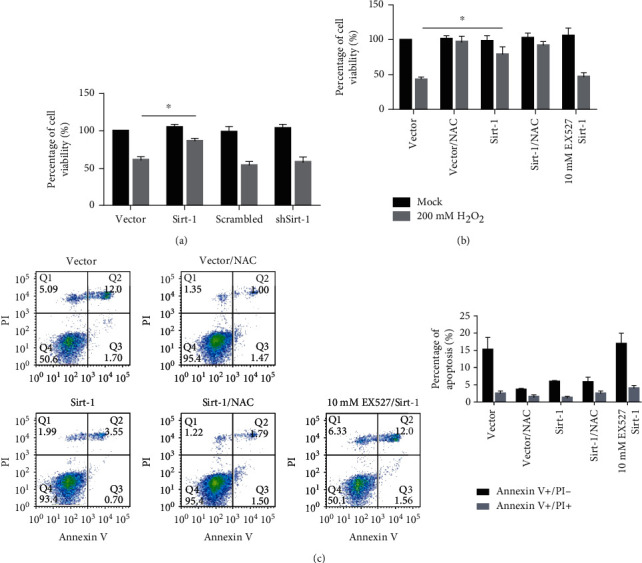
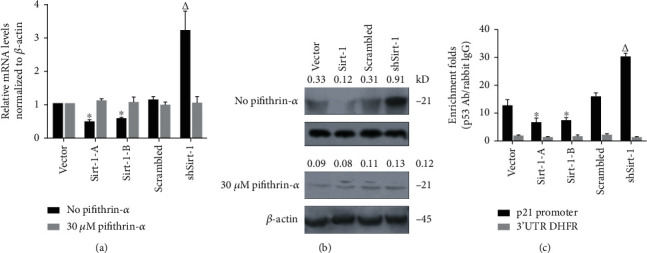
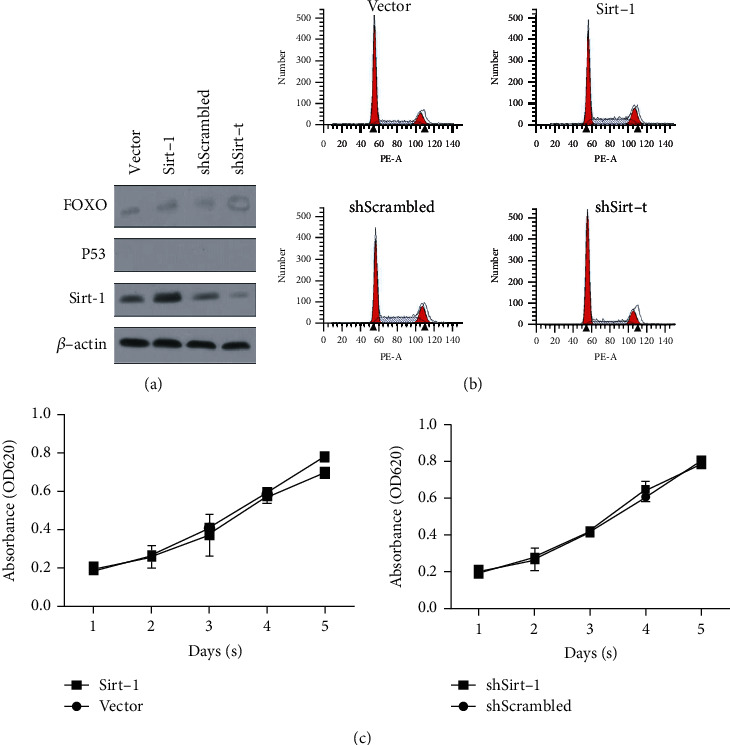
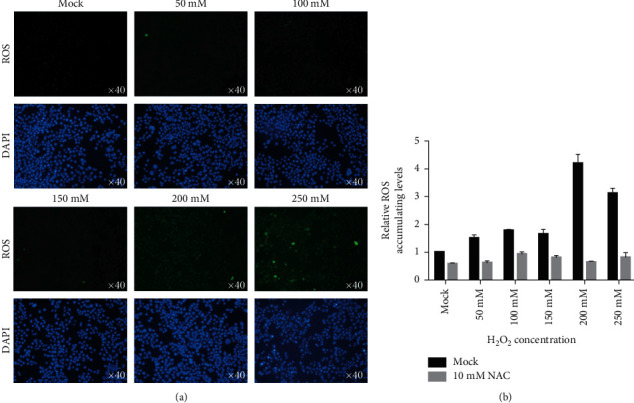
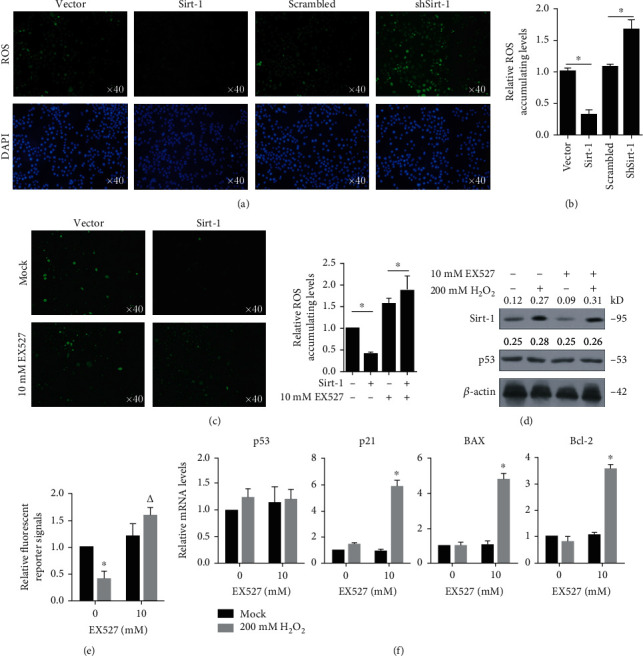
Sirt-1 suppressed the p53 downstream gene p21 transcription, while shRNA-mediated Sirt-1 knockdown resulted in a significant increase in p21 expression, implying a possibility that Sirt-1 promotes neuron proliferation through suppressing p53 transcriptional activity. The mRNA and protein levels of p53 were not affected by the altered Sirt-1 expression, suggesting that Sirt-1 regulates the transcriptional regulatory activity of p53 rather than p53 expression. Indeed, we further confirmed that Sirt-1 appeared to inhibit p53 transcriptional activity by attenuating its acetylation and resulted in a decrease of p53's binding to the p21 promoter. Overexpressed Sirt-1 scavenged reactive oxygen species (ROS) production in SK-N-SH with HO. Knockdown of Sirt-1 presented opposite effect; the addition of EX527 (Sirt-1 inhibitor) increased ROS accumulation.
Oxidative stress induces Sirt-1 in neuron cells, and Sirt-1 promotes proliferation in SK-N-SH cells, which protects them from oxidative stress-induced cell death, potentially via suppressing the transcriptional activity of p53. These results provide a molecular explanation underlying how the reduced Sirt-1 potentially causes the AD and depression-related diseases, supporting the idea that Sirt-1 can possibly be used as a diagnostic biomarker and/or therapeutic drug target for the AD and depression-related diseases.
最近的研究表明,Sirt-1 表达减少与阿尔茨海默病(AD)和抑郁症分别相关,这表明 Sirt-1 表达的改变可能在神经元退行性疾病(如 AD 和抑郁症)中具有致病作用。然而,Sirt-1 减少如何损害神经元功能的分子机制尚不清楚。
我们使用 SK-N-SH 神经母细胞瘤细胞来研究 Sirt-1 表达在神经元细胞中的生理作用。通过瞬时转染 Sirt-1 表达质粒来获得 Sirt-1 的过表达。使用 Sirt-1 特异性 shRNA 来阐明 Sirt-1 功能丧失的作用。CCK-8(细胞计数试剂盒-8)检测和流式细胞术用于评估细胞增殖。半定量 Western 印迹用于检测相对蛋白水平。进一步的荧光素酶报告基因检测用于检查 Sirt-1 表达对 p53 转录活性的影响。RT-qPCR 用于确定 p21、Bax 和 Bcl-2 的 mRNA 水平,它们是 p53 的下游靶基因。
Sirt-1 抑制了 p53 下游基因 p21 的转录,而 shRNA 介导的 Sirt-1 敲低导致 p21 表达显著增加,这表明 Sirt-1 通过抑制 p53 转录活性促进神经元增殖。改变 Sirt-1 表达并不影响 p53 的 mRNA 和蛋白水平,表明 Sirt-1 调节 p53 的转录调节活性而不是 p53 的表达。事实上,我们进一步证实 Sirt-1 通过减弱其乙酰化来抑制 p53 的转录活性,从而导致 p53 与 p21 启动子的结合减少。过表达的 Sirt-1 可清除 SK-N-SH 细胞中 HO 诱导的活性氧(ROS)产生。Sirt-1 的敲低则呈现相反的效果,添加 EX527(Sirt-1 抑制剂)会增加 ROS 的积累。
氧化应激诱导神经元细胞中的 Sirt-1,Sirt-1 促进 SK-N-SH 细胞的增殖,这使其免受氧化应激诱导的细胞死亡,可能是通过抑制 p53 的转录活性。这些结果为 Sirt-1 如何降低潜在导致 AD 和抑郁相关疾病提供了分子解释,支持 Sirt-1 可作为 AD 和抑郁相关疾病的诊断生物标志物和/或治疗药物靶点的想法。