Division of Cardiology, University Hospital, University of South Alabama, 2451 University Hospital Dr, Suite 10D, Mobile, AL, 36617, USA.
Department of Biostatistics and Bioinformatics, Milken Institute School of Public Health, The George Washington University, Washington, DC, 20052, USA.
Adv Ther. 2021 Jun;38(6):2954-2972. doi: 10.1007/s12325-021-01709-7. Epub 2021 Apr 9.
This study aimed to describe the rates and causes of unplanned readmissions within 30 days following carotid artery stenting (CAS) and to use artificial intelligence machine learning analysis for creating a prediction model for short-term readmissions. The prediction of unplanned readmissions after index CAS remains challenging. There is a need to leverage deep machine learning algorithms in order to develop robust prediction tools for early readmissions.
Patients undergoing inpatient CAS during the year 2017 in the US Nationwide Readmission Database (NRD) were evaluated for the rates, predictors, and costs of unplanned 30-day readmission. Logistic regression, support vector machine (SVM), deep neural network (DNN), random forest, and decision tree models were evaluated to generate a robust prediction model.
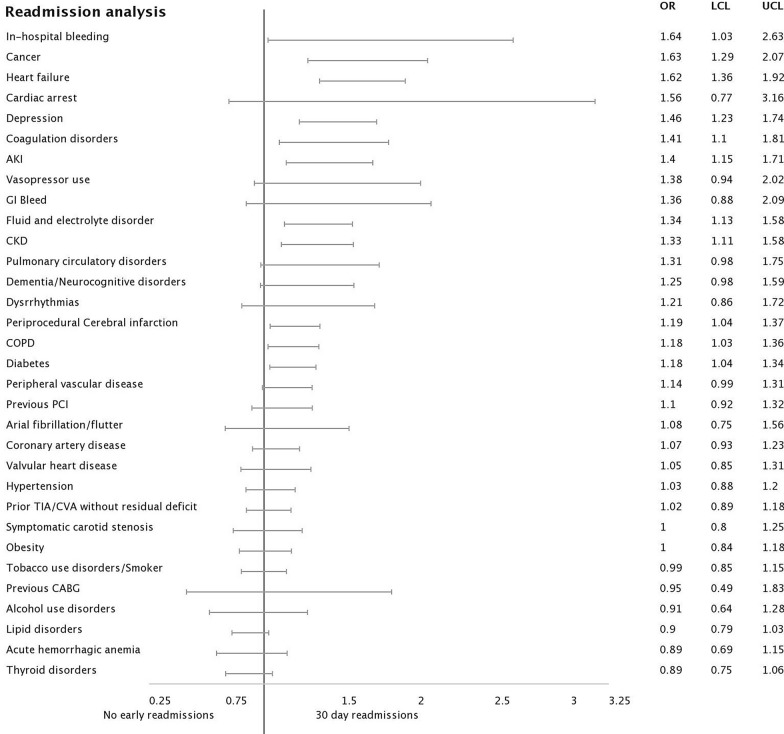
We identified 16,745 patients who underwent CAS, of whom 7.4% were readmitted within 30 days. Depression [p < 0.001, OR 1.461 (95% CI 1.231-1.735)], heart failure [p < 0.001, OR 1.619 (95% CI 1.363-1.922)], cancer [p < 0.001, OR 1.631 (95% CI 1.286-2.068)], in-hospital bleeding [p = 0.039, OR 1.641 (95% CI 1.026-2.626)], and coagulation disorders [p = 0.007, OR 1.412 (95% CI 1.100-1.813)] were the strongest predictors of readmission. The artificial intelligence machine learning DNN prediction model has a C-statistic value of 0.79 (validation 0.73) in predicting the patients who might have all-cause unplanned readmission within 30 days of the index CAS discharge.
Machine learning derived models may effectively identify high-risk patients for intervention strategies that may reduce unplanned readmissions post carotid artery stenting.
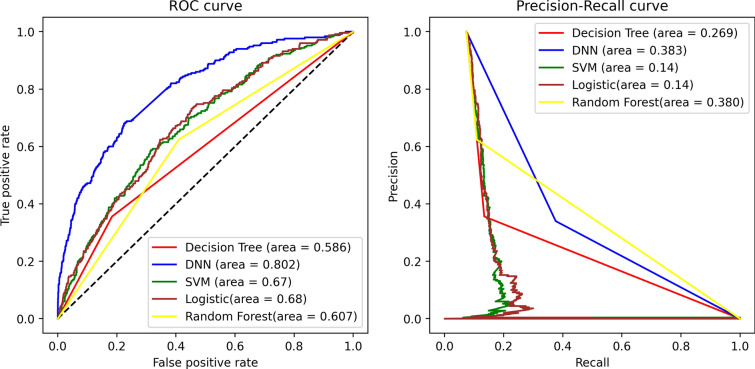
Figure 2: ROC and AUPRC analysis of DNN prediction model with other classification models on 30-day readmission data for CAS subjects.
本研究旨在描述颈动脉支架置入术(CAS)后 30 天内计划性再入院的发生率和原因,并利用人工智能机器学习分析建立短期再入院的预测模型。预测指数 CAS 后计划性再入院仍然具有挑战性。需要利用深度学习算法开发强大的预测工具,以早期预测再入院。
评估 2017 年美国全国再入院数据库(NRD)中接受住院 CAS 的患者计划性 30 天再入院的发生率、预测因素和费用。评估逻辑回归、支持向量机(SVM)、深度神经网络(DNN)、随机森林和决策树模型,以生成稳健的预测模型。
我们确定了 16745 例接受 CAS 的患者,其中 7.4%在 30 天内再入院。抑郁[P<0.001,OR 1.461(95%CI 1.231-1.735)]、心力衰竭[P<0.001,OR 1.619(95%CI 1.363-1.922)]、癌症[P<0.001,OR 1.631(95%CI 1.286-2.068)]、住院内出血[P=0.039,OR 1.641(95%CI 1.026-2.626)]和凝血障碍[P=0.007,OR 1.412(95%CI 1.100-1.813)]是再入院的最强预测因素。人工智能机器学习 DNN 预测模型在预测索引 CAS 出院后 30 天内可能发生全因计划性再入院的患者方面,其 C 统计量值为 0.79(验证值为 0.73)。
机器学习衍生模型可有效识别高危患者,采取干预策略可减少颈动脉支架置入术后计划性再入院。
图 2:DNN 预测模型与 CAS 患者 30 天再入院数据的其他分类模型的 ROC 和 AUPRC 分析。