Department of Women and Children's Health, King's College London, UK.
Centre for the Developing Brain, King's College London, London, UK.
Neuroimage Clin. 2021;30:102650. doi: 10.1016/j.nicl.2021.102650. Epub 2021 Mar 29.
Infants born preterm are at increased risk of neurological complications resulting in significant morbidity and mortality. The exact mechanism and the impact of antenatal factors has not been fully elucidated, although antenatal infection/inflammation has been implicated in both the aetiology of preterm birth and subsequent neurological sequelae. It is therefore hypothesized that processes driving preterm birth are affecting brain development in utero. This study aims to compare MRI derived regional brain volumes in fetuses that deliver < 32 weeks with fetuses that subsequently deliver at term.
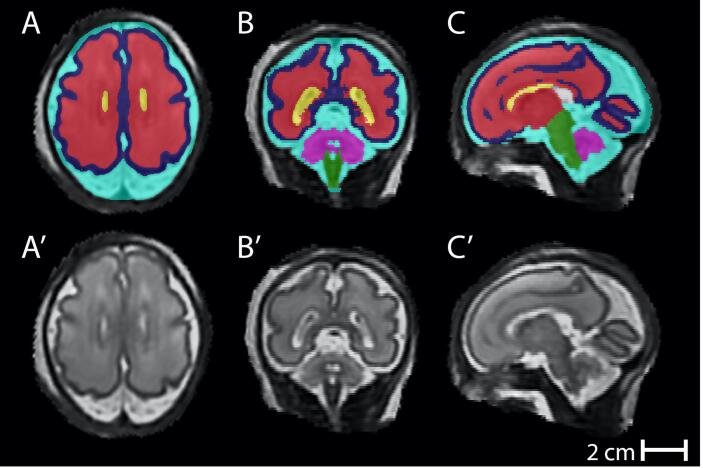
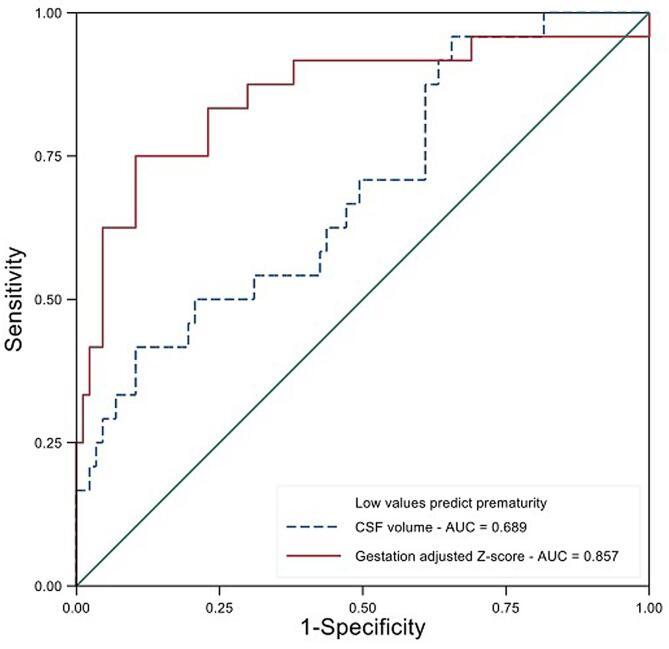
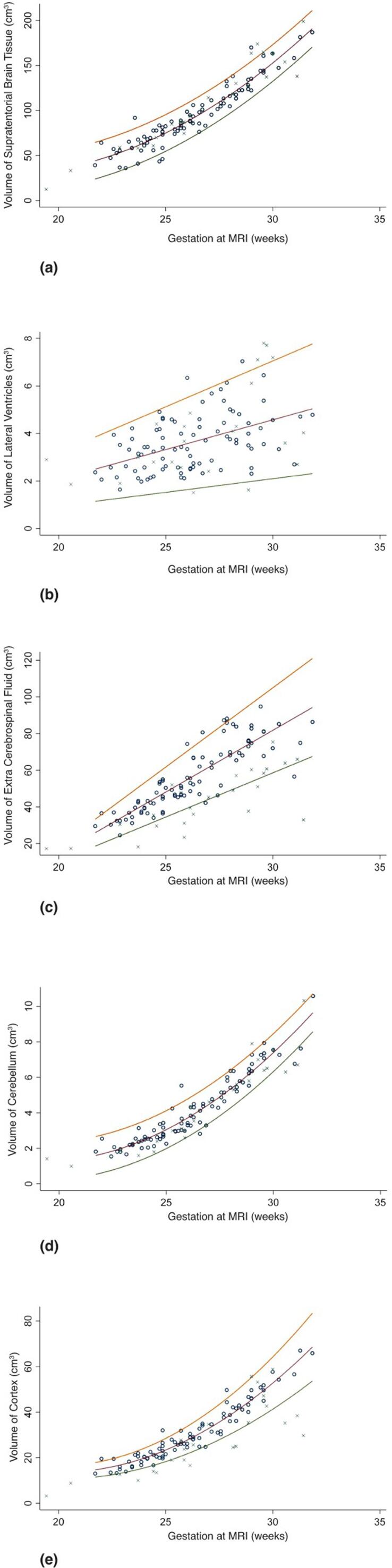
Women at high risk of preterm birth, with gestation 19.4-32 weeks were recruited prospectively. A control group was obtained from existing study datasets. Fetal MRI was performed on a 1.5 T or 3 T MRI scanner: T2-weighted images were obtained of the fetal brain. 3D brain volumetric datsets were produced using slice to volume reconstruction and regional segmentations were produced using multi-atlas approaches for supratentorial brain tissue, lateral ventricles, cerebellum cerebral cortex and extra-cerebrospinal fluid (eCSF). Statistical comparison of control and high-risk for preterm delivery fetuses was performed by creating normal ranges for each parameter from the control datasets and then calculating gestation adjusted z scores. Groups were compared using t-tests.
Fetal image datasets from 24 pregnancies with delivery < 32 weeks and 87 control pregnancies that delivered > 37 weeks were included. Median gestation at MRI of the preterm group was 26.8 weeks (range 19.4-31.4) and control group 26.2 weeks (range 21.7-31.9). No difference was found in supra-tentorial brain volume, ventricular volume or cerebellar volume but the eCSF and cerebral cortex volumes were smaller in fetuses that delivered preterm (p < 0.001 in both cases).
Fetuses that deliver preterm have a reduction in cortical and eCSF volumes. This is a novel finding and needs further investigation. If alterations in brain development are commencing antenatally in fetuses that subsequently deliver preterm, this may present a window for in utero therapy in the future.
早产儿存在神经并发症风险增加的情况,这导致了较高的发病率和死亡率。尽管产前感染/炎症与早产的病因以及随后的神经后遗症都有关,但确切的机制和产前因素的影响尚未完全阐明。因此,有人假设导致早产的过程正在子宫内影响大脑发育。本研究旨在比较<32 周分娩的胎儿与随后足月分娩的胎儿的 MRI 得出的区域性脑容量。
高风险早产的孕妇,妊娠 19.4-32 周,前瞻性招募。对照组从现有研究数据集获得。对胎儿进行 1.5T 或 3T MRI 扫描:获得胎儿大脑的 T2 加权图像。使用切片到体积重建获得 3D 脑容积数据集,并使用多图谱方法对幕上脑组织、侧脑室、小脑、大脑皮层和额外脑脊髓液(eCSF)进行区域分割。通过为对照组数据集创建每个参数的正常范围,然后计算妊娠调整 z 分数,对控制组和早产高风险胎儿进行统计比较。使用 t 检验比较组间差异。
共纳入 24 例<32 周分娩和 87 例>37 周分娩的胎儿的胎儿图像数据集。早产组 MRI 的中位妊娠周数为 26.8 周(范围 19.4-31.4),对照组为 26.2 周(范围 21.7-31.9)。幕上脑容量、脑室容量或小脑容量无差异,但早产儿脑室 eCSF 和大脑皮层体积较小(均 p<0.001)。
早产儿的皮质和 eCSF 体积减少。这是一个新的发现,需要进一步研究。如果在随后早产的胎儿中,脑发育的改变在产前就已经开始,那么这可能为未来的宫内治疗提供了一个窗口。