Neurosurgery and Neurooncology Service, Centre Hospitalier Regional Universitaire de Lille, Roger Salengro Hospital, Lille, France.
Department of Clinical Neurosciences, Neurosurgery Service and Gamma Knife Center, Lausanne University Hospital (CHUV), Lausanne, Switzerland.
Neurosurg Rev. 2021 Dec;44(6):3527-3537. doi: 10.1007/s10143-021-01538-w. Epub 2021 Apr 10.
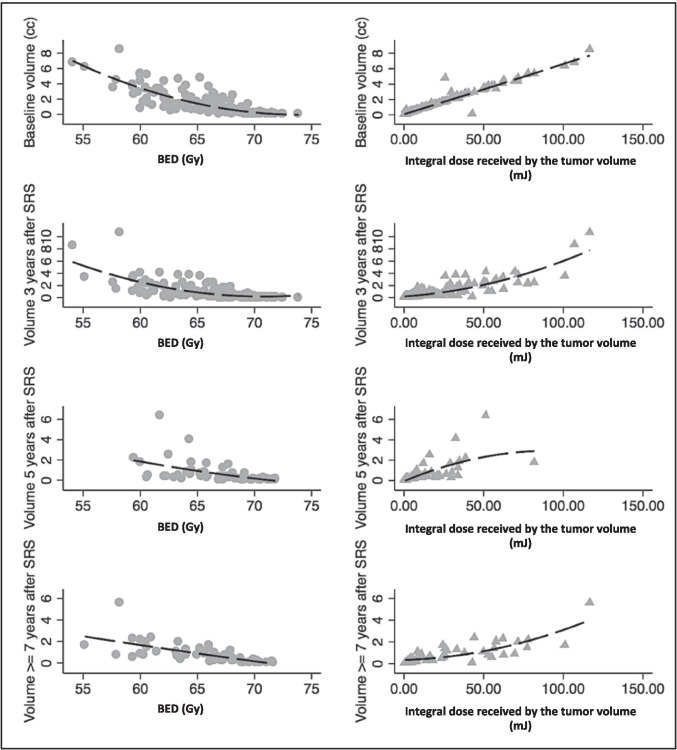
Vestibular schwannomas (VSs) are benign, slow-growing tumors. Management options include observation, surgery, and radiation. In this retrospective trial, we aimed at evaluating whether biologically effective dose (BED) plays a role in tumor volume changes after single-fraction first intention stereotactic radiosurgery (SRS) for VS. We compiled a single-institution experience (n = 159, Lausanne University Hospital, Switzerland). The indication for SRS was decided after multidisciplinary discussion. Only cases with minimum 3 years follow-up were included. The Koos grading, a reliable method for tumor classification was used. Radiosurgery was performed using Gamma Knife (GK) and a uniform marginal prescription dose of 12 Gy. Mean BED was 66.3 Gy (standard deviation 3.8, range 54.1-73.9). The mean follow-up period was 5.1 years (standard deviation 1.7, range 3-9.2). The primary outcome was changes in 3D volumes after SRS as function of BED and of integral dose received by the VS. Random-effect linear regression model showed that tumor volume significantly and linearly decreased over time with higher BED (p < 0.0001). Changes in tumor volume were also significantly associated with age, sex, number of isocenters, gradient index, and Koos grade. However, the effect of BED on tumor volume change was moderated by time after SRS and Koos grade. Lower integral doses received by the VSs were inversely correlated with BED in relationship with tumor volume changes (p < 0.0001). Six (3.4%) patients needed further intervention. For patients having uniformly received the same marginal dose prescription, higher BED linearly and significantly correlated with tumor volume changes after SRS for VSs. BED could represent a potential new treatment paradigm for patients with benign tumors, such as VSs, for attaining a desired radiobiological effect. This could further increase the efficacy and decrease the toxicity of SRS not only in benign tumors but also in other SRS indications.
前庭神经鞘瘤(VSs)是良性、生长缓慢的肿瘤。管理方案包括观察、手术和放疗。在这项回顾性试验中,我们旨在评估单次分割立体定向放射外科(SRS)治疗 VS 后,生物有效剂量(BED)是否对肿瘤体积变化起作用。我们汇编了一家机构的经验(n=159,瑞士洛桑大学医院)。SRS 的适应证是在多学科讨论后决定的。仅纳入随访时间至少 3 年的病例。使用 Koos 分级,这是一种可靠的肿瘤分类方法。放射外科采用伽玛刀(GK)和统一的边缘处方剂量 12Gy 进行。平均 BED 为 66.3Gy(标准差 3.8,范围 54.1-73.9)。平均随访时间为 5.1 年(标准差 1.7,范围 3-9.2)。主要结局是 SRS 后 3D 体积随 BED 和 VS 接受的积分剂量的变化。随机效应线性回归模型显示,随着 BED 的增加,肿瘤体积随时间显著呈线性下降(p<0.0001)。肿瘤体积的变化也与年龄、性别、等中心点数量、梯度指数和 Koos 分级显著相关。然而,BED 对肿瘤体积变化的影响受到 SRS 后时间和 Koos 分级的调节。VS 接受的较低积分剂量与肿瘤体积变化呈负相关(p<0.0001)。6 名(3.4%)患者需要进一步干预。对于接受相同边缘剂量处方的患者,BED 与 SRS 后 VS 肿瘤体积变化呈线性显著相关。BED 可能代表一种治疗 VS 等良性肿瘤的潜在新治疗模式,以达到理想的放射生物学效应。这不仅可以提高 SRS 治疗良性肿瘤的疗效,降低毒性,还可以提高其他 SRS 适应证的疗效和降低毒性。