Lee Andrew J, Jung Inkyung
Department of Biological Sciences, Korea Advanced Institute of Science and Technology (KAIST), Daejeon 34141, Korea.
Genomics Inform. 2021 Mar;19(1):e3. doi: 10.5808/gi.20073. Epub 2021 Mar 25.
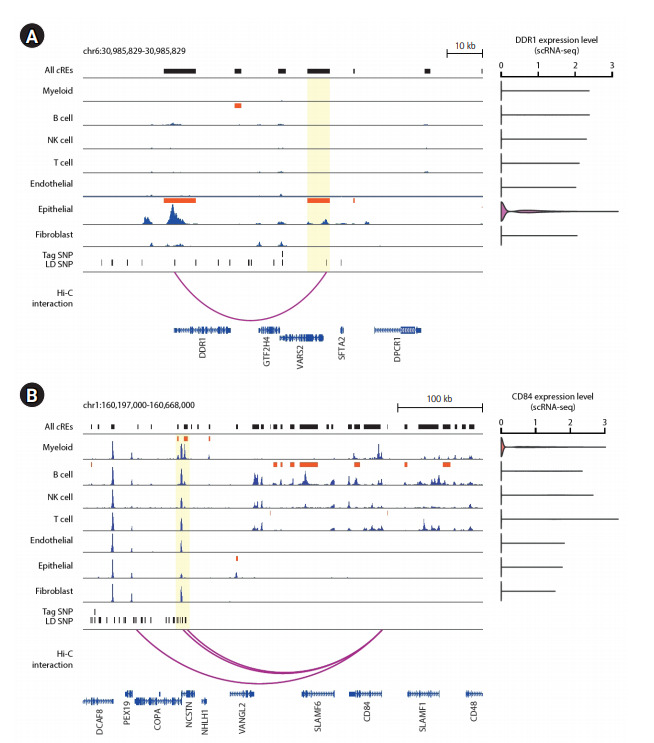
Functional interpretation of noncoding genetic variants associated with complex human diseases and traits remains a challenge. In an effort to enhance our understanding of common germline variants associated with lung cancer, we categorize regulatory elements based on eight major cell types of human lung tissue. Our results show that 21.68% of lung cancer‒associated risk variants are linked to noncoding regulatory elements, nearly half of which are cell type‒specific. Integrative analysis of high-resolution long-range chromatin interactome maps and single-cell RNA-sequencing data of lung tumors uncovers number of putative target genes of these variants and functionally relevant cell types, which display a potential biological link to cancer susceptibility. The present study greatly expands the scope of functional annotation of lung cancer‒associated genetic risk factors and dictates probable cell types involved in lung carcinogenesis.
与复杂人类疾病和性状相关的非编码基因变异的功能解释仍然是一项挑战。为了增进我们对与肺癌相关的常见种系变异的理解,我们根据人类肺组织的八种主要细胞类型对调控元件进行了分类。我们的结果表明,21.68%的肺癌相关风险变异与非编码调控元件相关,其中近一半是细胞类型特异性的。对肺肿瘤的高分辨率远程染色质相互作用图谱和单细胞RNA测序数据的综合分析揭示了这些变异的许多推定靶基因和功能相关的细胞类型,它们显示出与癌症易感性的潜在生物学联系。本研究极大地扩展了肺癌相关遗传风险因素的功能注释范围,并指出了可能参与肺癌发生的细胞类型。