Bednarik Petr, Spurny Benjamin, Silberbauer Leo R, Svatkova Alena, Handschuh Patricia A, Reiter Birgit, Konadu Melisande E, Stimpfl Thomas, Spies Marie, Bogner Wolfgang, Lanzenberger Rupert
High Field MR Center, Department of Biomedical Imaging and Image-Guided Therapy, Medical University of Vienna, Vienna, Austria.
Institute for Clinical Molecular MRI in Musculoskeletal System, Karl Landsteiner Society, Vienna, Austria.
Front Neurosci. 2021 Mar 24;15:609485. doi: 10.3389/fnins.2021.609485. eCollection 2021.
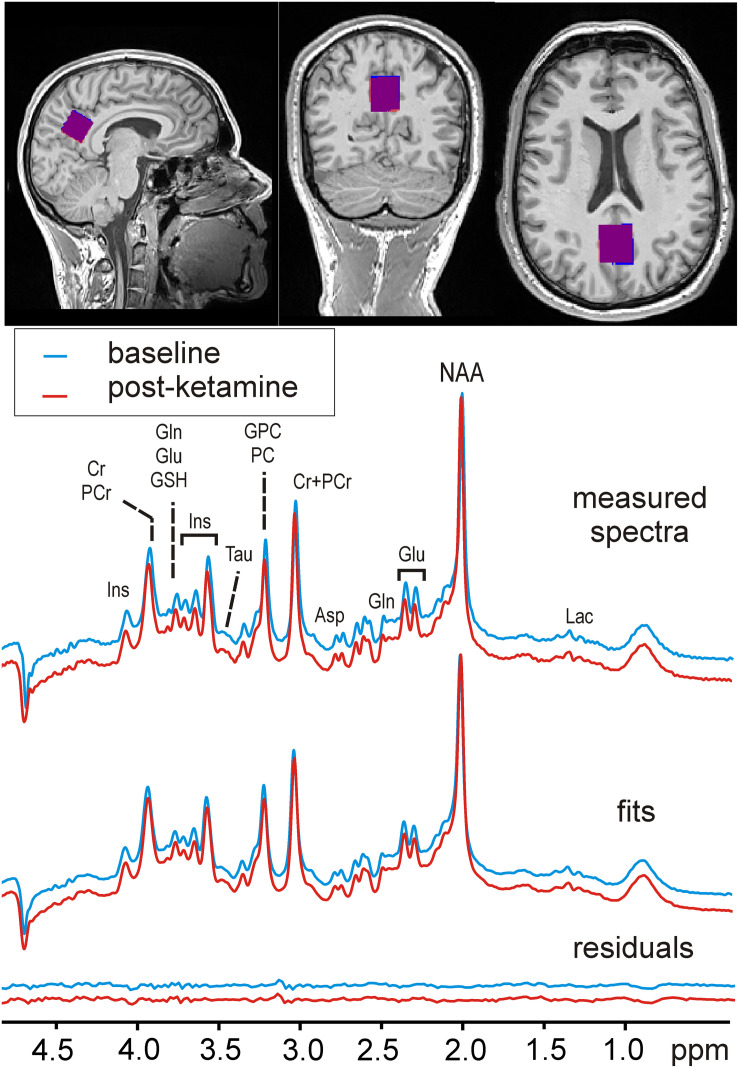
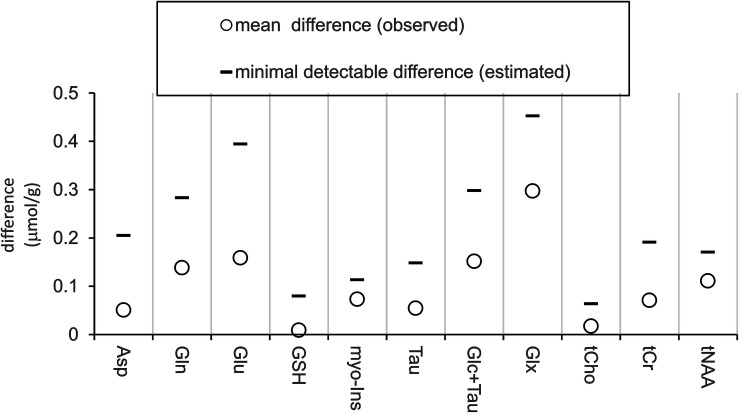
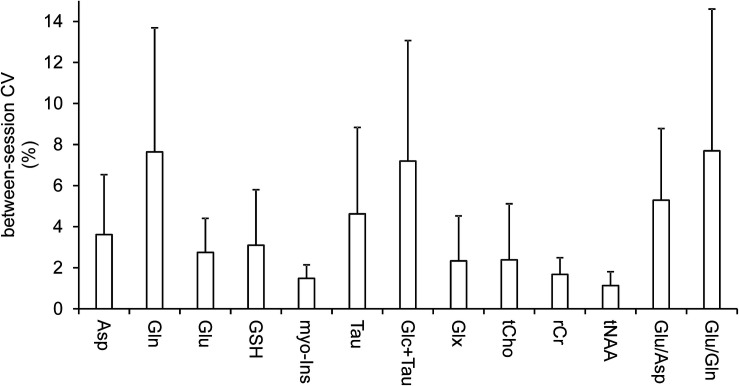
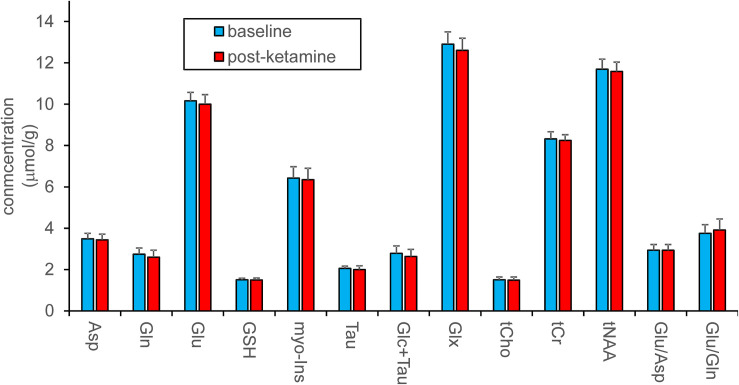
Ketamine is a powerful glutamatergic long-lasting antidepressant, efficient in intractable major depression. Whereas ketamine's immediate psychomimetic side-effects were linked to glutamate changes, proton MRS (H-MRS) showed an association between the ratio of glutamate and glutamine and delayed antidepressant effect emerging ∼2 h after ketamine administration. While most H-MRS studies focused on anterior cingulate, recent functional MRI connectivity studies revealed an association between ketamine's antidepressant effect and disturbed connectivity patterns to the posterior cingulate cortex (PCC), and related PCC dysfunction to rumination and memory impairment involved in depressive pathophysiology. The current study utilized the state-of-the-art single-voxel 3T sLASER H-MRS methodology optimized for reproducible measurements. Ketamine's effects on neurochemicals were assessed before and ∼3 h after intravenous ketamine challenge in PCC. Concentrations of 11 neurochemicals, including glutamate (CRLB ∼ 4%) and glutamine (CRLB ∼ 13%), were reliably quantified with the LCModel in 12 healthy young men with between-session coefficients of variation (SD/mean) <8%. Also, ratios of glutamate/glutamine and glutamate/aspartate were assessed as markers of synaptic function and activated glucose metabolism, respectively. Pairwise comparison of metabolite profiles at baseline and 193 ± 4 min after ketamine challenge yielded no differences. Minimal detectable concentration differences estimated with power analysis (power = 80%, alpha = 0.05) were below 0.5 μmol/g, namely 0.39 μmol/g (∼4%) for glutamate, 0.28 μmol/g (∼10%) for Gln, ∼14% for glutamate/glutamine and ∼8% for glutamate/aspartate. Despite the high sensitivity to detect between-session differences in glutamate and glutamine concentrations, our study did not detect delayed glutamatergic responses to subanesthetic ketamine doses in PCC.
氯胺酮是一种强效的谷氨酸能长效抗抑郁药,对难治性重度抑郁症有效。虽然氯胺酮的即时拟精神病副作用与谷氨酸变化有关,但质子磁共振波谱(H-MRS)显示,谷氨酸与谷氨酰胺的比例与氯胺酮给药后约2小时出现的延迟抗抑郁作用之间存在关联。虽然大多数H-MRS研究集中在前扣带回,但最近的功能磁共振成像连接性研究表明,氯胺酮的抗抑郁作用与后扣带回皮质(PCC)的连接模式紊乱有关,且PCC功能障碍与抑郁病理生理学中涉及的反刍和记忆损害有关。本研究采用了为可重复测量而优化的最先进的单体素3T sLASER H-MRS方法。在PCC中,于静脉注射氯胺酮激发前后评估氯胺酮对神经化学物质的影响。在12名健康年轻男性中,利用LCModel可靠地定量了11种神经化学物质的浓度,包括谷氨酸(CRLB约4%)和谷氨酰胺(CRLB约13%),各次测量间的变异系数(SD/均值)<8%。此外,分别评估谷氨酸/谷氨酰胺和谷氨酸/天冬氨酸的比例,作为突触功能和激活葡萄糖代谢的标志物。对基线和氯胺酮激发后193±4分钟时的代谢物谱进行成对比较,未发现差异。通过功效分析估计的最小可检测浓度差异(功效=80%,α=0.05)低于0.5μmol/g,即谷氨酸为0.39μmol/g(约4%),谷氨酰胺为0.28μmol/g(约10%),谷氨酸/谷氨酰胺约为14%,谷氨酸/天冬氨酸约为8%。尽管对检测各次测量间谷氨酸和谷氨酰胺浓度差异具有高灵敏度,但我们的研究未检测到PCC中对亚麻醉剂量氯胺酮的延迟谷氨酸能反应。