Li Feifei, Hopkins Will G, Wang Xuejing, Baker Julien S, Nie Jinlei, Qiu Junqiang, Quach Binh, Wang Kun, Yi Longyan
Department of Sport, Physical Education and Health, Hong Kong Baptist University, Hong Kong, China.
Centre for Health and Exercise Science Research, Hong Kong Baptist University, Hong Kong, China.
Front Physiol. 2021 Mar 26;12:651851. doi: 10.3389/fphys.2021.651851. eCollection 2021.
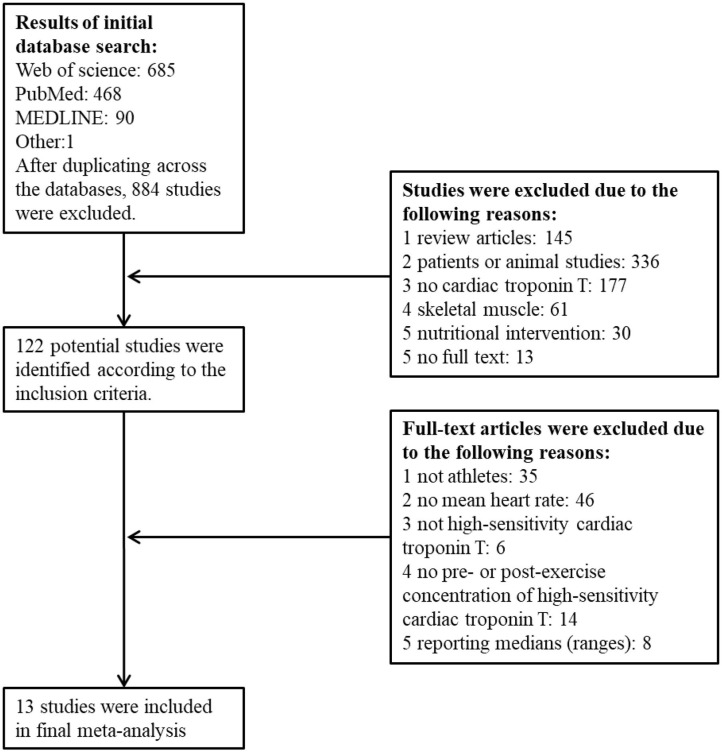
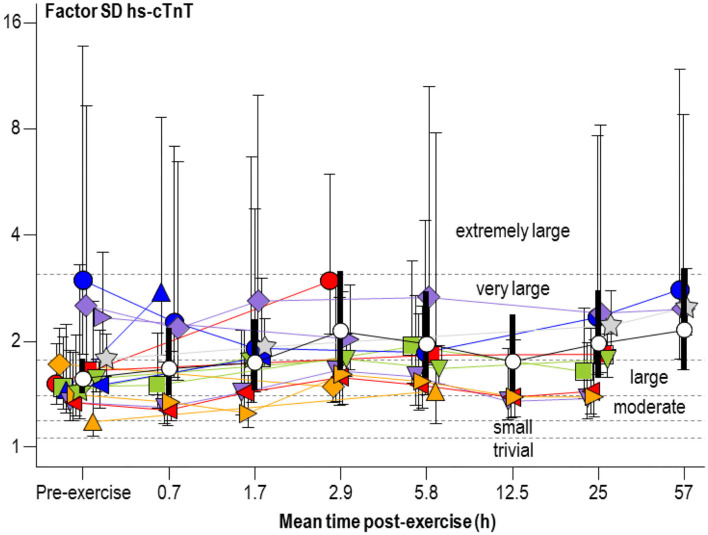
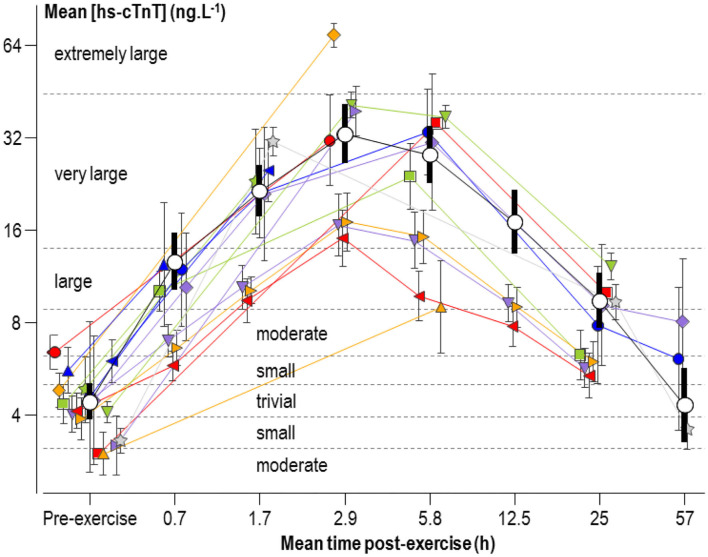
Kinetics, moderators and reference limits for exercise-induced cardiac troponin T (cTnT) elevations are still unclear. A systematic review of published literature was conducted adhering to the Preferred Reporting Items for Systematic Review and Meta-Analyses (PRISMA) guidelines. Studies reporting high-sensitivity cardiac troponin T (hs-cTnT) concentrations before and after a bout of exercise in athletes were included and analyzed. The final dataset consisted of 62 estimates from 16 bouts in 13 studies of 5-1,002 athletes (1,421 in total). Meta-analysis was performed using general linear mixed modeling and Bayesian inferences about effect magnitudes. Modifying fixed-effect moderators of gender, age, baseline level, exercise duration, intensity and modalities were investigated. Simulation was used to derive 99th percentile with 95% limits of upper reference ranges for hs-cTnT of athletic populations. The mean and upper reference limits of hs-cTnT before exercise were 4.4 and 19 ng.L. Clear increases in hs-cTnT ranging from large to very large (factor changes of 2.1-7.5, 90% compatibility limits, ×/÷1.3) were evident from 0.7 through 25 h, peaking at 2.9 h after the midpoint of a 2.5-h bout of running, when the mean and upper reference limit for hs-cTnT were 33 and 390 ng L. A four-fold increase in exercise duration produced a large clear increase (2.4, ×/÷1.7) in post-exercise hs-cTnT. Rowing exercise demonstrated an extremely large clear reduction (0.1 ×/÷2.4). The kinetics of cTnT elevation following exercise, the positive effect of exercise duration, the impact of exercise modality and 99th upper reference limits for athletic populations were reasonably well defined by this meta-analysis.
运动诱导的心肌肌钙蛋白T(cTnT)升高的动力学、调节因素和参考限值仍不明确。我们按照系统评价与Meta分析的首选报告项目(PRISMA)指南,对已发表的文献进行了系统评价。纳入并分析了报告运动员在一次运动前后高敏心肌肌钙蛋白T(hs-cTnT)浓度的研究。最终数据集包括来自13项研究中16次运动的62个估计值,涉及5 - 1002名运动员(共1421名)。使用一般线性混合模型和关于效应量的贝叶斯推断进行Meta分析。研究了性别、年龄、基线水平、运动持续时间、强度和运动方式等固定效应调节因素。通过模拟得出运动人群hs-cTnT的第99百分位数及95%上参考范围限值。运动前hs-cTnT的平均值和上参考限值分别为4.4和19 ng/L。从0.7小时到25小时,hs-cTnT有明显升高,范围从大到非常大(倍数变化为2.1 - 7.5,90%相容区间,×/÷1.3),在2.5小时跑步运动中点后2.9小时达到峰值,此时hs-cTnT的平均值和上参考限值分别为33和390 ng/L。运动持续时间增加四倍使运动后hs-cTnT有明显大幅升高(2.4,×/÷1.7)。划船运动显示出极其明显的降低(0.1,×/÷2.4)。这项Meta分析对运动后cTnT升高的动力学、运动持续时间的积极影响、运动方式的影响以及运动人群的第99百分位上参考限值进行了较为明确的界定。