Institute of Cardiology of Rio Grande do Sul/University Foundation of Cardiology (IC/FUC), Av. Princesa Isabel, 370, Porto Alegre, Rio Grande do Sul, Brazil.
Department of Mechanical Engineering, Federal University of Rio Grande do Sul, Porto Alegre, Rio Grande do Sul, Brazil.
Sci Rep. 2022 Apr 19;12(1):6422. doi: 10.1038/s41598-022-09361-z.
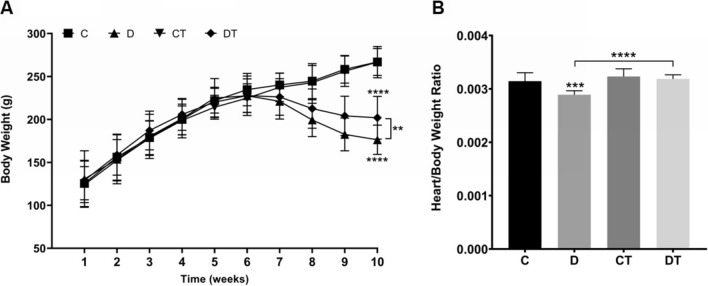
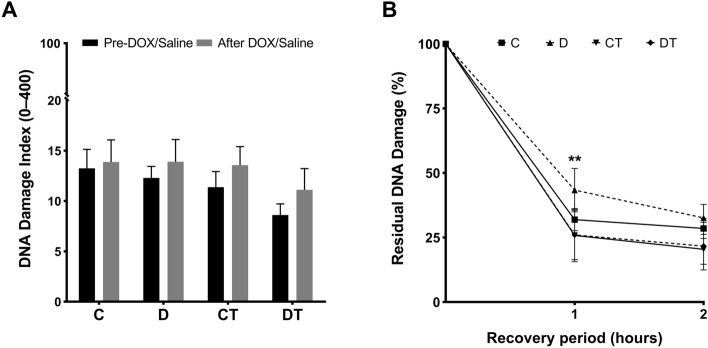
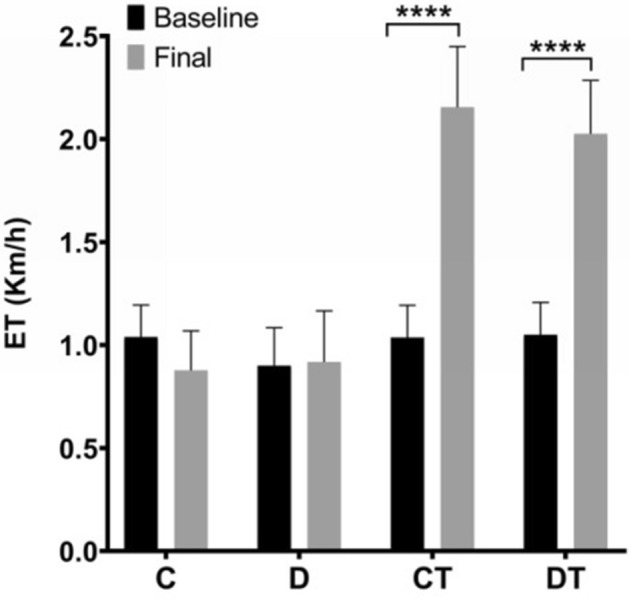
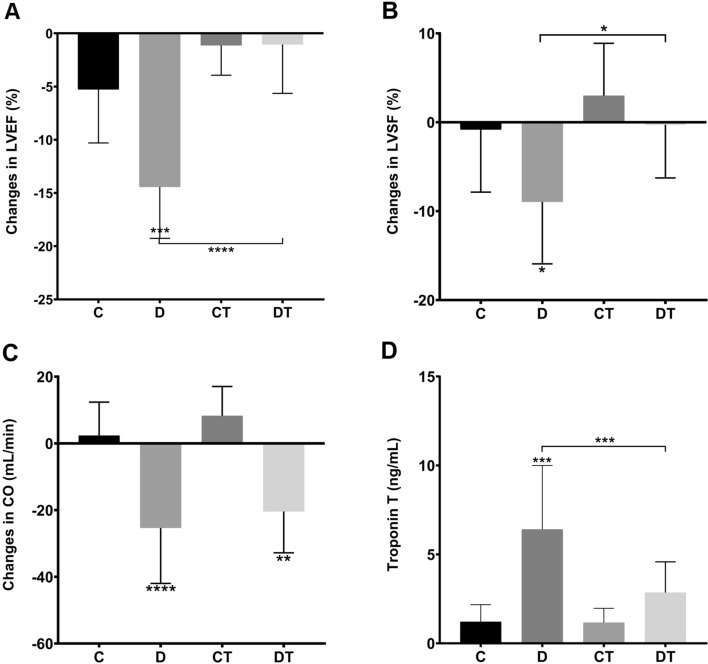
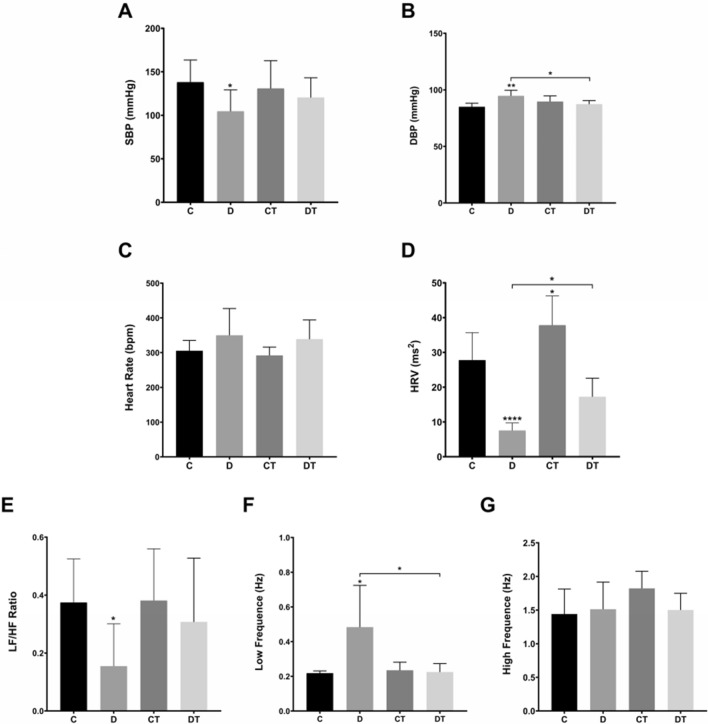
To evaluate the effect of preventive aerobic exercise training on sympathovagal function, cardiac function, and DNA repair capacity in a preclinical model of doxorubicin (DOX)-induced cardiomyopathy. Forty male Wistar-Kyoto rats were allocated into four groups (n = 10/group): D (DOX-treated) and C (controls) remained sedentary, and DT (DOX-trained) and CT (control-trained) performed aerobic training 4 days/week, during 4 weeks before exposure to DOX (4 mg/kg/week during 4 weeks) or saline solution. We evaluated cardiac function (echocardiography), hemodynamic and sympathovagal modulation (artery-femoral cannulation), cardiac troponin T levels, and DNA repair capacity (comet assay). Exercise training preserved ejection fraction (D: - 14.44% vs. DT: - 1.05%, p < 0.001), fractional shortening (D: - 8.96% vs. DT: - 0.27%, p = 0.025) and troponin T levels (D: 6.4 ± 3.6 vs. DT: 2.8 ± 1.7 ng/mL, p = 0.010). DOX increased heart rate variability (C: 27.7 ± 7.9 vs. D: 7.5 ± 2.2 ms, p < 0.001) and induced sympathovagal dysfunction (LF/HF, C: 0.37 ± 0.15 vs. D: 0.15 ± 0.15, p = 0.036) through exacerbation of sympathetic function (LF, C: 0.22 ± 0.01 vs. D: 0.48 ± 0.24 Hz, p = 0.019). Peripheral mononuclear blood cells of DT animals presented lower residual DNA damage (D: 43.4 ± 8.4% vs. DT: 26 ± 3.4%, p = 0.003 after 1 h). Cardioprotective effects of preventive aerobic exercise training are mediated by preservation of sympathovagal function and improvement of DNA repair capacity of peripheral blood mononuclear cells.
为了评估预防性有氧运动训练对阿霉素(DOX)诱导的心肌病前临床模型中心交感神经功能、心脏功能和 DNA 修复能力的影响。将 40 只雄性 Wistar-Kyoto 大鼠分为四组(每组 n=10):D(DOX 处理)和 C(对照)保持久坐,DT(DOX 训练)和 CT(对照训练)在暴露于 DOX(4 周内每周 4 毫克/千克)或生理盐水之前每周运动 4 天,进行有氧运动。我们评估了心脏功能(超声心动图)、血流动力学和心交感神经调节(股动脉插管)、心肌肌钙蛋白 T 水平和 DNA 修复能力(彗星试验)。运动训练可维持射血分数(D:-14.44%比 DT:-1.05%,p<0.001)、缩短分数(D:-8.96%比 DT:-0.27%,p=0.025)和肌钙蛋白 T 水平(D:6.4±3.6 比 DT:2.8±1.7ng/mL,p=0.010)。DOX 增加了心率变异性(C:27.7±7.9 比 D:7.5±2.2ms,p<0.001)并通过加剧交感神经功能(LF,C:0.22±0.01 比 D:0.48±0.24Hz,p=0.019)诱导心交感神经功能障碍(LF/HF,C:0.37±0.15 比 D:0.15±0.15)。DT 动物外周血单核细胞的残留 DNA 损伤较低(D:43.4±8.4%比 DT:26±3.4%,p=0.003,1 小时后)。预防性有氧运动训练的心脏保护作用是通过维持心交感神经功能和改善外周血单核细胞的 DNA 修复能力介导的。