Labidi Oumayma, Vives-Peris Vicente, Gómez-Cadenas Aurelio, Pérez-Clemente Rosa M, Sleimi Noomene
RME-Laboratory of Resources, Materials and Ecosystems Faculty of Sciences of Bizerte University of Carthage Bizerte Tunisia.
Departmento de Ciencias Agrarias i del Medi Natural Universitat Jaume I Castello ´de la Plana Spain.
Food Sci Nutr. 2021 Jan 31;9(4):2021-2031. doi: 10.1002/fsn3.2169. eCollection 2021 Apr.
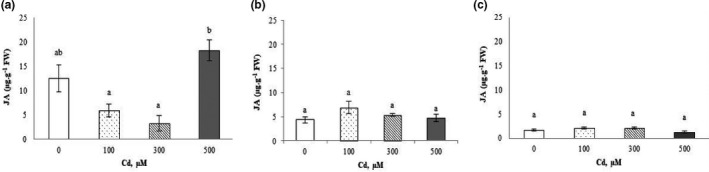
One of the major problems worldwide is soil pollution by trace metal elements, which limits plant productivity and threatens human health. In this work, we have studied the effect of different concentrations of cadmium on plants, evaluating different physiological and biochemical parameters: hormone signaling, metabolite concentration (malondialdehyde and hydrogen peroxide) and, in addition, the antioxidant enzyme activities of catalase and superoxide dismutase were evaluated. The production of biomass decreased under the Cd-stress. The results showed that accumulates higher amounts of Cd in roots than in shoots and fruits. Cd differently affected the content of endogenous phytohormones. Furthermore, data suggest an essential involvement of roots in the regulation of tolerance to trace elements. As a result, indole acetic acid content increased in roots of treated plants, indicating that this phytohormone can stimulate root promotion and growth under Cd-stress. Similarly, salicylic acid content in roots and shoots increased in response to Cd, as well as abscisic acid levels in roots and fruits. In roots, the rambling accumulation pattern observed for jasmonic acid and salicylic acid suggests the lack of a specific regulation role against trace element toxicity. The activity of catalase and superoxide dismutase decreased, disrupted by the metal stress. However, the proline, malondialdehyde and hydrogen peroxide content significantly increased in Cdin all the analyzed tissues of the stressed plants. All these data suggest that plants are equipped with an effective antioxidant mechanism against oxidative stress induced by cadmium up to a concentration of 500 μM.
全球主要问题之一是痕量金属元素对土壤的污染,这限制了植物生产力并威胁人类健康。在这项工作中,我们研究了不同浓度镉对植物的影响,评估了不同的生理和生化参数:激素信号传导、代谢物浓度(丙二醛和过氧化氢),此外,还评估了过氧化氢酶和超氧化物歧化酶的抗氧化酶活性。在镉胁迫下生物量产量下降。结果表明,植物根部积累的镉量高于地上部分和果实。镉对内源植物激素的含量有不同影响。此外,数据表明根部在微量元素耐受性调节中起着重要作用。结果,处理过的植物根部吲哚乙酸含量增加,表明这种植物激素在镉胁迫下可以刺激根系促进和生长。同样,镉处理后,根和地上部分的水杨酸含量增加,根和果实中的脱落酸水平也增加。在根部,茉莉酸和水杨酸观察到的杂乱积累模式表明缺乏针对微量元素毒性的特定调节作用。过氧化氢酶和超氧化物歧化酶的活性下降,受到金属胁迫的干扰。然而,在镉胁迫下,所有分析组织中脯氨酸、丙二醛和过氧化氢的含量均显著增加。所有这些数据表明,在镉浓度高达500μM的情况下,植物具备针对镉诱导的氧化应激的有效抗氧化机制。