
血栓性微血管病评估:关注补体。
Thrombotic microangiopathies assessment: mind the complement.
作者信息
Blasco Miquel, Guillén Elena, Quintana Luis F, Garcia-Herrera Adriana, Piñeiro Gastón, Poch Esteban, Carreras Enric, Campistol Josep M, Diaz-Ricart Maribel, Palomo Marta
机构信息
Department of Nephrology and Kidney Transplantation, Hospital Clínic, Centro de Referencia en Enfermedad Glomerular Compleja del Sistema Nacional de Salud (CSUR), University of Barcelona, Barcelona, Spain.
Institute of Biomedical Research August Pi i Sunyer (IDIPABS), Malalties Nefro-Urològiques i Trasplantament Renal, Barcelona, Spain.
出版信息
Clin Kidney J. 2020 Nov 6;14(4):1055-1066. doi: 10.1093/ckj/sfaa195. eCollection 2021 Apr.
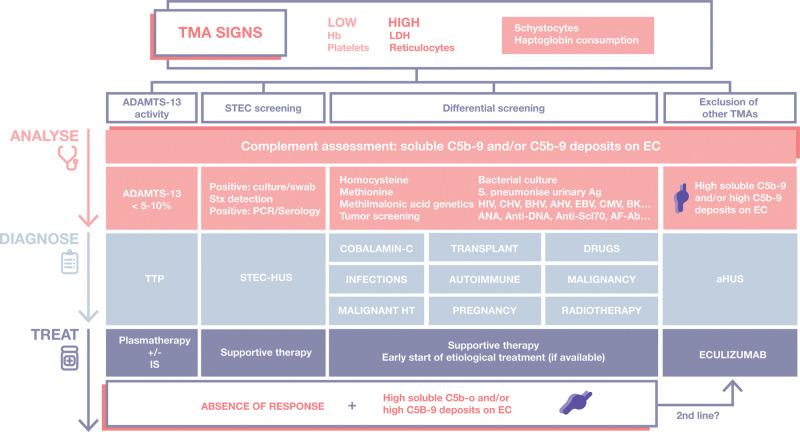
When faced with microangiopathic haemolytic anaemia, thrombocytopenia and organ dysfunction, clinicians should suspect thrombotic microangiopathy (TMA). The endothelial damage that leads to this histological lesion can be triggered by several conditions or diseases, hindering an early diagnosis and aetiological treatment. However, due to systemic involvement in TMA and its low incidence, an accurate early diagnosis is often troublesome. In the last few decades, major improvements have been made in the pathophysiological knowledge of TMAs such as thrombotic thrombocytopenic purpura [TTP, caused by ADAMTS-13 (a disintegrin and metalloproteinase with a thrombospondin Type 1 motif, member 13) deficiency] and atypical haemolytic uraemic syndrome (aHUS, associated with dysregulation of the alternative complement pathway), together with enhancements in patient management due to new diagnostic tools and treatments. However, diagnosis of aHUS requires the exclusion of all the other entities that can cause TMA, delaying the introduction of terminal complement blockers, which have shown high efficacy in haemolysis control and especially in avoiding organ damage if used early. Importantly, there is increasing evidence that other forms of TMA could present overactivation of the complement system, worsening their clinical progression. This review addresses the diagnostic and therapeutic approach when there is clinical suspicion of TMA, emphasizing complement evaluation as a potential tool for the inclusive diagnosis of aHUS, as well as for the improvement of current knowledge of its pathophysiological involvement in other TMAs. The development of both new complement activation biomarkers and inhibitory treatments will probably improve the management of TMA patients in the near future, reducing response times and improving patient outcomes.
当面对微血管病性溶血性贫血、血小板减少和器官功能障碍时,临床医生应怀疑血栓性微血管病(TMA)。导致这种组织学病变的内皮损伤可由多种情况或疾病引发,这阻碍了早期诊断和病因治疗。然而,由于TMA涉及全身且发病率低,准确的早期诊断往往很困难。在过去几十年中,在血栓性微血管病的病理生理学知识方面取得了重大进展,如血栓性血小板减少性紫癜 [TTP,由ADAMTS-13(含血小板反应蛋白基序的解聚素和金属蛋白酶13)缺乏引起] 和非典型溶血尿毒症综合征(aHUS,与替代补体途径失调有关),同时由于新的诊断工具和治疗方法,患者管理也得到了改善。然而,aHUS的诊断需要排除所有其他可导致TMA的疾病,这延迟了终末补体阻滞剂的应用,而终末补体阻滞剂在控制溶血方面显示出高效性,尤其是早期使用时可避免器官损伤。重要的是,越来越多的证据表明,其他形式的TMA可能存在补体系统过度激活,从而使临床病程恶化。本综述探讨了临床怀疑TMA时的诊断和治疗方法,强调补体评估作为aHUS包容性诊断的潜在工具,以及改善目前对其在其他TMA病理生理过程中作用的认识。新的补体激活生物标志物和抑制性治疗方法的开发可能在不久的将来改善TMA患者的管理,减少反应时间并改善患者预后。


 Zotero 插件