Stausholm Martin B, Baun Martin, Bjordal Jan M, Nielsen Dorte, Aagaard Henrik, Magnusson S Peter, Couppé Christian
Department of Global Public Health and Primary Care, University of Bergen; Department of Physical Therapy, Bispebjerg Hospital.
Team Danmark.
Int J Sports Phys Ther. 2021 Apr 1;16(2):504-510. doi: 10.26603/001c.21531.
Increased age has been shown to be associated with weaker external rotators and stronger internal rotators of the shoulder in pitchers and tennis players. Whether this age-associated change is present in elite badminton players is unknown.
To compare the internal and external rotation strength of the shoulder in adolescent and adult elite badminton players.
Cross-sectional.
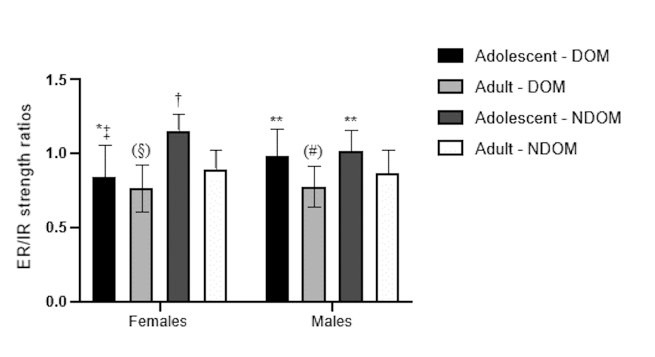
Thirty-one adolescent (12 females aged 16.8 ± 1.6 years and 19 males aged 17.1 ± 1.6 years) and 29 adult (10 females aged 25 ± 2.9 years and 19 males aged 26.2 ± 4.6 years) national level badminton players were tested pre-seasonally for external rotation (ER) and internal rotation (IR) isometric muscle strength bilaterally, using a hand-held dynamometer. Within-group ER to IR strength ratios were calculated (ER/IR×100%).
The adolescents had stronger shoulder ER than the adults on both sides (p < 0.05). The adult males tended to have stronger IR of the dominant shoulder than the adolescent males (p = 0.071). In the dominant shoulders, the strength ratios for adult females and males were 77% and 78%, respectively, while the same ratio for adolescent females and males were 85% and 99%, respectively. In the non-dominant shoulders, the ER/IR strength ratios for adult females and males were 90% and 87%, respectively, while the ratios for adolescent females and males were 116% and 102%, respectively.
This study is the first to demonstrate that in shoulder injury-free national team badminton players, adolescents have stronger shoulder ER than adults on both sides. Therefore, increased age appears to be associated with weaker shoulder ER muscles in elite badminton players.
3b.
年龄增长已被证明与投手和网球运动员肩部外旋肌力量减弱及内旋肌力量增强有关。这种与年龄相关的变化在精英羽毛球运动员中是否存在尚不清楚。
比较青少年和成年精英羽毛球运动员肩部的内旋和外旋力量。
横断面研究。
31名青少年(12名女性,年龄16.8±1.6岁;19名男性,年龄17.1±1.6岁)和29名成年(10名女性,年龄25±2.9岁;19名男性,年龄26.2±4.6岁)国家级羽毛球运动员在赛季前使用手持测力计双侧测试外旋(ER)和内旋(IR)等长肌肉力量。计算组内ER与IR力量比值(ER/IR×100%)。
青少年双侧肩部ER均比成年人强(p<0.05)。成年男性优势肩的IR往往比青少年男性强(p = 0.071)。在优势肩中,成年女性和男性的力量比值分别为77%和78%,而青少年女性和男性的相同比值分别为85%和99%。在非优势肩中,成年女性和男性的ER/IR力量比值分别为90%和87%,而青少年女性和男性的比值分别为116%和102%。
本研究首次表明,在无肩部损伤的国家队羽毛球运动员中,青少年双侧肩部ER比成年人强。因此,年龄增长似乎与精英羽毛球运动员肩部ER肌肉力量减弱有关。
3b。