Vidal-Rosas Ernesto E, Zhao Hubin, Nixon-Hill Reuben W, Smith Greg, Dunne Luke, Powell Samuel, Cooper Robert J, Everdell Nicholas L
University College London, Diffuse Optical Tomography of the Human Brain Research Group, Biomedical Optics Research Laboratory, Department of Medical Physics and Biomedical Engineering, London, United Kingdom.
University of Glasgow, James Watt School of Engineering, Glasgow, United Kingdom.
Neurophotonics. 2021 Apr;8(2):025002. doi: 10.1117/1.NPh.8.2.025002. Epub 2021 Apr 9.
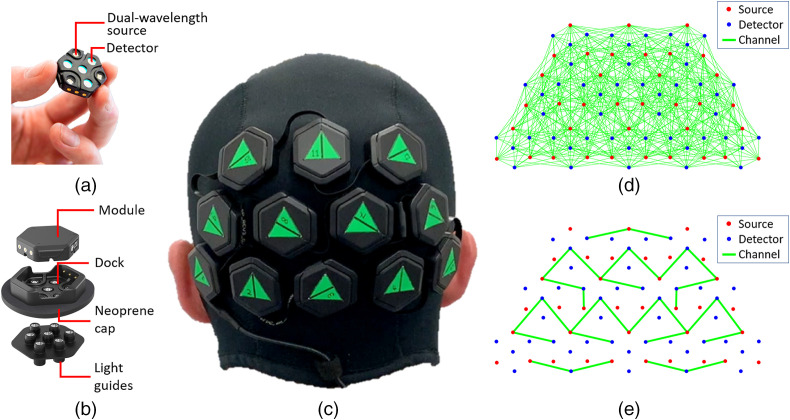
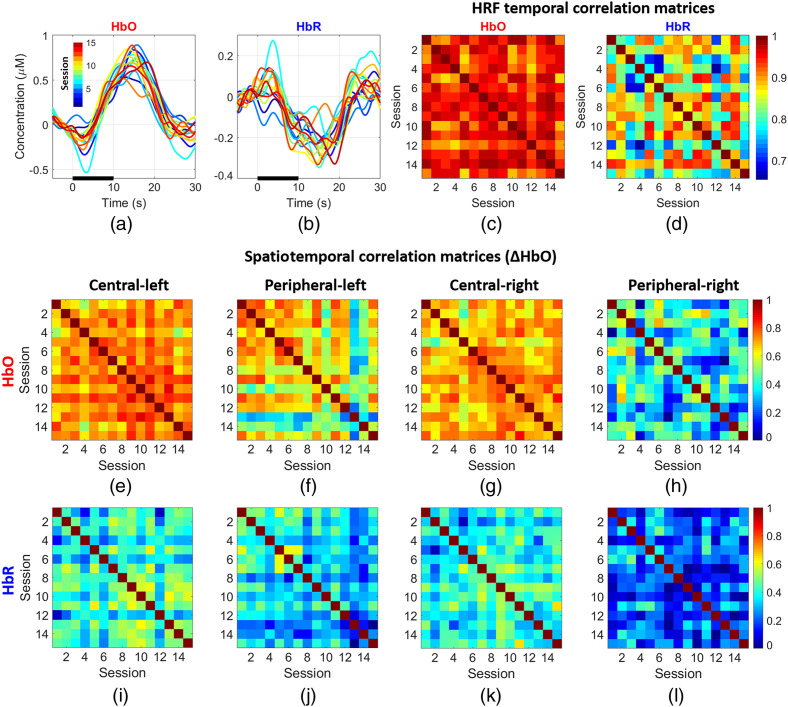
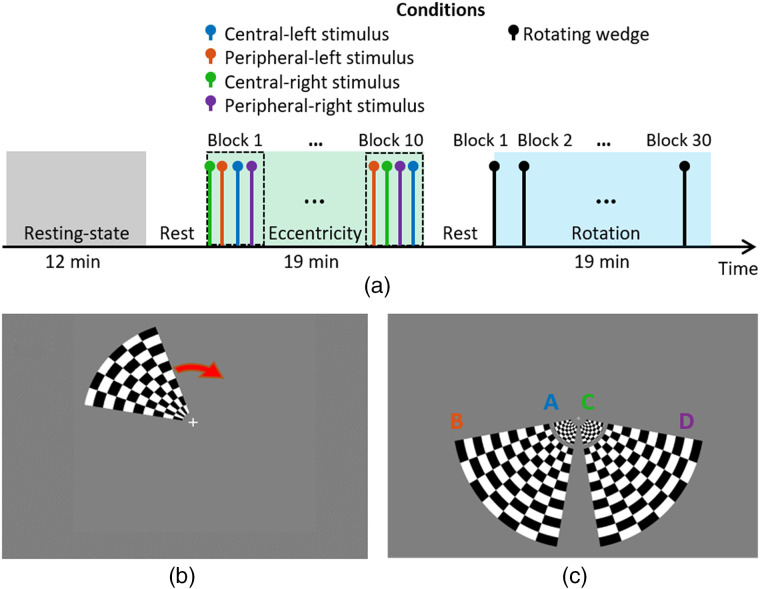
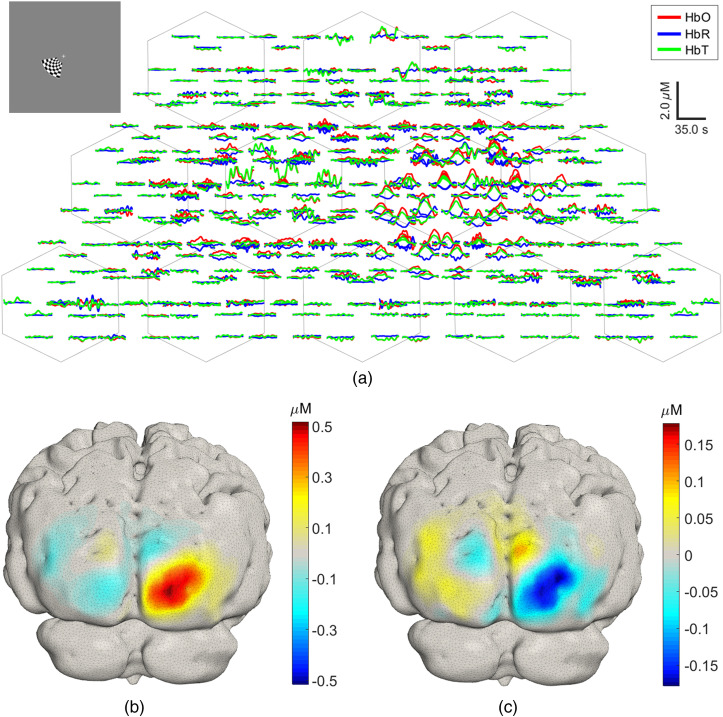
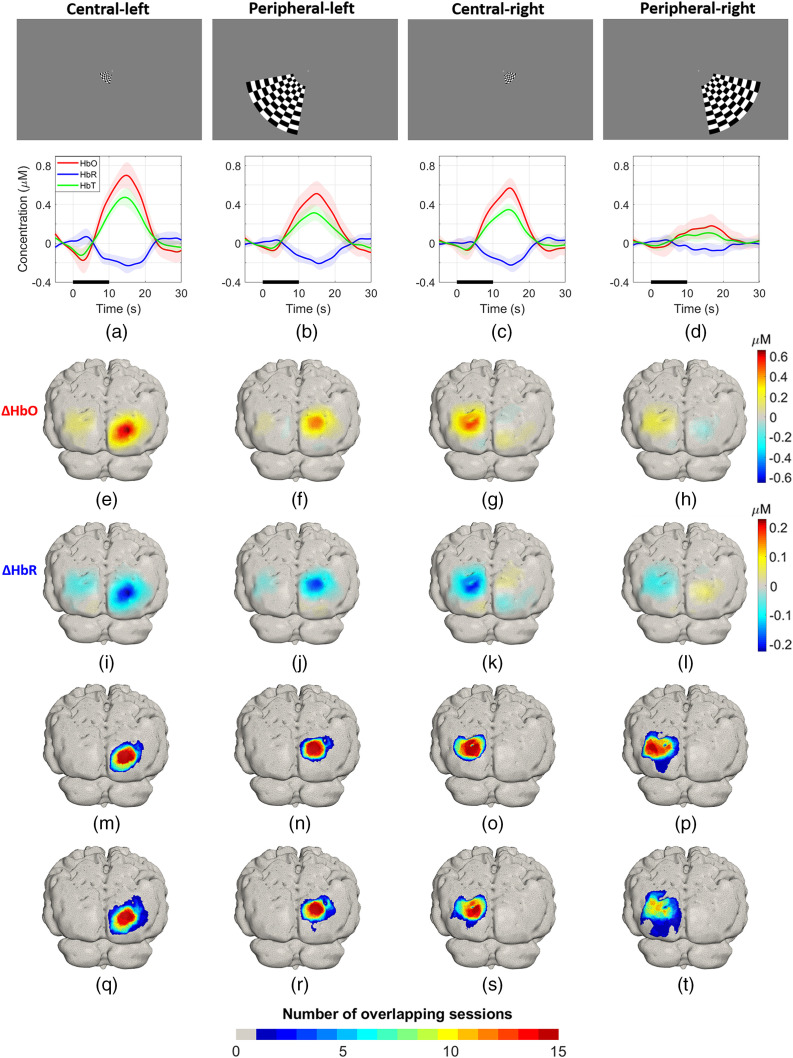
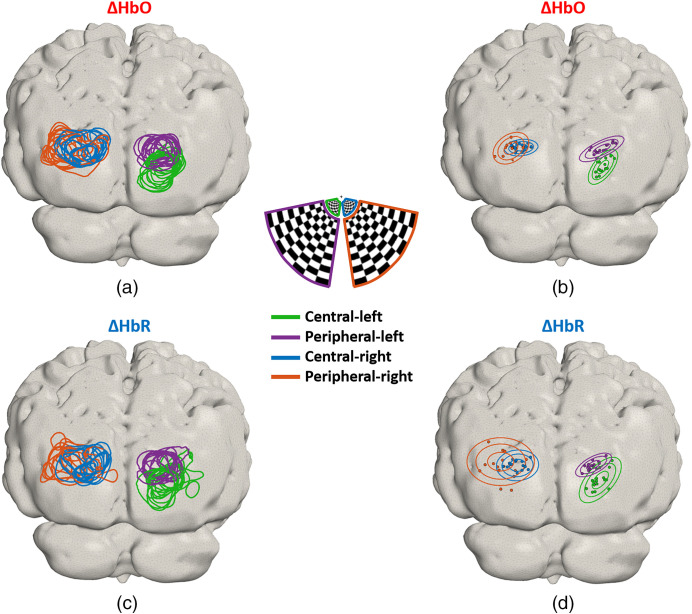
High-density diffuse optical tomography (HD-DOT) has been shown to approach the resolution and localization accuracy of blood oxygen level dependent-functional magnetic resonance imaging in the adult brain by exploiting densely spaced, overlapping samples of the probed tissue volume, but the technique has to date required large and cumbersome optical fiber arrays. : To evaluate a wearable HD-DOT system that provides a comparable sampling density to large, fiber-based HD-DOT systems, but with vastly improved ergonomics. : We investigated the performance of this system by replicating a series of classic visual stimulation paradigms, carried out in one highly sampled participant during 15 sessions to assess imaging performance and repeatability. : Hemodynamic response functions and cortical activation maps replicate the results obtained with larger fiber-based systems. Our results demonstrate focal activations in both oxyhemoglobin and deoxyhemoglobin with a high degree of repeatability observed across all sessions. A comparison with a simulated low-density array explicitly demonstrates the improvements in spatial localization, resolution, repeatability, and image contrast that can be obtained with this high-density technology. : The system offers the possibility for minimally constrained, spatially resolved functional imaging of the human brain in almost any environment and holds particular promise in enabling neuroscience applications outside of the laboratory setting. It also opens up new opportunities to investigate populations unsuited to traditional imaging technologies.
高密度扩散光学断层扫描(HD-DOT)已被证明,通过利用被探测组织体积的密集间隔、重叠样本,其在成人大脑中的分辨率和定位精度可接近血氧水平依赖性功能磁共振成像,但迄今为止该技术需要庞大且笨重的光纤阵列。:为了评估一种可穿戴式HD-DOT系统,该系统能提供与大型基于光纤的HD-DOT系统相当的采样密度,但人体工程学设计有了极大改进。:我们通过复制一系列经典视觉刺激范式来研究该系统的性能,在一名高采样率参与者身上进行了15次实验,以评估成像性能和可重复性。:血流动力学响应函数和皮质激活图重现了在更大的基于光纤的系统上获得的结果。我们的结果表明,在所有实验中均观察到氧合血红蛋白和脱氧血红蛋白的局灶性激活,且具有高度的可重复性。与模拟的低密度阵列进行比较明确显示了这种高密度技术在空间定位、分辨率、可重复性和图像对比度方面的改进。:该系统为在几乎任何环境中对人脑进行最小限度受限的、空间分辨的功能成像提供了可能性,并且在实现实验室环境之外的神经科学应用方面具有特殊前景。它还为研究不适合传统成像技术的人群开辟了新机会。