El Khoury Karim, Fockedey Martin, Brion Eliott, Macq Benoît
Université Catholique de Louvain, Institute of Information and Communication Technologies, Electronics and Applied Mathematics, Louvain-La-Neuve, Belgium.
J Med Imaging (Bellingham). 2021 Jul;8(4):041207. doi: 10.1117/1.JMI.8.4.041207. Epub 2021 Apr 5.
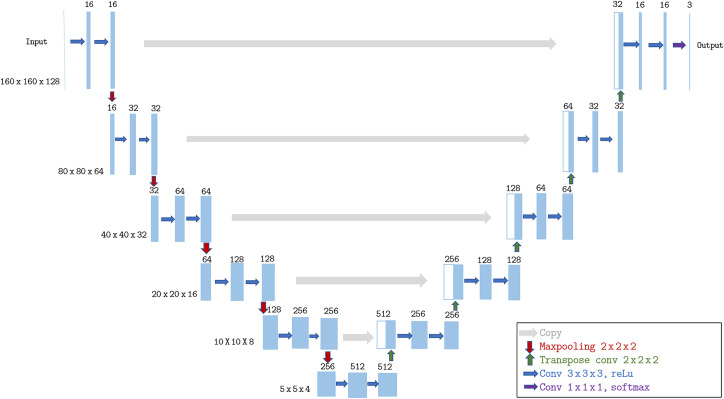
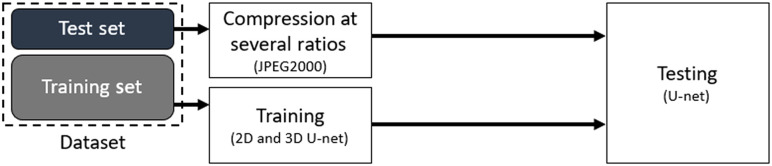
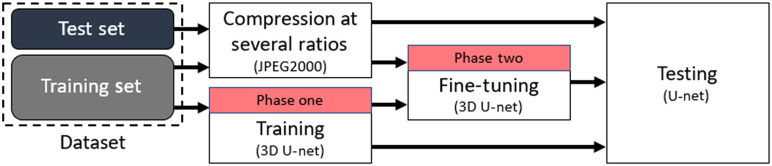
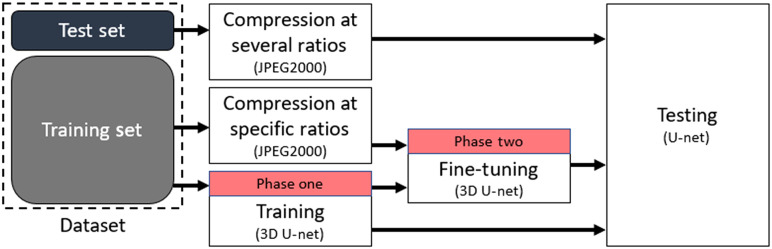
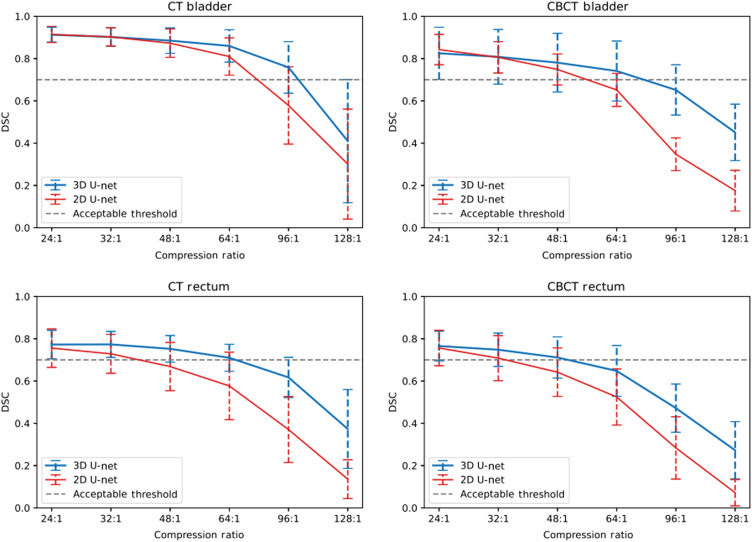
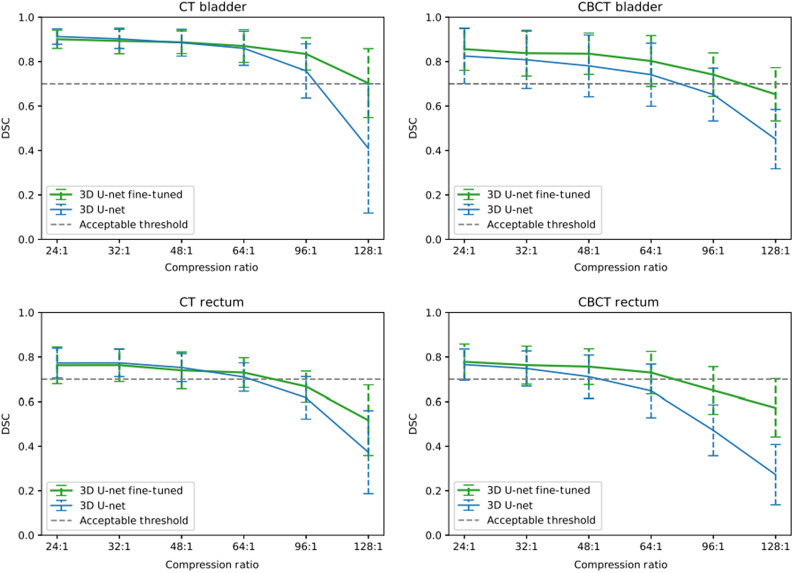
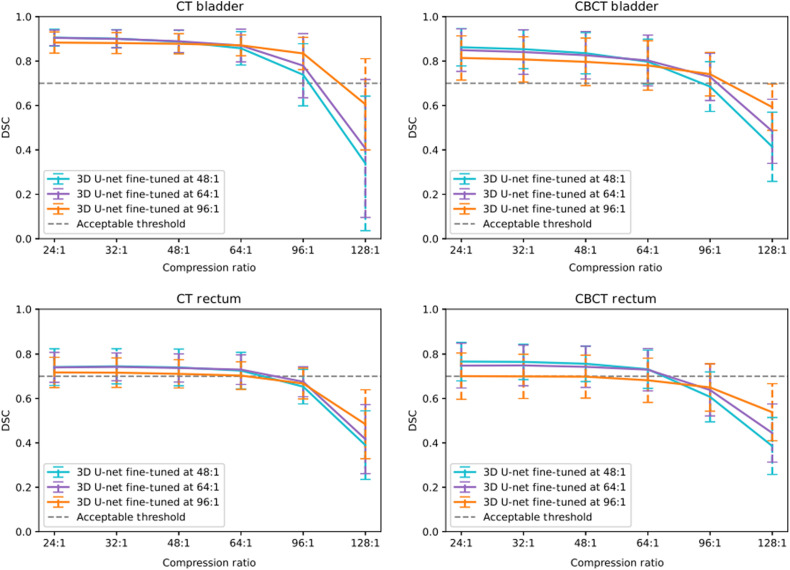
Automation of organ segmentation, via convolutional neural networks (CNNs), is key to facilitate the work of medical practitioners by ensuring that the adequate radiation dose is delivered to the target area while avoiding harmful exposure of healthy organs. The issue with CNNs is that they require large amounts of data transfer and storage which makes the use of image compression a necessity. Compression will affect image quality which in turn affects the segmentation process. We address the dilemma involved with handling large amounts of data while preserving segmentation accuracy. We analyze and improve 2D and 3D U-Net robustness against JPEG 2000 compression for male pelvic organ segmentation. We conduct three experiments on 56 cone beam computed tomography (CT) and 74 CT scans targeting bladder and rectum segmentation. The two objectives of the experiments are to compare the compression robustness of 2D versus 3D U-Net and to improve the 3D U-Net compression tolerance via fine-tuning. We show that a 3D U-Net is 50% more robust to compression than a 2D U-Net. Moreover, by fine-tuning the 3D U-Net, we can double its compression tolerance compared to a 2D U-Net. Furthermore, we determine that fine-tuning the network to a compression ratio of 64:1 will ensure its flexibility to be used at compression ratios equal or lower. We reduce the potential risk involved with using image compression on automated organ segmentation. We demonstrate that a 3D U-Net can be fine-tuned to handle high compression ratios while preserving segmentation accuracy.
通过卷积神经网络(CNN)实现器官分割自动化,是确保在向目标区域输送足够辐射剂量的同时避免健康器官受到有害辐射,从而便利医学从业者工作的关键。CNN的问题在于它们需要大量的数据传输和存储,这使得图像压缩成为必要。压缩会影响图像质量,进而影响分割过程。我们解决了在处理大量数据的同时保持分割精度所涉及的困境。我们分析并提高了二维和三维U-Net针对男性盆腔器官分割的JPEG 2000压缩鲁棒性。我们对56例锥形束计算机断层扫描(CT)和74例针对膀胱和直肠分割的CT扫描进行了三项实验。实验的两个目标是比较二维和三维U-Net的压缩鲁棒性,并通过微调提高三维U-Net的压缩耐受性。我们表明,三维U-Net对压缩的鲁棒性比二维U-Net高50%。此外,通过微调三维U-Net,与二维U-Net相比,我们可以将其压缩耐受性提高一倍。此外,我们确定将网络微调至64:1的压缩比将确保其在等于或更低的压缩比下使用的灵活性。我们降低了在自动器官分割中使用图像压缩所涉及的潜在风险。我们证明,三维U-Net可以通过微调来处理高压缩比,同时保持分割精度。